
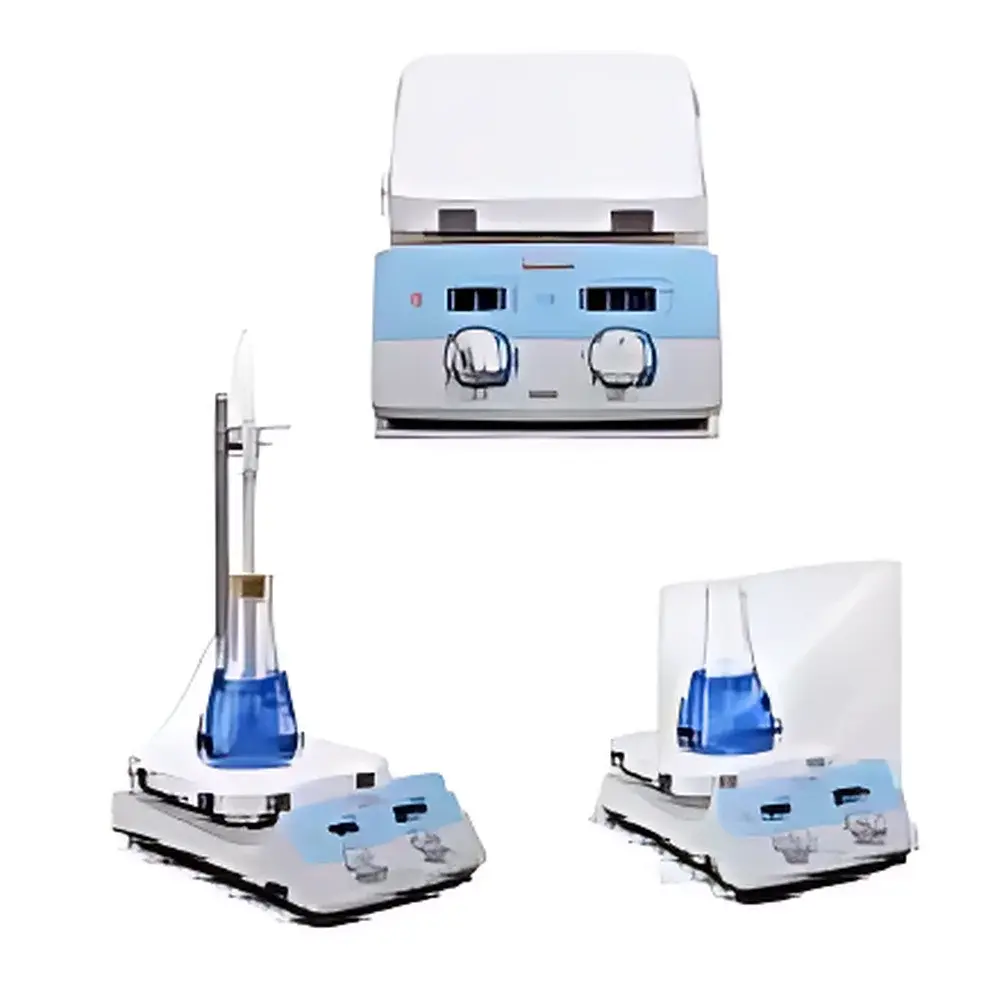
Thermo Fisher Scientific Cimarec+™ Series Hotplate Stirrers
| Brand | Thermo Fisher Scientific |
|---|---|
| Origin | Shanghai, China |
| Manufacturer Type | Original Equipment Manufacturer (OEM) |
| Product Category | Domestic |
| Models | SP88857106 / SP88854105 / SP88857105 |
| Instrument Type | Magnetic Hotplate Stirrer |
| Maximum Stirring Volume | 1 L / 4 L / 6 L |
| Speed Range | 50–1500 rpm |
| Temperature Range | 30–300°C (Aluminum Plate, 7″) / 30–400°C (Ceramic Plate, 10″) / 30–540°C (Ceramic Plate, 4″ & 7″) |
| Heating Time to Max Temp (No Load) | ≤8 min |
| Temperature Accuracy @100°C | ≤±5°C (center of top plate) |
| Temperature Uniformity @100°C | ≤±2°C (center of top plate) |
| Top Plate Material Options | Ceramic or Anodized Aluminum |
| Max Load Capacity | 11.3 kg (25 lbs) |
| Power Supply | 220–240 V AC, 1.6–4.6 A |
| Certifications | cCSAus, CE |
| Warranty | 3 years |
Overview
The Thermo Fisher Scientific Cimarec+™ Series Hotplate Stirrers integrate precise magnetic stirring with independent, high-temperature heating capabilities in a single compact platform. Designed for reproducible thermal and mechanical control in demanding laboratory workflows, these instruments operate on the principle of electromagnetic induction—generating rotational torque on PTFE- or glass-coated stir bars via a rotating magnetic field beneath the heated surface. The dual-function architecture supports both open-vessel heating and temperature-regulated mixing across pharmaceutical development, synthetic chemistry, materials science, and bioprocess optimization. Unlike basic hotplates or standalone stirrers, the Cimarec+ series delivers synchronized control over speed and surface temperature with real-time digital feedback, enabling consistent reaction kinetics, solvent evaporation studies, dissolution testing, and viscosity-sensitive homogenization protocols.
Key Features
- StirTrac™ intelligent stirring algorithm ensures stable low-speed operation (down to 50 rpm) with high-torque magnetic coupling—even under viscous or dense sample conditions.
- Incremental temperature adjustment in 1°C steps, with HOT TOP visual alert activated when surface temperature exceeds 50°C to mitigate accidental contact injury.
- Auto over-temperature shutdown safeguards equipment and samples by cutting power if setpoint is exceeded by >10°C.
- Interchangeable top plates: chemically inert ceramic (rated up to 540°C) or lightweight anodized aluminum (rated up to 300°C), each engineered for thermal stability and mechanical durability.
- Front-panel tactile design with raised bezel prevents liquid ingress into controls during splash-prone operations.
- High-resolution LED display simultaneously shows actual speed (rpm) and surface temperature (°C), with intuitive rotary dial interface.
- Optional external temperature monitoring via PT100 or PT1000 probe input enables closed-loop sample temperature control—critical for USP dissolution validation and GLP-compliant thermal profiling.
- Modular footprint options (4″, 7″, and 10″ top plates) accommodate vessels from small vials to 6 L reactors without compromising thermal uniformity or stirring efficiency.
Sample Compatibility & Compliance
The Cimarec+ series accommodates standard laboratory glassware—including round-bottom flasks, beakers, Erlenmeyer flasks, and jacketed reactors—within its load capacity of 11.3 kg. Its ceramic top plate resists corrosion from acids, bases, and organic solvents, while the aluminum variant offers faster thermal response for rapid ramp-and-hold applications. All models comply with IEC 61010-1:2010 for electrical safety in laboratory environments and carry cCSAus and CE markings for North American and European market access. When used with optional PT100/PT1000 probes and validated SOPs, the system supports audit-ready documentation required under FDA 21 CFR Part 11, ISO/IEC 17025, and GMP Annex 11 frameworks.
Software & Data Management
While the Cimarec+ operates as a stand-alone instrument with local digital control, its analog output (0–10 V) and RS232 interface enable integration into centralized lab automation systems. Third-party SCADA or LIMS platforms can log speed, surface temperature, and runtime data at user-defined intervals. For regulated environments, optional software packages provide electronic signatures, audit trails, and deviation reporting aligned with ALCOA+ principles. Temperature calibration certificates traceable to NIST standards are available upon request for IQ/OQ/PQ validation packages.
Applications
- Pharmaceutical R&D: Controlled heating and stirring during API crystallization, granulation slurry preparation, and accelerated stability studies per ICH Q1 guidelines.
- Chemical Synthesis: Exothermic reaction management, reflux setup, and catalyst dispersion in heterogeneous catalysis experiments.
- Materials Science: Polymer solution blending, nanoparticle dispersion, and ceramic precursor mixing requiring uniform thermal distribution.
- Quality Control Labs: Dissolution testing per USP , buffer preparation, and reagent conditioning prior to HPLC or titration analysis.
- Biotechnology: Media pre-warming, enzyme incubation support, and gentle agitation of cell culture supplements without shear-induced denaturation.
FAQ
What is the difference between ceramic and aluminum top plates?
Ceramic plates offer superior chemical resistance and higher maximum temperatures (up to 540°C), making them ideal for aggressive solvents and high-temperature reactions. Aluminum plates provide faster thermal response and lower mass, suitable for applications requiring rapid ramp rates below 300°C.
Can the Cimarec+ maintain precise sample temperature—not just surface temperature?
Yes—when paired with an optional PT100 or PT1000 temperature probe inserted directly into the sample, the unit supports PID-controlled sample temperature regulation, decoupling thermal management from ambient or vessel-specific heat transfer variables.
Is the device compatible with international power standards?
All units ship with interchangeable EU, UK, and AUS/CHN plugs and operate on 220–240 V AC input; no voltage conversion is required for use in most global laboratories.
How is temperature uniformity verified across the plate surface?
Thermo Fisher specifies ≤±2°C uniformity at 100°C measured at the center of the top plate; users may perform additional mapping using calibrated thermocouples per ASTM E220 or ISO 17025-compliant procedures.
Does the 3-year warranty cover consumables such as stir bars or temperature probes?
The warranty covers manufacturing defects in materials and workmanship for the main unit only; stir bars, probes, and plug adapters are considered consumables and excluded unless damaged due to verified product fault.



