
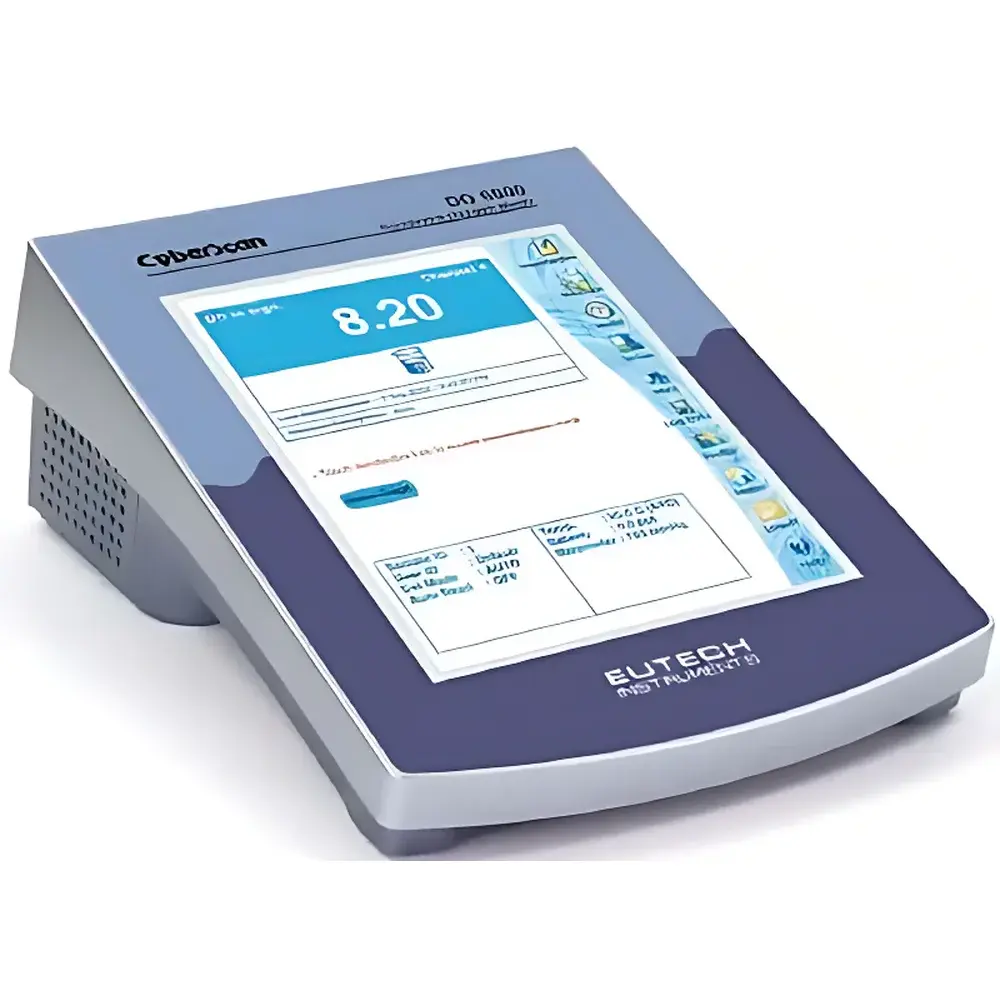
Thermo Fisher Scientific Eutech CyberScan DO6000 Dissolved Oxygen Meter
| Brand | Thermo Fisher Scientific |
|---|---|
| Origin | Singapore |
| Manufacturer Type | Original Equipment Manufacturer (OEM) |
| Origin Category | Imported Instrument |
| Model | DO6000 |
| Price | Available Upon Request |
| DO Range | 0.00–60.00 mg/L (ppm) / 0–1272 mbar |
| DO Resolution | 0.01 mg/L (0.1 mbar) |
| DO Accuracy | ±1% of reading + 1 LSD |
| % Saturation Range | 0.0–600.0% |
| % Saturation Resolution | 0.1% |
| % Saturation Accuracy | ±1% of reading + 1 LSD |
| Salinity Compensation Range | 0.0–45.0 ppt |
| Salinity Resolution | 0.1 ppt |
| Atmospheric Pressure Compensation Range | 450–825 mmHg |
| Pressure Resolution | 1 mmHg |
| Temperature Range | −5.0 to 46.0 °C |
| Temperature Resolution | 0.1 °C |
| Temperature Accuracy | ±0.2 °C |
| Data Storage Capacity | 1,000 measurement records |
| Display | 11.43 × 15.24 cm Windows CE–based color touchscreen |
| Operating Temperature | 5.0–45.0 °C |
| Power Supply | 9 V DC regulated adapter (100–240 VAC input, SMPS) |
| Dimensions (Instrument) | 16.5 × 23.5 × 8.9 cm |
| Weight (Instrument) | 1100 g |
Overview
The Thermo Fisher Scientific Eutech CyberScan DO6000 Dissolved Oxygen Meter is a high-precision, multi-parameter benchtop instrument engineered for regulatory-compliant water quality analysis in environmental monitoring laboratories, wastewater treatment facilities, and research institutions. It employs Clark-type polarographic sensing technology with integrated temperature, salinity, and barometric pressure compensation to deliver traceable, reproducible dissolved oxygen (DO) measurements across diverse aqueous matrices—including freshwater, seawater, activated sludge, and industrial effluents. The instrument supports standardized biochemical oxygen demand (BOD5) determination per U.S. EPA Method 405.1 and ASTM D5210, enabling automated incubation tracking, real-time oxygen depletion profiling, and calculation of oxygen uptake rate (OUR) and specific oxygen uptake rate (SOUR). Its embedded Windows CE operating system and full-color resistive touchscreen provide intuitive navigation while maintaining audit-ready GLP data integrity.
Key Features
- Self-stirring DO probe compatibility for fully automated BOD5, OUR, and SOUR assays—eliminating manual agitation and minimizing operator-induced variability
- Triple automatic compensation: temperature (−5.0 to 46.0 °C), salinity (0.0–45.0 ppt), and atmospheric pressure (450–825 mmHg), ensuring metrological traceability under field-relevant conditions
- Extended DO measurement range up to 60.00 mg/L (600% saturation), suitable for hyperoxic environments such as ozonated effluent or aerated bioreactors
- High-resolution color touchscreen (11.43 × 15.24 cm) with context-sensitive prompts, error diagnostics, and multilingual UI support (English, Spanish, French, German)
- Comprehensive GLP compliance: time-stamped data logging, user ID authentication, calibration history tracking, and electronic signature readiness for FDA 21 CFR Part 11–aligned workflows
- Dual-output connectivity: USB 2.0 host/device, RS-232C serial, IrDA infrared, and Ethernet (RJ45) for seamless integration into LIMS and SCADA systems
Sample Compatibility & Compliance
The CyberScan DO6000 is validated for use with standard 12-mm diameter polarographic DO probes (e.g., Eutech DO100, DO200) featuring Teflon membrane electrodes and built-in thermistors. It accommodates samples with turbidity ≤400 NTU, suspended solids ≤10,000 mg/L, and chloride concentrations up to 45,000 mg/L without drift or membrane fouling artifacts. All measurement protocols align with ISO 5814:2012 (electrochemical determination of dissolved oxygen), ASTM D888-22 (effects of oxygen scavengers), and APHA Standard Methods 4500-O G. Calibration verification follows NIST-traceable zero-oxygen (sodium sulfite) and saturated-air standards. The instrument’s firmware and data structure meet IEC 61508 SIL 2 functional safety requirements for continuous environmental monitoring applications.
Software & Data Management
Data acquisition and reporting are managed through the onboard Windows CE platform, supporting 1,000 timestamped records with full metadata (operator ID, probe serial number, calibration date, environmental parameters). Export options include CSV via SD card (microSD slot), USB mass storage mode, or direct transmission to PC-based software (Eutech LogPro v3.2 or third-party platforms via Modbus RTU/ASCII over RS-232). Audit trails record all configuration changes, calibration events, and data deletions—enabling full traceability during GLP/GMP inspections. Optional cloud synchronization (via Ethernet-enabled gateway) supports remote calibration validation and predictive maintenance alerts based on electrode polarization stability metrics.
Applications
- Regulatory BOD5 testing in municipal and industrial wastewater discharge compliance (EPA NPDES, EU WFD)
- Activated sludge process control via real-time SOUR monitoring for nitrification/denitrification optimization
- Drinking water distribution system integrity assessment through DO gradient mapping
- Aquaculture pond health management using diurnal DO cycling profiles
- Bioreactor oxygen transfer coefficient (kLa) validation in pharmaceutical fermentation QA/QC labs
- Environmental impact assessments requiring multi-point, long-duration DO logging in rivers, lakes, and estuaries
FAQ
Does the DO6000 support automatic BOD5 calculation per EPA Method 405.1?
Yes—the instrument guides users through initial seed dilution setup, incubation duration selection, and final DO endpoint confirmation, then computes BOD5 using the standard formula (D1 − D2) − (B1 − B2)f, with f representing the dilution factor.
Can the meter store calibration data for multiple probes?
Yes—up to four unique probe IDs can be registered; each retains individual slope, zero offset, membrane response time, and last-calibration timestamp.
Is the touchscreen operable with gloves or wet fingers?
The resistive touch interface responds reliably to gloved fingertips and moderate moisture exposure, though prolonged immersion or high-salinity residue requires periodic screen cleaning per IEC 60529 IP22 guidelines.
What validation documentation is provided for GLP audits?
Factory-issued Certificate of Conformance (CoC), NIST-traceable calibration report (including DO, temperature, and pressure sensor verification), and firmware version log are supplied with each unit.
How frequently must the DO probe membrane be replaced?
Under typical laboratory use (≤5 measurements/day), membrane replacement is recommended every 6–8 weeks; frequency increases proportionally with sample particulate load or aggressive chemical exposure (e.g., H2S-rich anaerobic digester supernatant).
Related Products







