
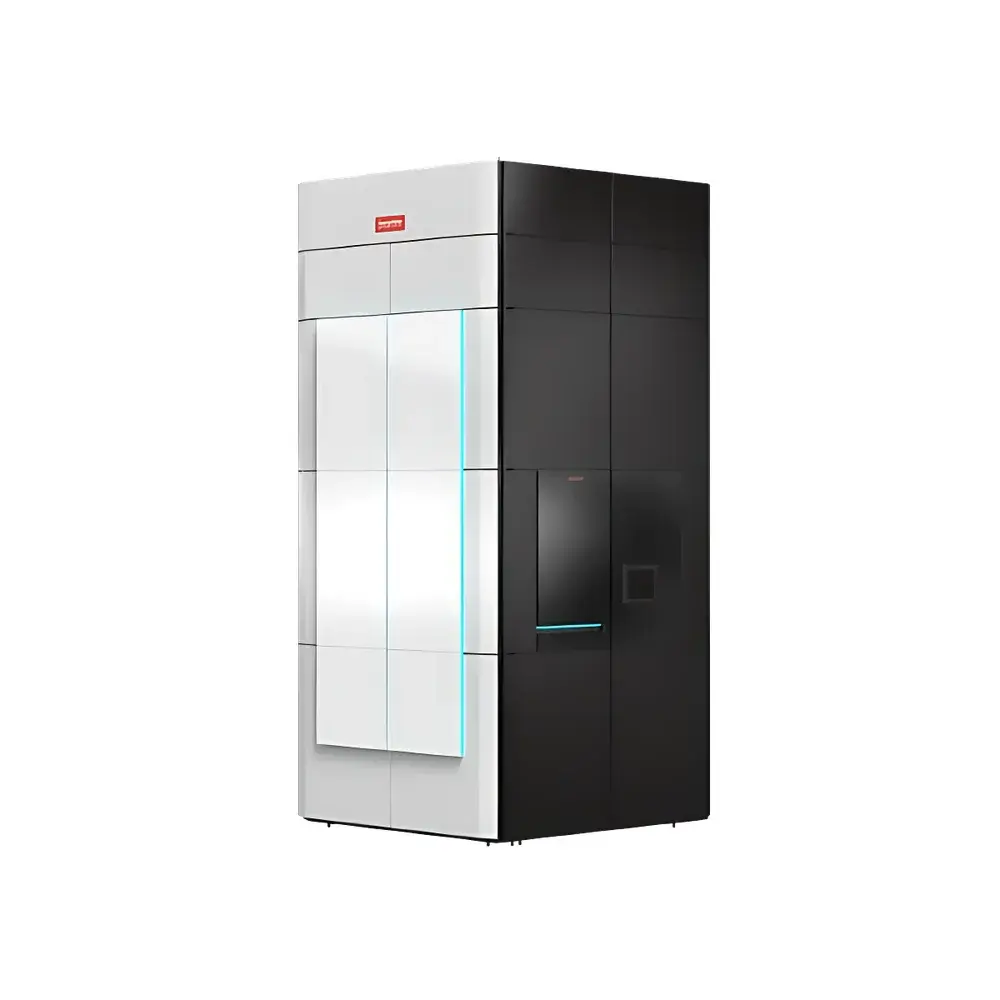
Thermo Fisher Scientific Iliad S/TEM with Integrated Cs-Corrector and Advanced EELS
| Brand | Thermo Fisher Scientific |
|---|---|
| Model | Iliad |
| Type | Spherical Aberration-Corrected Scanning/Transmission Electron Microscope (S/TEM) |
| Integrated Spectroscopy | Dual-mode EELS (including XEELS™ up to 30 keV) and Energy-Filtered Imaging |
| Detectors | Zebra EELS Detector, NanoPulser Electrostatic Beam Blanking (1 MHz, ≤10 ns pulse width), Optional Dual-X/Super-X/Ultra-X EDX |
| Software | Velox™ (S/TEM, EDX, EELS acquisition & analysis), Autoscript™ TEM (Python-based automation, AI-integrated workflow control) |
| Compliance | Designed for GLP/GMP-aligned labs |
Overview
The Thermo Fisher Scientific Iliad is a fully integrated spherical aberration-corrected scanning/transmission electron microscope (Cs-corrected S/TEM), engineered for atomic-resolution structural and chemical characterization of advanced materials. Unlike legacy instruments requiring external add-ons or post-acquisition spectral alignment, the Iliad embeds electron energy loss spectroscopy (EELS) at the optical core—leveraging a monochromated high-brightness field-emission gun (FEG), a next-generation Cs corrector, and a purpose-built optical pathway optimized for energy-filtered imaging and multi-modal spectroscopy. Its architecture enables simultaneous acquisition of high-angle annular dark-field (HAADF) STEM, energy-dispersive X-ray spectroscopy (EDX), and quantitative EELS across wide energy windows—including core-loss ionization edges, low-loss plasmons, and extended-energy regions up to 30 keV (XEELS™). This integration eliminates mechanical drift-induced misregistration between imaging and spectral data, ensuring sub-Å spatial fidelity and eV-level energy calibration stability over multi-hour acquisitions.
Key Features
- NanoPulser electrostatic beam blanking: Delivers synchronized, sub-10 ns electron pulses at up to 1 MHz frequency—enabling dose-controlled imaging of beam-sensitive specimens (e.g., MOFs, 2D materials, organic-inorganic hybrids) and time-resolved experiments such as pump-probe EELS.
- Zebra EELS detector: A dedicated, high-collection-efficiency spectrometer with optimized dispersion linearity and thermal/mechanical stability, co-aligned with the objective lens to maintain focus across the full energy range (0–30 keV).
- MultiEELS™ acquisition: Simultaneous capture of up to five independent energy windows—each configurable in width, offset, and dwell time—supporting correlated edge-fitting, background subtraction, and dual-edge ratio mapping without sequential scanning.
- “Always-in-focus” EELS optics: Real-time dynamic correction of chromatic defocus across energy losses, ensuring zero-loss peak and all core-loss edges remain sharply focused on the detector plane regardless of energy shift—critical for quantitative thickness mapping and fine-structure analysis (ELNES/XANES).
- Velox™ software platform: Unified interface for S/TEM, EDX, and EELS acquisition, processing, and reporting—featuring guided workflows, automated drift correction, spectral deconvolution tools, and export-compatible metadata (EMDB, CIF, NIST-compatible formats).
- Autoscript™ TEM: Python API enabling script-driven instrument control, batch acquisition scheduling, AI-assisted feature recognition (e.g., grain boundary detection), and integration with third-party ML libraries for unsupervised spectral clustering.
Sample Compatibility & Compliance
The Iliad accommodates standard 3 mm TEM grids (including cryo-EM holders), in-situ heating/cooling stages (up to 1000 °C), and electrical biasing holders—enabling operando characterization of catalysts, battery electrodes, and ferroelectric heterostructures. Its vacuum architecture meets ISO 14644-1 Class 5 cleanroom requirements for column integrity. For regulated environments, Velox optionally supports 21 CFR Part 11-compliant electronic signatures, audit trails, and role-based access control—facilitating validation under GMP/GLP frameworks. All EELS calibration protocols align with ASTM E2798 (Standard Practice for Quantitative EELS Analysis) and ISO/IEC 17025 traceability guidelines.
Software & Data Management
Velox stores raw and processed datasets in vendor-neutral HDF5 containers, preserving pixel geometry, energy calibration, and acquisition parameters per frame. EELS spectral libraries are searchable via elemental and edge-type filters, and batch processing supports normalization, background modeling (power-law or spline), and PCA-based denoising. Autoscript-generated scripts are version-controlled and executable across Iliad systems—ensuring reproducibility in multi-lab collaborations. Data export complies with FAIR principles (Findable, Accessible, Interoperable, Reusable), including MIAPPE-compliant metadata tagging for materials science repositories.
Applications
- Atomic-scale mapping of dopant segregation and interfacial bonding in semiconductor heterojunctions using ELNES fingerprinting.
- Quantitative oxygen vacancy profiling in perovskite oxides via O-K edge fine-structure evolution under controlled gas atmospheres.
- In-situ lithiation/delithiation dynamics in solid-state battery cathodes monitored by time-resolved XEELS™ at 20–30 keV.
- Correlative nanochemical analysis of extracellular vesicles—combining HAADF-STEM tomography, Ca-L₂,₃ edge mapping, and C/N/O K-edge EELS for lipid/protein stoichiometry.
- Validation of DFT-predicted electronic structures in topological insulators through momentum-resolved EELS bandgap measurements.
FAQ
What is the maximum energy-loss range supported by the Iliad’s XEELS™ capability?
The system achieves calibrated, high-SNR EELS acquisition up to 30 keV energy loss—enabling direct comparison with synchrotron-based X-ray absorption spectroscopy (XAS) datasets.
Does the “always-in-focus” EELS function require manual recalibration between different energy windows?
No—chromatic focus correction is applied automatically and continuously during acquisition via real-time feedback from the objective lens current and energy-selecting aperture position.
Can Velox import and reprocess legacy EELS data acquired on non-Thermo instruments?
Yes—Velox accepts DM3, EMIF, and Nion-format spectra with user-defined calibration files; however, full multi-dimensional correlation (e.g., spectrum-image + STEM stack) requires native Iliad acquisition metadata.
Is Autoscript TEM compatible with open-source machine learning frameworks like PyTorch or scikit-learn?
Yes—Autoscript exposes instrument state variables and detector streams as NumPy arrays, enabling direct ingestion into training pipelines without intermediate file I/O.
How does the NanoPulser improve signal-to-noise in low-dose EELS of biological thin sections?
By gating electrons into precisely timed bursts synchronized with detector readout, NanoPulser suppresses readout noise and enables frame-averaging with motion correction—achieving usable core-loss spectra at <0.1 e⁻/Ų total dose.







