
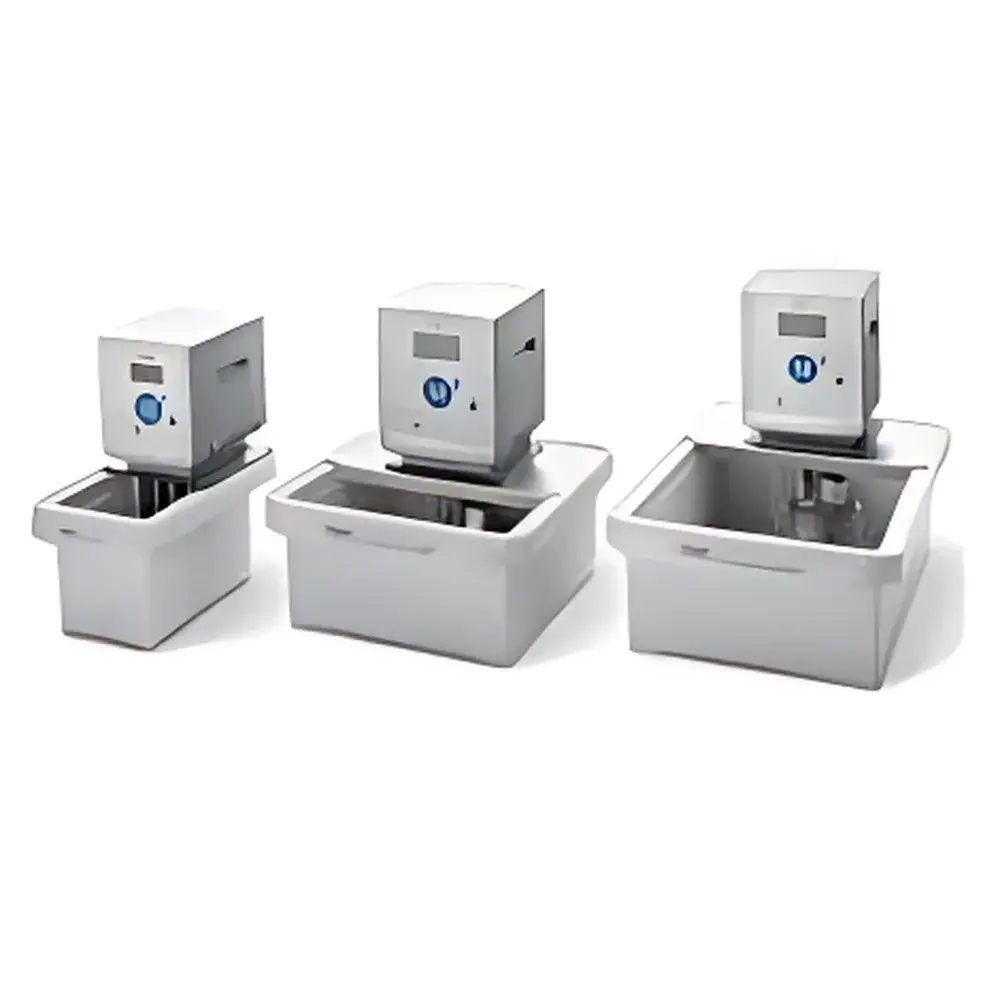
Thermo Fisher Scientific NESLAB HAAKE S5P / S14P / S21P Polyphenyl Ether (PPE) Heating Circulator
| Brand | Thermo Fisher Scientific |
|---|---|
| Origin | USA |
| Manufacturer | Yes |
| Import Status | Imported |
| Model Series | S5P, S14P, S21P |
| Bath Volume | 5 L / 14 L / 21 L |
| Temperature Range | Ambient +13 °C to 100 °C |
| Temperature Stability | ±0.01 °C |
| Circulation Type | Internal & External |
| Control Mode | Heating-Only PID |
| Compliance | UL/CSA/CE, RoHS, DIN 12876 Class 3 / NFL Safety Rating |
| Interface Options | RS232, RS485, USB, Ethernet, Analog I/O, Multi-function Port |
| Safety Alarms | High/Low Temperature, High/Low Liquid Level |
Overview
The Thermo Fisher Scientific NESLAB HAAKE S5P, S14P, and S21P series are precision heating circulators engineered for laboratory applications requiring stable, contamination-free thermal control of external systems or immersion-based sample conditioning. Unlike conventional water baths, these units utilize polyphenyl ether (PPE) heat transfer fluid—a thermally stable, non-volatile, non-oxidizing synthetic oil—enabling safe, long-term operation at elevated temperatures without evaporation, degradation, or microbial growth. The circulators operate on a closed-loop forced-convection principle: an integrated pump delivers PPE fluid through insulated tubing to external jackets, coils, or reactors, while high-resolution platinum resistance thermometers (Pt100) and adaptive PID algorithms maintain setpoint accuracy within ±0.01 °C across the full operating range (ambient +13 °C to 100 °C). This architecture eliminates reliance on open-bath convection and supports both internal bath temperature regulation and external process temperature control with reproducible thermal profiles.
Key Features
- Three standard bath volumes (5 L, 14 L, 21 L) optimized for scalability—from benchtop reactor jacketing to multi-vessel thermal management
- Heating-only operation with programmable ramp/soak profiles and energy-efficient duty-cycle modulation
- Dual-mode circulation: selectable internal recirculation (for bath homogeneity) or external flow (for remote thermal coupling)
- Large backlit LCD display with intuitive menu navigation, real-time parameter logging, and on-screen alarm diagnostics
- Comprehensive safety architecture including dual independent temperature limit sensors, low-fluid cutoff, overtemperature cutout, and audible/visual fault indication
- Multi-protocol digital connectivity (RS232, RS485, USB, Ethernet) plus analog 0–10 V and 4–20 mA I/O for integration into SCADA, LIMS, or PLC-controlled environments
- Compliance with DIN 12876 Class 3 (NFL) safety certification—ensuring protection against overheating, leakage, and electrical hazards in demanding lab settings
Sample Compatibility & Compliance
These circulators are designed for use with chemically inert PPE fluids (e.g., Santovac 5, Therminol VP-1), making them compatible with glass, stainless steel, PTFE, and fluoropolymer-lined equipment. They are unsuitable for aqueous or volatile organic solvent loops due to fluid incompatibility and sealing requirements. Regulatory alignment includes UL 61010-1 and CSA C22.2 No. 61010-1 for electrical safety; CE marking under the EU Machinery Directive and Electromagnetic Compatibility Directive; and RoHS 2011/65/EU compliance. For GLP/GMP-regulated laboratories, optional audit-trail-enabled firmware supports 21 CFR Part 11-compliant electronic records when paired with validated data acquisition software.
Software & Data Management
Standard operation requires no proprietary software—parameter configuration and monitoring are fully accessible via front-panel interface. Optional Thermo Fisher Connect™ Lab Management Suite enables remote monitoring, alarm notification (email/SMS), historical trend analysis, and export of time-stamped CSV logs. All communication interfaces support Modbus RTU/TCP protocols for third-party system integration. Firmware updates are delivered via USB or Ethernet and include version-controlled release notes traceable to ISO/IEC 17025 calibration documentation. Data integrity safeguards include write-protected configuration memory and cyclic redundancy check (CRC) validation on all serial transmissions.
Applications
- Temperature control of rotary evaporators, jacketed reactors, and calorimeters in synthetic chemistry and pharmaceutical development
- Stabilization of optical components (e.g., spectrophotometer cuvette holders, interferometer stages) where microthermal drift affects measurement fidelity
- Calibration of temperature-sensitive sensors (RTDs, thermistors, infrared detectors) across extended thermal ranges
- Pre-conditioning of polymer samples prior to rheological or mechanical testing per ASTM D3418 and ISO 3146
- Support of accelerated stability studies (ICH Q1A) requiring precise, uninterrupted thermal exposure at 40 °C/75% RH or 60 °C ambient conditions
- Integration into automated analytical workflows involving HPLC column ovens, GC injectors, or dissolution apparatus per USP <724>
FAQ
What heat transfer fluids are approved for use with the S-series PPE circulators?
Only certified polyphenyl ether (PPE) fluids meeting ASTM D6922 specifications—such as Santovac 5 or Therminol VP-1—are permitted. Water, glycol mixtures, silicone oils, or hydrocarbon-based oils must not be used.
Can the unit be operated without external circulation?
Yes—the internal recirculation mode maintains uniform bath temperature without connecting external tubing. However, external flow is required for jacketed equipment or process temperature control.
Is temperature calibration traceable to NIST standards?
Each unit ships with a factory calibration certificate referencing NIST-traceable standards. On-site recalibration services are available through Thermo Fisher Certified Service Engineers.
Does the circulator support cooling functionality?
No—the S5P/S14P/S21P models are heating-only devices. For combined heating/cooling applications, consider the Thermo Fisher HAAKE EX series or NESLAB RTE recirculating chillers.
What maintenance intervals are recommended for optimal performance?
Fluid level and visual inspection every 3 months; full fluid replacement every 24 months or after 5,000 operating hours—whichever occurs first. Pump impeller and seal inspection is advised annually under continuous operation.



