
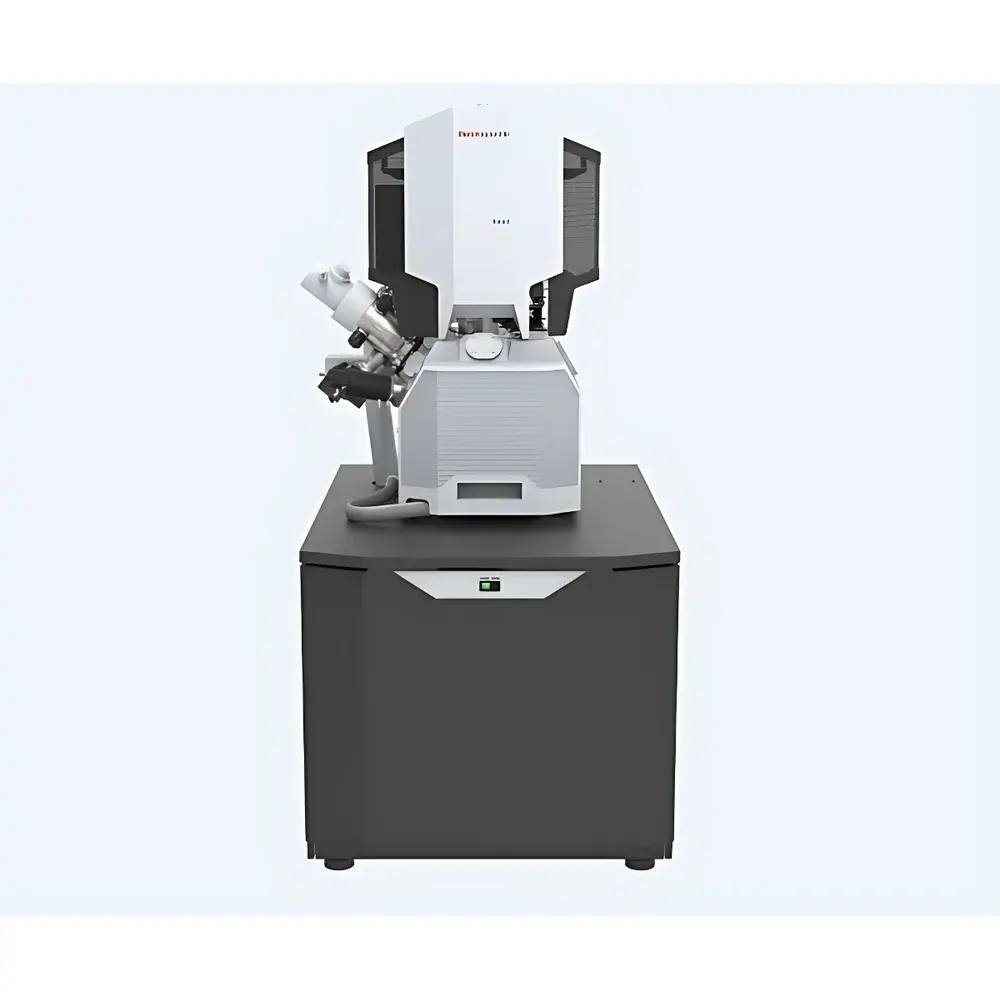
Thermo Fisher Scientific Scios DualBeam Focused Ion Beam-Scanning Electron Microscope (FIB-SEM)
| Brand | Thermo Fisher Scientific |
|---|---|
| Origin | Czech Republic |
| Manufacturer Type | Original Equipment Manufacturer (OEM) |
| Origin Category | Imported |
| Model | Scios |
| Price Range | USD 920,000 – 1,315,000 (based on EUR/USD exchange and typical landed cost for high-end FIB-SEM systems) |
Overview
The Thermo Fisher Scientific Scios DualBeam is a high-performance focused ion beam–scanning electron microscope (FIB-SEM) engineered for nanoscale characterization, precision site-specific sample preparation, and correlative 3D structural analysis. Leveraging a dual-column architecture—comprising a high-brightness Schottky field-emission SEM column and a liquid metal gallium ion (Ga⁺) FIB column—the Scios enables simultaneous or sequential electron imaging, ion milling, deposition, and nanomanipulation. Its optical design incorporates aberration-corrected electron optics and advanced beam deceleration, supporting stable low-voltage imaging down to 20 eV landing energy—critical for charge-sensitive, non-conductive, or beam-sensitive specimens. The system is widely deployed in materials science laboratories, semiconductor R&D facilities, and life science core imaging centers where quantitative 3D tomography, TEM lamella preparation, and failure analysis demand sub-nanometer spatial resolution and high signal fidelity.
Key Features
- Trinity™ In-Lens Detection System: Integrates three independent detectors—Everhart-Thornley (ET), solid-state backscattered electron (BSE), and through-the-lens secondary electron (TTL-SE)—within the objective lens, enabling simultaneous multi-signal acquisition with optimized signal-to-noise ratio and material-specific contrast separation.
- Concentric Under-Lens BSE Detector: Positioned coaxially beneath the objective lens to capture angularly resolved backscattered electrons; allows unambiguous differentiation between topographic and atomic-number contrast—even at ultra-low landing energies (≤20 eV).
- Drift-Compensated Nanolithography: Combines real-time stage drift correction with beam-blanking synchronization to enable maskless, positionally accurate ion beam patterning without pre-coating or conductive sputtering—ideal for insulating ceramics, polymers, and biological tissues.
- EasyLift™ Nano-Manipulator: A fully integrated, motorized micromanipulator with piezo-driven fine positioning and real-time SEM-guided navigation for reliable, high-yield TEM lamella lift-out from bulk samples or device cross-sections.
- Automated 3D Tomography Workflow: Supports serial sectioning via FIB milling followed by SEM imaging of freshly exposed surfaces; data cubes are reconstructed using Thermo Fisher’s Avizo or Amira software for quantitative volumetric analysis of inclusions, porosity, grain boundaries, and crack propagation pathways.
Sample Compatibility & Compliance
The Scios DualBeam accommodates diverse specimen types—including magnetic alloys, oxide ceramics, battery electrode composites, frozen-hydrated cryo-sections, and resin-embedded biological tissue—without mandatory conductive coating, thanks to its low-kV imaging capability and active charge compensation. All hardware and software modules comply with ISO 9001 manufacturing standards and support GLP/GMP-aligned documentation practices. Data acquisition logs, user access records, and instrument parameter histories are timestamped and exportable in audit-trail format per FDA 21 CFR Part 11 requirements when configured with optional secure login and electronic signature modules. System calibration protocols align with ASTM E1558 (standard guide for SEM measurement uncertainty) and ISO/IEC 17025 for accredited testing laboratories.
Software & Data Management
Operation is managed through Thermo Fisher’s AutoScript 4 platform—a Python-based scripting environment enabling full automation of acquisition sequences, stage navigation, detector synchronization, and conditional logic execution. Image data are stored in standardized TIFF/DM3 formats with embedded metadata (accelerating voltage, dwell time, working distance, detector gain, etc.). Integration with Thermo Fisher Connect cloud services facilitates remote monitoring, collaborative annotation via shared project workspaces, and AI-assisted segmentation using pre-trained convolutional neural networks (CNNs) for phase identification in multiphase alloys or organelle classification in cryo-ET datasets. Raw FIB-SEM stacks are compatible with open-source reconstruction pipelines including IMOD, Dragonfly, and Fiji/ImageJ plugins.
Applications
- Materials Science: Quantitative 3D characterization of inclusion populations in high-strength steels, interfacial delamination in thermal barrier coatings, and lithium dendrite morphology in solid-state battery anodes.
- Semiconductor Metrology: Cross-sectional analysis of FinFET gate stacks, defect localization in EUV lithography masks, and trench profile metrology with sub-2 nm edge detection repeatability.
- Geosciences: Pore-network modeling in shale matrix, clay mineral orientation mapping in fault gouge, and fluid inclusion 3D reconstruction in metamorphic quartz.
- Life Sciences: Correlative light and electron microscopy (CLEM) workflows using fiducial markers; targeted lamella preparation from fluorescently labeled neurons; and serial block-face imaging of synaptic ultrastructure in brain tissue.
FAQ
What vacuum conditions does the Scios DualBeam require for optimal performance?
The system operates under ultra-high vacuum (UHV) conditions: ≤1 × 10⁻⁷ Pa in the SEM column and ≤5 × 10⁻⁶ Pa in the FIB column, maintained by turbomolecular pumps with cryo-trapping capabilities to minimize hydrocarbon contamination during long-duration acquisitions.
Can the Scios be used for in situ heating or electrical biasing experiments?
Yes—when equipped with optional holders (e.g., DENSsolutions Wildfire or Protochips Aduro), the Scios supports in situ heating up to 1200 °C and four-probe electrical biasing with picoampere current resolution and synchronized voltage ramping.
Is STEM-in-SEM imaging supported on the Scios platform?
The Scios supports scanning transmission electron microscopy (STEM) mode using an annular dark-field (ADF) detector mounted below the sample stage, enabling Z-contrast imaging of thin sections with resolution down to 0.7 nm at 30 kV.
How is beam damage minimized during extended 3D tomography sessions?
Beam damage mitigation strategies include dose fractionation, adaptive dwell time mapping, low-dose acquisition protocols, and real-time electron dose monitoring via integrated Faraday cup feedback—enabling reproducible sub-5 nm voxel resolution across >500 serial sections.
Does Thermo Fisher provide application-specific training and method development support?
Yes—Thermo Fisher offers tiered technical support packages including on-site installation qualification (IQ), operational qualification (OQ), application workshops, and dedicated application scientists for method optimization in metallurgy, semiconductor, and life science domains.




