
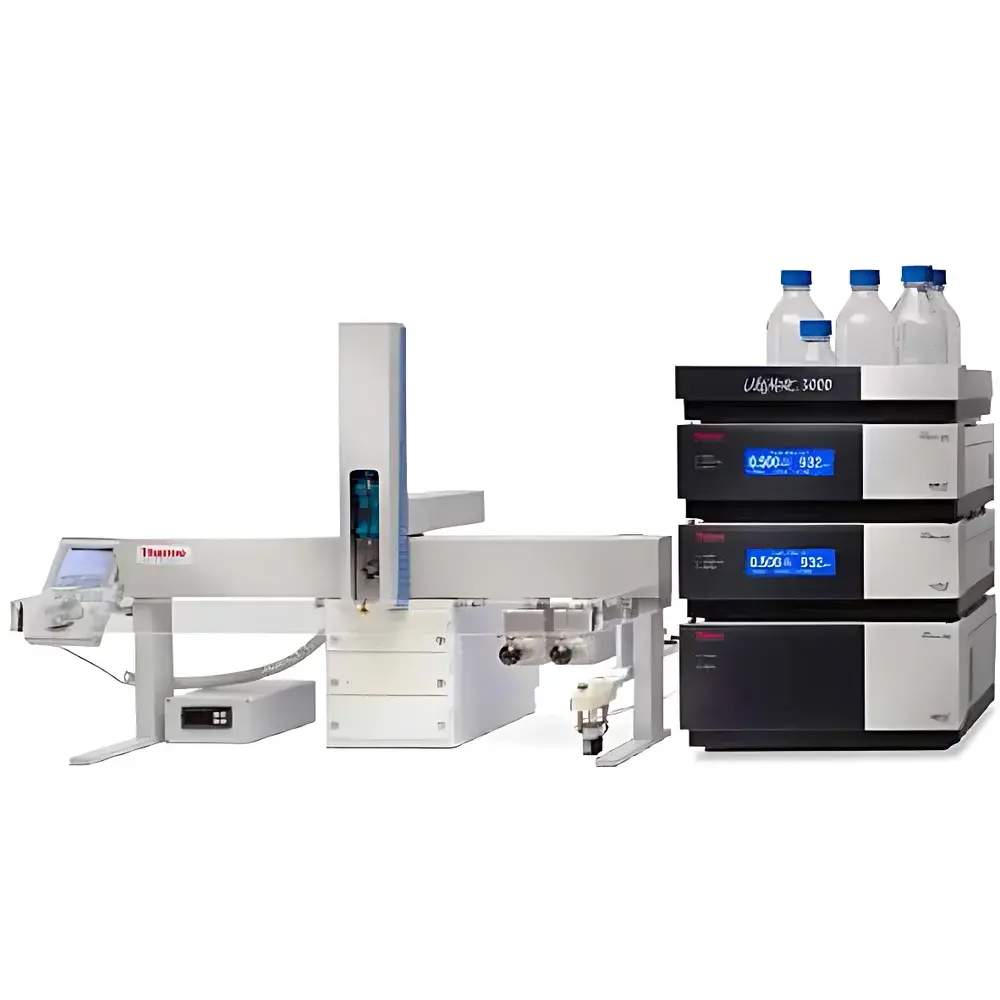
Thermo Fisher Scientific Transcend II Ultra-High-Performance Liquid Chromatography System with Online SPE Capability
| Brand | Thermo Fisher |
|---|---|
| Origin | USA |
| Manufacturer Type | Original Equipment Manufacturer (OEM) |
| Import Status | Imported |
| Model | Transcend II |
| Instrument Type | UHPLC–Online Solid-Phase Extraction (SPE) Coupled System |
| Configuration Flexibility | Single-method quad-channel or multi-method independent-channel operation |
Overview
The Thermo Fisher Scientific Transcend II system is an integrated ultra-high-performance liquid chromatography (UHPLC) platform engineered for high-throughput, robust bioanalytical and pharmaceutical analysis. It operates on a dual-technology architecture combining TurboFlow online sample cleanup with parallel multi-channel UHPLC separation—enabling automated, reproducible sample preparation and chromatographic analysis in a single instrument footprint. Unlike conventional offline SPE workflows requiring manual handling, evaporation, reconstitution, and transfer steps, the Transcend II performs selective matrix removal directly within the flow path using restricted-access media (RAM) or mixed-mode sorbents, preserving analyte integrity while eliminating carryover and variability. Its fluidic design supports both isocratic and gradient elution across all channels, with pressure capabilities up to 15,000 psi and sub-2 µm particle column compatibility—ensuring resolution, speed, and sensitivity required for complex biological matrices such as plasma, urine, tissue homogenates, and cell lysates.
Key Features
- Integrated TurboFlow technology for online, column-based sample purification prior to UHPLC–MS analysis—reducing manual intervention and inter-sample contamination.
- Four independently controllable LC channels supporting simultaneous method execution: one method across all channels (e.g., replicate injections), or four distinct methods (e.g., different gradients, columns, or mobile phases) running concurrently.
- Modular valve architecture enabling seamless switching between TurboFlow SPE mode and conventional multi-channel UHPLC mode without hardware reconfiguration.
- Full compatibility with Thermo Scientific mass spectrometers—including Q Exactive, TSQ Altis, and Orbitrap Exploris platforms—via standardized LC–MS interfaces and timing synchronization protocols.
- High-pressure gradient mixing with ≤0.1% RSD composition accuracy and <100 µL total dwell volume per channel, ensuring retention time stability across long sequences.
- Onboard column oven with temperature control from 5 °C to 90 °C and active pre-heating of mobile phase lines to minimize thermal dispersion effects.
Sample Compatibility & Compliance
The Transcend II system accommodates a broad range of sample types including but not limited to human and animal biofluids, environmental extracts, food homogenates, and formulation intermediates. Its TurboFlow modules support diverse sorbent chemistries (C18, polymeric reversed-phase, ion-exchange, and hybrid modes), allowing method development for small molecules, peptides, and polar metabolites. From a regulatory perspective, the system supports 21 CFR Part 11-compliant data acquisition when operated with Thermo Scientific Chromeleon Chromatography Data System (CDS) v7.3 or later—including electronic signatures, audit trails, user access controls, and method versioning. It meets ISO/IEC 17025 requirements for testing laboratories and aligns with ICH M10 guidance for bioanalytical method validation. Routine performance qualification follows ASTM D7475 (for LC system suitability) and USP (Chromatography) criteria.
Software & Data Management
Control and data acquisition are managed through Chromeleon CDS, which provides centralized method building, sequence scheduling, real-time monitoring, and post-run reporting. The software includes dedicated TurboFlow method wizards, multi-channel synchronization tools, and automatic calibration curve generation with weighted linear regression. Raw data files (.RAW) are stored in vendor-neutral formats compatible with third-party processing tools (e.g., Skyline, SimGlycan). Audit trail logs record all user actions—including method edits, injection events, and instrument parameter changes—with timestamps and operator IDs. Data archiving complies with ALCOA+ principles (Attributable, Legible, Contemporaneous, Original, Accurate, Complete, Consistent, Enduring, Available) and supports long-term retention strategies aligned with GLP and GMP documentation standards.
Applications
- High-volume therapeutic drug monitoring (TDM) in clinical laboratories—processing hundreds of patient samples daily with minimal hands-on time.
- Pharmacokinetic (PK) and toxicokinetic (TK) studies in nonclinical development, where rapid turnaround of plasma concentration-time profiles is critical.
- Residue analysis in food safety labs—screening for veterinary drugs, pesticides, and mycotoxins in milk, meat, and produce extracts.
- Metabolomics and proteomics core facilities performing untargeted profiling with consistent retention time alignment across large cohort studies.
- Quality control of biologics—quantifying host-cell proteins (HCPs), aggregates, and charge variants using orthogonal UHPLC–MS workflows.
FAQ
Can the Transcend II system operate without mass spectrometry detection?
Yes—it is fully functional with UV/Vis, fluorescence, or CAD detectors; however, its TurboFlow architecture delivers maximum value in LC–MS environments due to stringent matrix suppression requirements.
Is method transfer between Transcend I and Transcend II systems straightforward?
Most TurboFlow and multi-channel methods are backward-compatible; however, updated valve timing parameters and pressure limits require verification during migration.
Does the system support gradient delay compensation across all four channels?
Yes—each channel maintains independent dwell volume calibration, and Chromeleon automatically adjusts gradient start times to ensure synchronized elution windows.
What maintenance intervals are recommended for TurboFlow columns and trapping cartridges?
Typical lifetime is 500–1,000 injections depending on sample cleanliness; preventive replacement is advised after 300 injections in high-fat-content biofluids.
How does the system handle carryover in multi-method operation?
It employs post-injection needle wash (with solvent selection per method), active column flushing, and programmable purge cycles—validated to achieve <0.01% carryover for high-concentration standards.



