
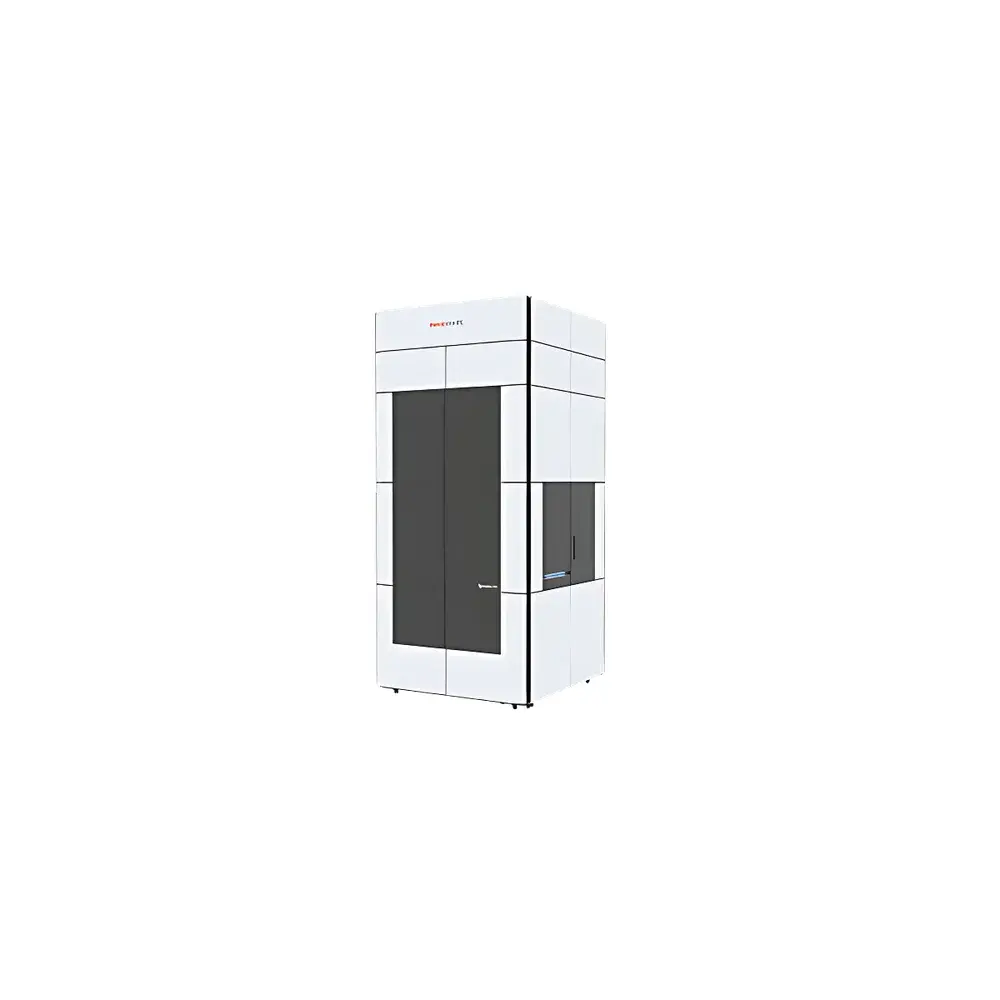
Thermo Fisher Spectra S/TEM Scanning Transmission Electron Microscope
| Brand | Thermo Fisher |
|---|---|
| Origin | Netherlands |
| Manufacturer Type | Original Equipment Manufacturer (OEM) |
| Origin Category | Imported |
| Model | Spectra S/TEM |
| Price Range | USD 4.2–4.9 million (approx.) |
Overview
The Thermo Fisher Spectra S/TEM is a high-end scanning transmission electron microscope engineered for atomic-resolution structural and chemical characterization of advanced materials. Operating on the fundamental principles of electron optics and inelastic scattering, the Spectra platform integrates aberration-corrected probe-forming optics with monochromated and ultra-bright electron sources to achieve sub-angstrom spatial resolution and meV-scale energy resolution. It is purpose-built for laboratories requiring quantitative, reproducible nanoscale analysis under controlled beam conditions—particularly where specimen sensitivity, compositional heterogeneity, or electronic structure mapping are critical. Unlike conventional TEMs, the Spectra S/TEM enables simultaneous acquisition of multiple signal modalities—including annular dark-field (ADF), bright-field (BF), integrated differential phase contrast (iDPC), and spectroscopic data—within a single instrument architecture. Its design reflects decades of advancement in electron source engineering, detector physics, and vacuum system reliability, making it suitable for both academic discovery and industrial R&D environments subject to GLP-compliant workflows.
Key Features
- Aberration-corrected X-CFEG (cold field emission gun) delivering >2× higher X-ray signal intensity and >10% improved spatial resolution versus legacy CFEG systems
- Three configurable electron source options: XFEG Mono (for ultra-high energy resolution), X-FEG UltiMono (optimized for parallel EELS/EDS acquisition), and X-CFEG (for maximum brightness and stability in beam-sensitive imaging)
- EMPAD (Electron Microscope Pixel Array Detector)—a high-dynamic-range, high-frame-rate direct detection camera enabling ptychographic reconstruction, 4D-STEM strain mapping, and low-dose phase retrieval
- Integrated dual-spectroscopy capability: simultaneous energy-dispersive X-ray spectroscopy (EDS) and electron energy-loss spectroscopy (EELS) with sub-eV energy resolution and atomic-column sensitivity
- Advanced beam control architecture featuring real-time dose management, automated drift correction, and programmable scan protocols compliant with ISO/IEC 17025 traceability requirements
Sample Compatibility & Compliance
The Spectra S/TEM supports a broad spectrum of beam-sensitive and heterogeneous specimens—including metal–organic frameworks (MOFs), zeolites, polymer nanocomposites, 2D materials (e.g., transition metal dichalcogenides), and operational battery cathode/anode interfaces. Its low-dose imaging modes, combined with sub-second dwell time control and variable acceleration voltage (60–300 kV), allow stable observation of organic and hybrid structures without radiolytic damage. All hardware and software modules comply with international standards relevant to analytical instrumentation: ASTM E2821 (standard practice for EDS quantification), ISO 22473-2 (electron microscopy terminology), and USP (analytical instrument qualification). The system supports audit-trail-enabled operation per FDA 21 CFR Part 11 when deployed in regulated pharmaceutical or medical device development settings.
Software & Data Management
Acquisition and analysis are managed via Thermo Fisher’s Velox™ software suite—a modular, Python-extendable platform supporting automated experiment scripting, AI-assisted feature recognition (e.g., grain boundary segmentation), and standardized metadata embedding (FAIR data principles). Velox natively exports HDF5 and TIFF stacks compatible with open-source tools such as HyperSpy and TomoJ. For enterprise integration, the system supports DICOM-EM extensions and secure LDAP-authenticated network deployment. Raw STEM datasets—including 4D diffraction volumes—are stored with embedded calibration parameters, enabling retrospective reprocessing and cross-laboratory method transfer. Data integrity is enforced through SHA-256 checksum logging and timestamped user action tracking.
Applications
- Atomic-scale defect analysis in high-strength alloys and lightweight automotive materials (e.g., Al–Mg–Sc precipitates, TRIP steel dislocation networks)
- In situ and operando characterization of solid-electrolyte interphase (SEI) evolution in Li-ion and solid-state batteries
- Quantitative dopant profiling and interface chemistry mapping in next-generation logic transistors (e.g., SiGe/Si heterojunctions, high-κ gate stacks)
- Structural fingerprinting of catalytic active sites in single-atom catalysts and porous carbons
- Correlative multimodal analysis combining EELS fine-structure (ELNES/XANES) with DPC-based electric field mapping for ferroelectric domain studies
FAQ
What voltage configurations are available for the Spectra S/TEM?**
The Spectra 300 operates at 300 kV; the Spectra 200 is configured for 200 kV. Both support variable kV ramping (60–300 kV) with <0.01% stability over 8 hours.
Is the system compatible with in situ heating, cooling, or biasing holders?**
Yes—Thermo Fisher offers certified in situ holders (e.g., NanoEx-Illuminator, Protochips Fusion) fully integrated into Velox with synchronized thermal/electrical parameter logging.
How does the EMPAD detector improve quantitative STEM imaging?**
EMPAD provides single-electron sensitivity, >10⁶ dynamic range, and 1000 fps frame rates—enabling statistically robust 4D-STEM reconstructions without pixel binning or post-acquisition denoising.
Can the Spectra S/TEM meet regulatory requirements for GMP documentation?**
When configured with optional IQ/OQ/PQ packages and enabled audit trail modules, the system satisfies GMP Annex 11 and ISO 13485 documentation rigor for materials release testing.
What level of technical support and service coverage is included?**
Standard warranty includes 24/7 remote diagnostics, annual preventive maintenance, and access to Thermo Fisher’s global application scientist network for method development and training.




