
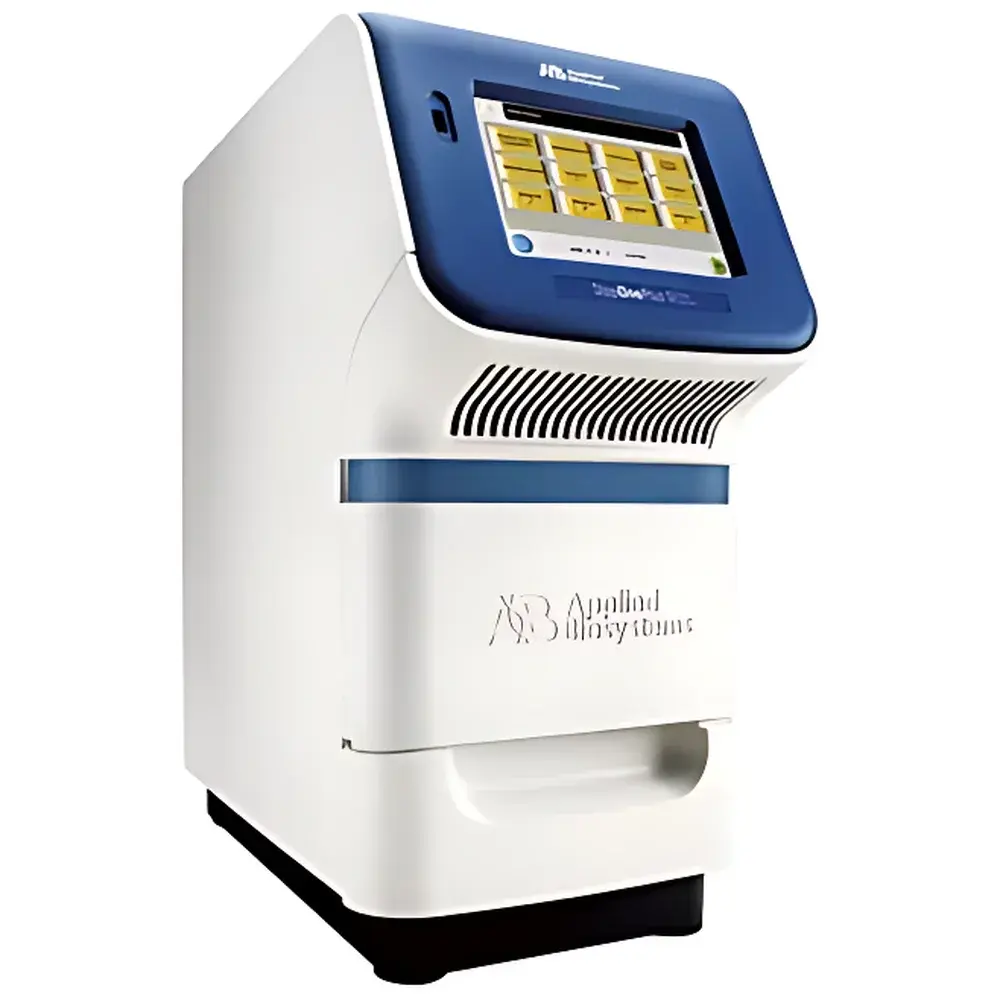
Thermo Fisher StepOnePlus™ Real-Time PCR System
| Brand | Thermo Fisher |
|---|---|
| Origin | USA |
| Model | StepOnePlus™ Real-Time PCR System |
| Instrument Type | Real-Time Quantitative PCR (qPCR) System |
| Sample Format | 96-well standard plate |
| Optical Channels | 4-color LED-based detection (FAM™/SYBR® Green, VIC®/JOE™, NED™/TAMRA™, ROX™) |
| Thermal Control | VeriFlex™ heated block with 6 independently controlled temperature zones |
| Software | StepOne™ Software (Windows® XP/Vista®/7 compatible) |
| Compliance | MIQE-compliant RDML export, supports HRM analysis, GLP-ready audit trail features |
| Included | Pre-calibrated instrument, RNase P validation plate, StepOne™ software, Primer Express® design software, comprehensive application documentation |
Overview
The Thermo Fisher StepOnePlus™ Real-Time PCR System is a benchtop, 96-well real-time quantitative polymerase chain reaction (qPCR) platform engineered for precision, reproducibility, and operational simplicity across diverse life science research environments. It employs a solid-state, four-channel LED excitation and photodiode-based fluorescence detection architecture—optimized for common qPCR dyes including FAM™/SYBR® Green I (channel 1), VIC®/JOE™ (channel 2), NED™/TAMRA™ (channel 3), and ROX™ (channel 4) as a passive reference. The system utilizes a Peltier-driven thermal cycling block integrated with VeriFlex™ technology—a proprietary architecture featuring six thermally isolated heating zones. This enables simultaneous, independent temperature control across the block surface, allowing precise optimization of annealing conditions within a single run—critical for multiplex assay development, gradient-based primer validation, or comparative amplification of targets with divergent melting temperatures.
Key Features
- Compact footprint (28 × 41 × 35 cm) designed for space-constrained laboratories without compromising thermal or optical performance.
- Integrated 7-inch LCD touchscreen interface supporting standalone operation—no external PC required for setup, run initiation, or basic result viewing.
- USB 2.0 port enabling direct data export, firmware updates, and method transfer without network dependency.
- Pre-calibrated optical and thermal subsystems delivered with factory-validated RNase P control plate for immediate verification of detection sensitivity and thermal uniformity.
- VeriFlex™ block architecture ensures ±0.25 °C thermal accuracy across all 96 wells under standard cycling conditions, with zone-specific temperature offsets programmable from 0.1 °C to 5.0 °C increments.
- Optical system demonstrates <0.15 CV% inter-well fluorescence variability at 10⁴ copies/µL template concentration, supporting high-confidence low-abundance target detection.
Sample Compatibility & Compliance
The StepOnePlus™ system accepts standard 0.1 mL and 0.2 mL skirted or semi-skirted 96-well PCR plates, as well as compatible optical adhesive seals. It is validated for use with TaqMan® Assays, SYBR® Green-based master mixes, and third-party chemistries meeting standard qPCR spectral emission profiles. From a regulatory standpoint, the platform supports Good Laboratory Practice (GLP) workflows through configurable user access levels, electronic signature-capable method locking, and time-stamped audit logs embedded in raw data files. StepOne™ Software v2.3+ complies with Minimum Information for Publication of Quantitative Real-Time PCR Experiments (MIQE) guidelines via native RDML (Real-time PCR Data Markup Language) export functionality. While not FDA 21 CFR Part 11–certified out-of-the-box, the system architecture permits integration into validated environments when deployed with appropriate procedural controls and IT infrastructure.
Software & Data Management
StepOne™ Software provides an integrated environment for instrument control, real-time monitoring, endpoint analysis, and advanced quantification—including absolute quantification, relative quantification (ΔΔCT), presence/absence calling, and high-resolution melt (HRM) curve analysis. The software includes an experiment wizard guiding users through plate layout definition, assay assignment, cycling profile selection, and analysis parameter configuration—reducing protocol errors for novice operators. Remote monitoring is enabled via HTTP-based status polling; email notifications trigger upon run completion or error events. Raw data (.eds files) retain full metadata—including instrument serial number, operator ID, timestamped thermal/optical logs, and calibration history—ensuring traceability. Export options include CSV, Excel-compatible reports, and publication-ready figures compliant with journal submission standards.
Applications
The StepOnePlus™ system serves as a foundational tool in academic, clinical, and industrial molecular biology labs for applications requiring quantitative nucleic acid measurement. These include—but are not limited to—gene expression profiling (mRNA and miRNA), SNP genotyping using allele-specific hydrolysis probes, copy number variation (CNV) analysis, viral load quantification (e.g., HIV, HBV, SARS-CoV-2), fusion transcript detection, and pathogen identification. Its compatibility with pre-qualified TaqMan® Assay kits accelerates assay deployment while maintaining analytical specificity and sensitivity. The VeriFlex™ block further supports assay development workflows such as touchdown PCR, annealing temperature optimization, and multiplex assay balancing—where differential thermal requirements must be resolved within one thermal cycler.
FAQ
What operating systems are supported by StepOne™ Software?
StepOne™ Software v2.3 is validated for Windows® XP SP3, Windows Vista® SP2, and Windows® 7 SP1 (32-bit and 64-bit editions). No native support exists for Windows 10 or later without compatibility mode configuration and third-party driver validation.
Does the system support high-resolution melt (HRM) analysis?
Yes—StepOne™ Software v2.1 and later includes dedicated HRM analysis modules with baseline correction, normalization, and difference curve generation, compatible with saturating dyes such as LCGreen® Plus and EvaGreen®.
Can I perform multiplex qPCR on this instrument?
The four-channel optical system supports up to four-target multiplexing, provided emission spectra of dyes are spectrally resolvable and probe designs minimize cross-talk. Optimization of primer/probe concentrations and cycling parameters is required per assay.
Is remote instrument monitoring possible without a local network connection?
Remote monitoring requires the instrument to be connected to a local Ethernet network. The system does not support Wi-Fi or cellular connectivity natively.
What validation materials are included with the system?
Each unit ships with a pre-validated RNase P genomic DNA control plate, instrument calibration certificate, and a set of reference amplification curves for each optical channel—enabling immediate post-installation performance verification per ISO/IEC 17025–aligned lab practices.



