
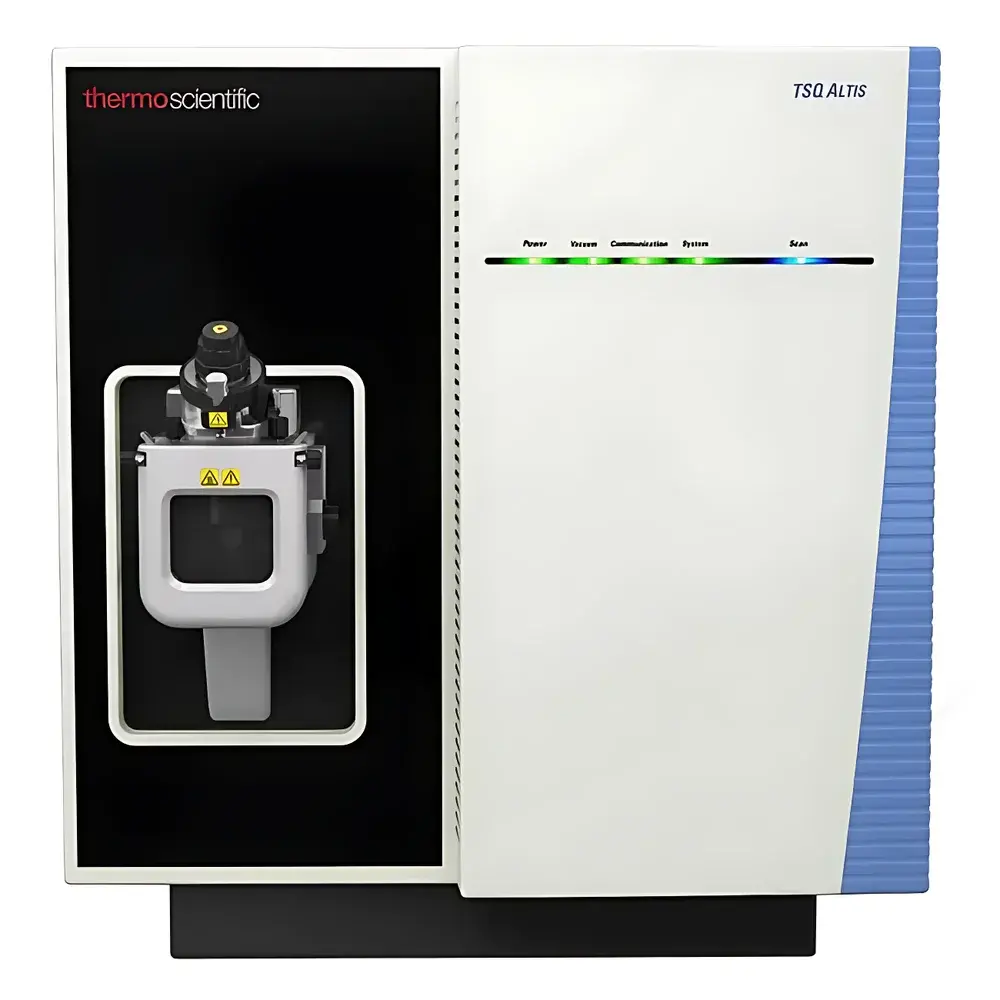
Thermo Fisher TSQ Altis LC-MS/MS Triple Quadrupole Mass Spectrometer
| Brand | Thermo Fisher |
|---|---|
| Origin | USA |
| Manufacturer Type | Original Equipment Manufacturer (OEM) |
| Origin Category | Imported |
| Model | TSQ Altis LC-QQQ |
| Instrument Type | Triple Quadrupole (QqQ) |
| Mass Range | 5–2000 m/z |
| Price Range | USD $135,000–$270,000 (FOB US port, excluding VAT, shipping, installation, or training) |
Overview
The Thermo Fisher TSQ Altis LC-MS/MS is a high-performance triple quadrupole mass spectrometer engineered for robust, high-sensitivity targeted quantitative analysis in regulated and research laboratory environments. Operating on the principle of tandem mass spectrometry (MS/MS) via collision-induced dissociation (CID) in a Q1–q2–Q3 configuration, the system delivers exceptional selectivity and reproducibility for small molecules, peptides, metabolites, and polar pharmaceutical compounds. Its core architecture integrates electrospray ionization (ESI) and atmospheric pressure chemical ionization (APCI) sources with ultra-high-performance liquid chromatography (UHPLC) compatibility, enabling precise retention-time-aligned SRM (Selected Reaction Monitoring) and dMRM (dynamic Multiple Reaction Monitoring) acquisition. Designed for mission-critical applications—including clinical toxicology, bioanalysis, food safety residue testing, and environmental contaminant quantification—the TSQ Altis balances analytical rigor with operational resilience across multi-shift laboratory workflows.
Key Features
- Active Ion Management (AIM™) Technology: Dynamically optimizes ion transmission efficiency by real-time adjustment of RF/DC voltages across the ion path, minimizing signal drift and enhancing sensitivity—particularly for low-abundance analytes in complex biological matrices.
- Segmented Quadrupole Design: Q1 and Q3 employ independently controlled segmented rods to improve mass filtering resolution and reduce cross-talk between adjacent transitions, supporting high-density multiplexed assays without compromising duty cycle.
- Dual-Mode Electron Multiplier Detector: Switches seamlessly between analog (for high-intensity signals) and pulse-counting (for low-level detection) modes, delivering linear dynamic range exceeding 6 orders of magnitude and sub-femtogram LODs for many compounds.
- High-Throughput Ion Transfer Tube: Features heated, low-dead-volume capillary design with active desolvation control to maximize ion transmission from LC eluent to vacuum region while minimizing adduct formation and source contamination.
- Robust Vacuum Architecture: Dual-stage turbomolecular pumping system maintains stable operating pressure (<1×10⁻⁶ Torr in Q2 collision cell) across extended run times—even during gradient elution—ensuring consistent CID efficiency and fragmentation reproducibility.
Sample Compatibility & Compliance
The TSQ Altis supports direct coupling to standard and micro/nano-flow UHPLC systems (e.g., Thermo Vanquish, Waters ACQUITY, Agilent 1290), accommodating flow rates from 100 nL/min to 2 mL/min. It routinely analyzes plasma, serum, urine, tissue homogenates, plant extracts, food digests, and wastewater filtrates—with demonstrated performance in ISO/IEC 17025-accredited labs for pesticide residue testing (EN 15662), veterinary drug monitoring (EU 2021/808), and clinical bioanalysis per FDA Guidance for Industry (2022) and EMA CHMP Guideline (2023). The instrument’s firmware and data system architecture support full audit trail, electronic signature, and 21 CFR Part 11 compliance when deployed with Thermo Scientific Chromeleon CDS or Compound Discoverer software in validated GxP environments.
Software & Data Management
Controlled via Thermo Scientific Tune and Xcalibur software platforms, the TSQ Altis enables method development, acquisition, and post-run processing within a unified interface. Quantitation workflows integrate seamlessly with TraceFinder for automated peak integration, calibration curve fitting (linear/log-linear weighted regression), and QC sample evaluation against pre-defined acceptance criteria (e.g., %CV ≤15%, accuracy ±15%). Raw data files (.raw) are stored in vendor-neutral formats compatible with third-party tools (e.g., Skyline, OpenMS) and enterprise LIMS systems via ODBC or REST API. All processing steps—including integration parameters, calibration model selection, and flagging logic—are fully traceable and exportable for regulatory submission packages.
Applications
- Pharmaceutical bioanalysis: PK/PD studies, metabolite identification support, and impurity profiling in accordance with ICH M10 guidelines.
- Clinical toxicology screening: Simultaneous quantification of opioids, benzodiazepines, stimulants, and novel psychoactive substances in whole blood and oral fluid.
- Food safety: Multi-residue analysis of mycotoxins, veterinary antibiotics, and environmental contaminants (e.g., PFAS, PCBs) at EU ML and FDA action level thresholds.
- Environmental monitoring: Detection of endocrine-disrupting compounds (EDCs), pharmaceutical residues, and microplastic degradation markers in surface water and sediment extracts.
- Academic and industrial metabolomics: Targeted quantification of central carbon metabolism intermediates, amino acids, and acylcarnitines using isotopically labeled internal standards.
FAQ
What ionization sources are supported?
The TSQ Altis ships standard with heated ESI and APCI sources; optional nano-ESI, HESI-II, and dopant-assisted APCI modules are available for specialized applications.
Is the system compatible with non-Thermo UHPLC systems?
Yes—via standard LC-MS interface protocols (e.g., analog voltage output, TTL trigger lines) and configurable dwell time synchronization; validated integrations exist with Waters, Agilent, and Shimadzu platforms.
How is instrument performance verified over time?
Built-in automated calibration routines (e.g., daily tune, weekly mass accuracy verification using polytyrosine or caffeine standards) generate PDF reports compliant with ISO/IEC 17025 Clause 6.4.3 requirements.
Can SRM methods be transferred from older TSQ platforms?
Yes—method import wizards preserve transition lists, dwell times, and collision energies; minor optimization of Q1/Q3 offsets and CE values may be required due to improved mass filter stability.
What maintenance intervals are recommended for routine operation?
Source cleaning every 7–10 days (depending on matrix load), ion transfer tube replacement every 6 months, and turbo pump bearing inspection annually—documented in the Thermo Fisher Preventive Maintenance Guide (P/N MAN0019247).





