
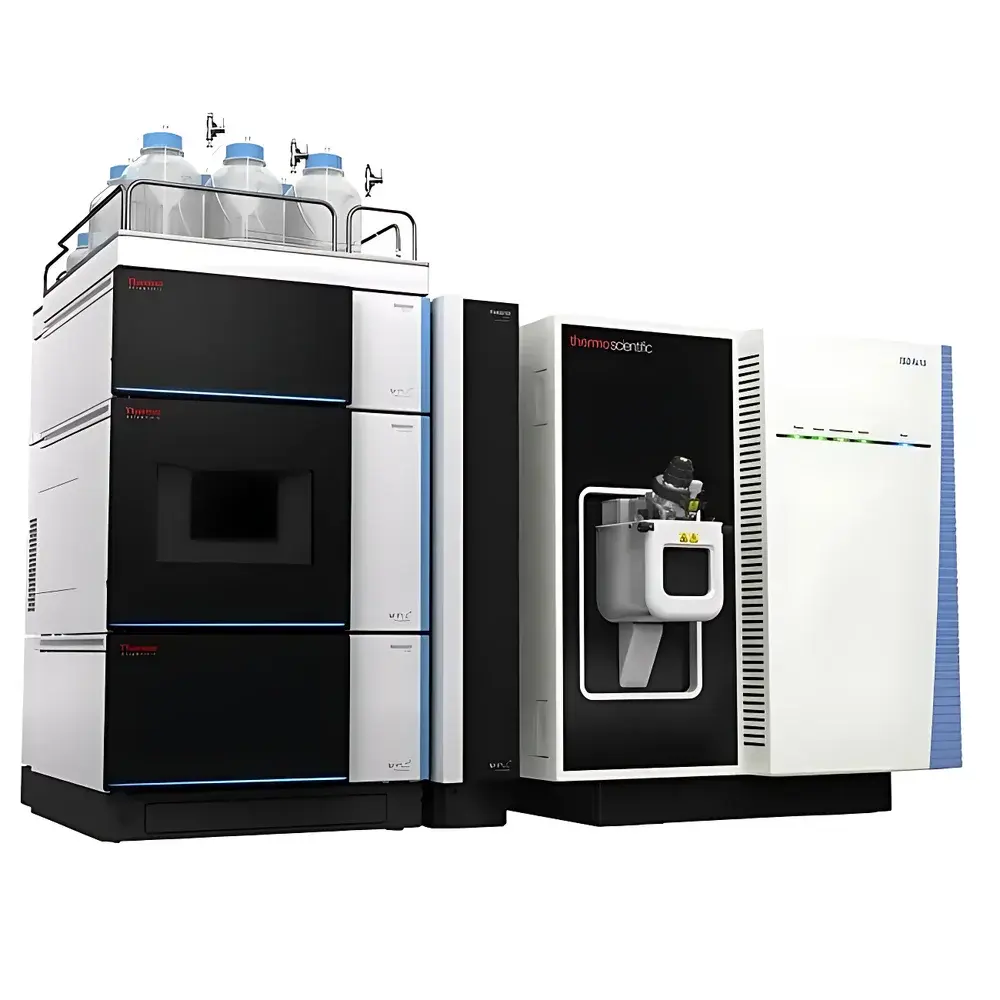
Thermo Fisher TSQ Altis Triple Quadrupole Mass Spectrometer
| Brand | Thermo Fisher |
|---|---|
| Origin | USA |
| Manufacturer Type | Original Equipment Manufacturer (OEM) |
| Import Status | Imported |
| Model | TSQ Altis |
| Instrument Type | Tandem Quadrupole (Triple Quadrupole) |
| Price Range | USD $250,000 – $380,000 (FOB USA) |
Overview
The Thermo Fisher TSQ Altis Triple Quadrupole Mass Spectrometer is a high-performance, benchtop tandem quadrupole mass spectrometer engineered for robust, high-sensitivity quantitative analysis in regulated and research laboratory environments. Operating on the principle of sequential mass filtering—where Q1 selects a precursor ion, Q2 performs collision-induced dissociation (CID), and Q3 analyzes a specific product ion—the TSQ Altis delivers exceptional selectivity and signal-to-noise performance in Selected Reaction Monitoring (SRM) and Multiple Reaction Monitoring (MRM) modes. Designed for seamless integration with ultra-high-performance liquid chromatography (UHPLC) systems, it supports trace-level quantitation across diverse molecular classes—including small molecules, peptides, lipids, metabolites, and pharmaceutical compounds—in complex biological, environmental, and food matrices. Its architecture emphasizes operational stability over extended acquisition periods, minimizing downtime while maintaining consistent calibration and response linearity—critical for GLP-compliant bioanalysis, clinical toxicology, and quality control workflows.
Key Features
- High-efficiency ion transmission optics optimized for maximum sensitivity across broad m/z ranges (5–2000 Da), enabling low-femtogram-level detection limits in SRM mode.
- Advanced Active Ion Management (AIM) technology to maintain stable ion beam focus and reduce source contamination, contributing to >72-hour uninterrupted operation without recalibration.
- Fast-polarity switching (1,000 transitions per run.
- Dual-pressure RF-only collision cell with tunable collision energy and gas flow control, ensuring reproducible fragmentation efficiency across diverse analyte chemistries.
- Integrated vacuum system with dual-stage turbomolecular pumps and intelligent pressure regulation, delivering stable operating pressures in both Q0 and Q3 regions under variable flow conditions (0.2–2.0 mL/min).
- Modular front-end compatibility with electrospray ionization (ESI), atmospheric pressure chemical ionization (APCI), and optional microflow/nano-ESI sources.
Sample Compatibility & Compliance
The TSQ Altis accommodates liquid samples introduced via standard UHPLC, HPLC, or direct infusion, with demonstrated performance for plasma, serum, urine, tissue homogenates, plant extracts, and fortified environmental water samples. It meets essential regulatory design criteria for use in FDA-regulated laboratories, including support for 21 CFR Part 11-compliant audit trails, electronic signatures, and role-based user access controls when operated with Thermo Scientific™ Chromeleon™ Chromatography Data System (CDS) v7.3 or later. Instrument qualification documentation aligns with ASTM E2656 (Standard Guide for Validation of Liquid Chromatography–Mass Spectrometry Systems) and ISO/IEC 17025:2017 requirements for testing laboratories. Routine performance verification follows Thermo’s PQ/QC protocol, covering mass accuracy (±0.1 Da), retention time stability (RSD < 0.2%), and peak area precision (RSD < 3% over 24 h).
Software & Data Management
Controlled via Thermo Scientific™ Xcalibur™ Software v4.5+ or Chromeleon CDS v7.3+, the TSQ Altis supports method development, acquisition scheduling, real-time data review, and automated report generation. Quantitative workflows integrate with QuanBrowser™ for intuitive MRM transition setup, peak integration refinement, and calibration curve fitting (linear, quadratic, or weighted least-squares). All raw data files (.raw) are stored in open-format Thermo RAW format, compatible with third-party processing tools (e.g., Skyline, OpenMS, MS-DIAL) for retrospective analysis. Audit trail logs record all parameter modifications, sequence changes, and user logins with timestamps and IP metadata—fully traceable for internal audits or regulatory inspections.
Applications
- Clinical and forensic toxicology: Quantitation of drugs of abuse, opioids, benzodiazepines, and novel psychoactive substances in whole blood and oral fluid.
- Pharmaceutical development: Bioavailability and pharmacokinetic (PK) studies, impurity profiling, and extractable/leachable analysis per ICH Q5A and Q3B guidelines.
- Food safety: Residue screening of veterinary drugs (e.g., beta-agonists, sulfonamides), mycotoxins, and pesticide multiresidue panels at EU MRL-compliant levels.
- Environmental monitoring: Detection of endocrine-disrupting compounds (EDCs), per- and polyfluoroalkyl substances (PFAS), and persistent organic pollutants (POPs) in wastewater and soil extracts.
- Metabolomics and lipidomics: Targeted quantitation of polar metabolites (e.g., amino acids, organic acids) and glycerophospholipid species using stable isotope-labeled internal standards.
FAQ
What is the typical mass range and resolution capability of the TSQ Altis?
The instrument operates across a nominal mass range of m/z 5–2000 with unit mass resolution in both Q1 and Q3; resolution is fixed by quadrupole rod geometry and RF/DC voltage settings—not software-tunable.
Does the TSQ Altis support scheduled MRM acquisition?
Yes—it supports retention time–based scheduling with dynamic dwell time allocation, optimizing sensitivity and cycle time for large-scale targeted assays.
Can the system be validated for GMP/GLP compliance?
Yes—when deployed with validated software versions and documented IQ/OQ/PQ protocols, it fulfills core instrumentation requirements for GMP and GLP environments.
Is remote monitoring and diagnostics available?
Instrument status, vacuum levels, detector gain, and recent error logs can be accessed remotely via secure HTTPS interface integrated into Chromeleon CDS.
What maintenance intervals are recommended for routine operation?
Source cleaning every 2–4 weeks (depending on sample load), ion transfer tube replacement every 6 months, and annual preventive maintenance including RF amplifier calibration and detector verification.
Related Products




