
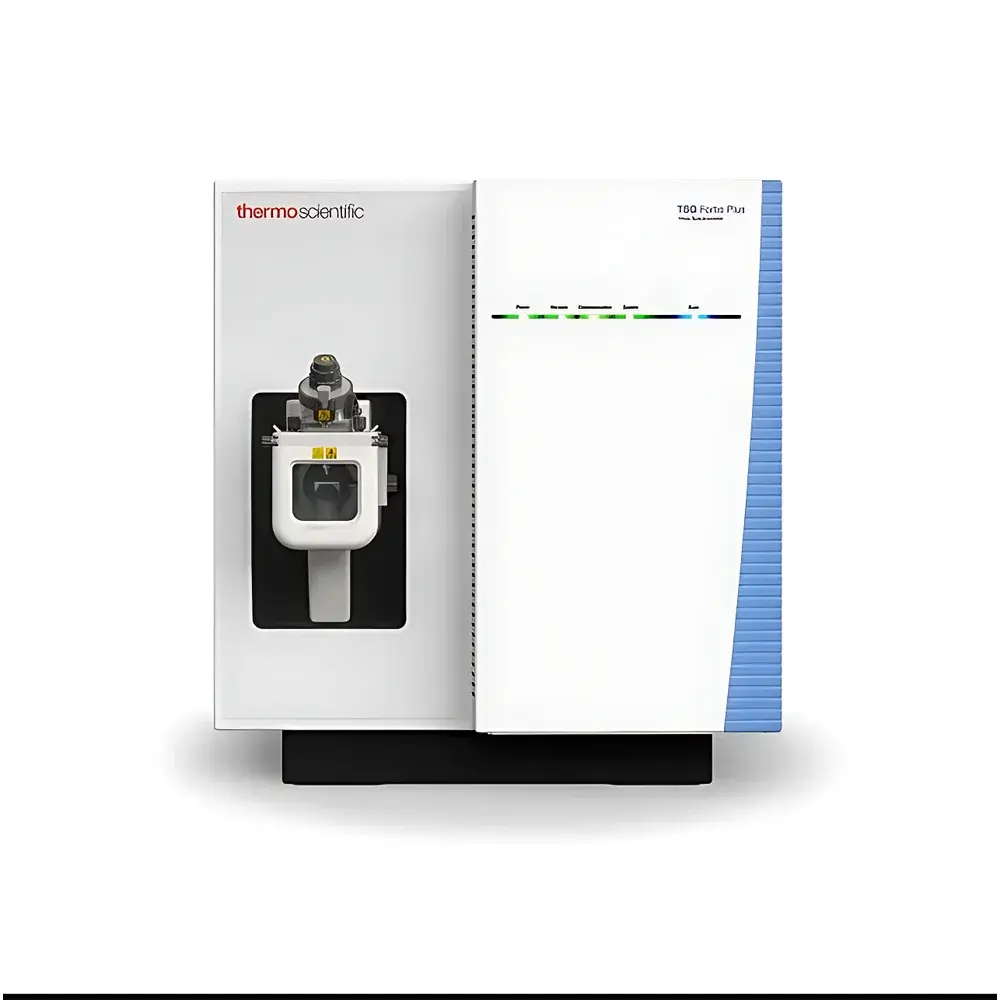
Thermo Fisher TSQ Fortis Plus Triple Quadrupole Mass Spectrometer
| Brand | Thermo Fisher |
|---|---|
| Origin | Germany |
| Manufacturer Type | Original Equipment Manufacturer (OEM) |
| Product Origin | Imported |
| Model | TSQ Fortis Plus Triple Quadrupole Mass Spectrometer |
| Instrument Type | Tandem Quadrupole (QQQ) |
| Application Scope | General-Purpose LC-MS/MS Analysis |
| Mass Range | 2–3000 m/z |
| Resolution | 35–100 m/z |
Overview
The Thermo Fisher TSQ Fortis Plus Triple Quadrupole Mass Spectrometer is a high-performance, robust tandem quadrupole (QQQ) system engineered for precision quantitative analysis in liquid chromatography–mass spectrometry (LC-MS/MS) workflows. Operating on the well-established triple quadrupole principle—where Q1 selects precursor ions, Q2 serves as a collision-induced dissociation (CID) cell, and Q3 analyzes product ions—the TSQ Fortis Plus delivers exceptional sensitivity, specificity, and reproducibility across diverse analytical domains. Designed as an evolutionary upgrade within the TSQ platform lineage, it maintains full backward compatibility with existing TSQ methods and method packages, enabling seamless migration without re-optimization. Its architecture supports routine compliance-critical applications in regulated environments, including those governed by FDA 21 CFR Part 11, USP , and ICH guidelines for method validation.
Key Features
- Method Transfer Compatibility: Direct import and execution of validated SRM/MRM methods developed on legacy TSQ systems—including TSQ Quantum, TSQ Vantage, and TSQ Altis—without recalibration or parameter adjustment.
- mzCloud-Integrated SRM Workflow: Native integration with mzCloud, Thermo Fisher’s cloud-based high-resolution MSn spectral library, enables one-click extraction of optimal precursor→product ion transitions directly from spectral trees, significantly accelerating MRM method development.
- 5-ms Polarity Switching: Achieves full positive/negative mode switching—including settling time—in ≤5 ms, facilitating simultaneous detection of analytes with opposing ionization behaviors in a single run.
- Enhanced Low-m/z Ion Transmission: Redesigned Q2 collision cell improves transmission efficiency for fragment ions below m/z 50 (e.g., halogenated acetic acids, genotoxic impurities), delivering higher signal-to-noise ratios and improved assay robustness.
- Priority-Based Dwell Time Allocation: Intelligent dwell time scheduling algorithm prioritizes longer dwell times for low-abundance analytes while maintaining cycle time integrity—critical for multi-analyte assays requiring high quantitative precision.
Sample Compatibility & Compliance
The TSQ Fortis Plus interfaces seamlessly with all major UHPLC systems and accommodates a broad range of sample matrices—including plasma, urine, tissue homogenates, environmental water extracts, food digests, and pharmaceutical formulations—following standard protein precipitation, solid-phase extraction (SPE), or dilute-and-shoot preparation protocols. It meets essential regulatory requirements for GLP and GMP laboratories: audit trail functionality, electronic signature support, user access control, and data integrity safeguards compliant with ALCOA+ principles. All instrument control and data acquisition are fully compatible with Thermo Fisher’s Chromeleon CDS and Compound Discoverer software, supporting 21 CFR Part 11-compliant workflows out-of-the-box.
Software & Data Management
Controlled via Thermo Fisher’s latest version of Xcalibur software (v4.5+), the TSQ Fortis Plus supports automated calibration, real-time diagnostic monitoring, and integrated QC reporting. mzCloud access is embedded directly into the method editor, allowing users to search, visualize, and validate fragmentation pathways using >8.6 million experimentally acquired spectra across ~20,000 compounds. Spectral Tree navigation supports hierarchical interpretation of MS2 and MS3 data, enhancing confidence in structural elucidation. Raw data files (.raw) are stored in vendor-neutral formats compatible with third-party quantitation platforms (e.g., Skyline, MultiQuant) and LIMS integrations via standard API protocols.
Applications
The TSQ Fortis Plus serves as a foundational platform for quantitative targeted analysis in multiple regulated and research-intensive sectors:
- Pharmaceutical Quality Control: Residual solvent analysis, elemental impurity testing (ICH Q3D), and genotoxic impurity quantification per ICH M7.
- Clinical Toxicology & Therapeutic Drug Monitoring: Multi-analyte panels for antidepressants, antipsychotics, immunosuppressants, and opioids in whole blood or dried blood spots.
- Food Safety & Authenticity: Pesticide residue screening (EU SANTE/11312/2021), mycotoxin quantification (AOAC 2012.05), and veterinary drug monitoring (Commission Decision 2002/657/EC).
- Environmental Analysis: PFAS quantification (EPA Method 1633), endocrine disruptors (e.g., bisphenols, phthalates), and emerging contaminants in wastewater and soil leachates.
- Metabolomics & Biomarker Discovery: Targeted quantitation of polar metabolites (e.g., amino acids, organic acids, acylcarnitines) using stable isotope-labeled internal standards.
FAQ
Is the TSQ Fortis Plus compatible with existing TSQ method libraries?
Yes—validated SRM methods from prior TSQ instruments (TSQ Quantum, Vantage, Altis, Endura) can be imported and executed without modification.
Does mzCloud require a subscription or license fee?
No—mzCloud is freely accessible to all registered Thermo Fisher customers and does not require additional licensing.
What is the minimum dwell time supported in priority-based scheduling?
Dwell times can be configured down to 1 ms per transition, with dynamic allocation based on user-defined priority tiers.
Can the system operate under GLP-compliant data integrity requirements?
Yes—the instrument control software includes full 21 CFR Part 11 compliance features, including electronic signatures, audit trails, and role-based access controls.
Is the Q2 collision cell design proprietary to the TSQ Fortis Plus?
Yes—the redesigned RF-only Q2 cell employs optimized rod geometry and DC bias profiles to enhance transmission efficiency for low-mass fragments, distinguishing it from earlier TSQ generation hardware.
Related Products





