
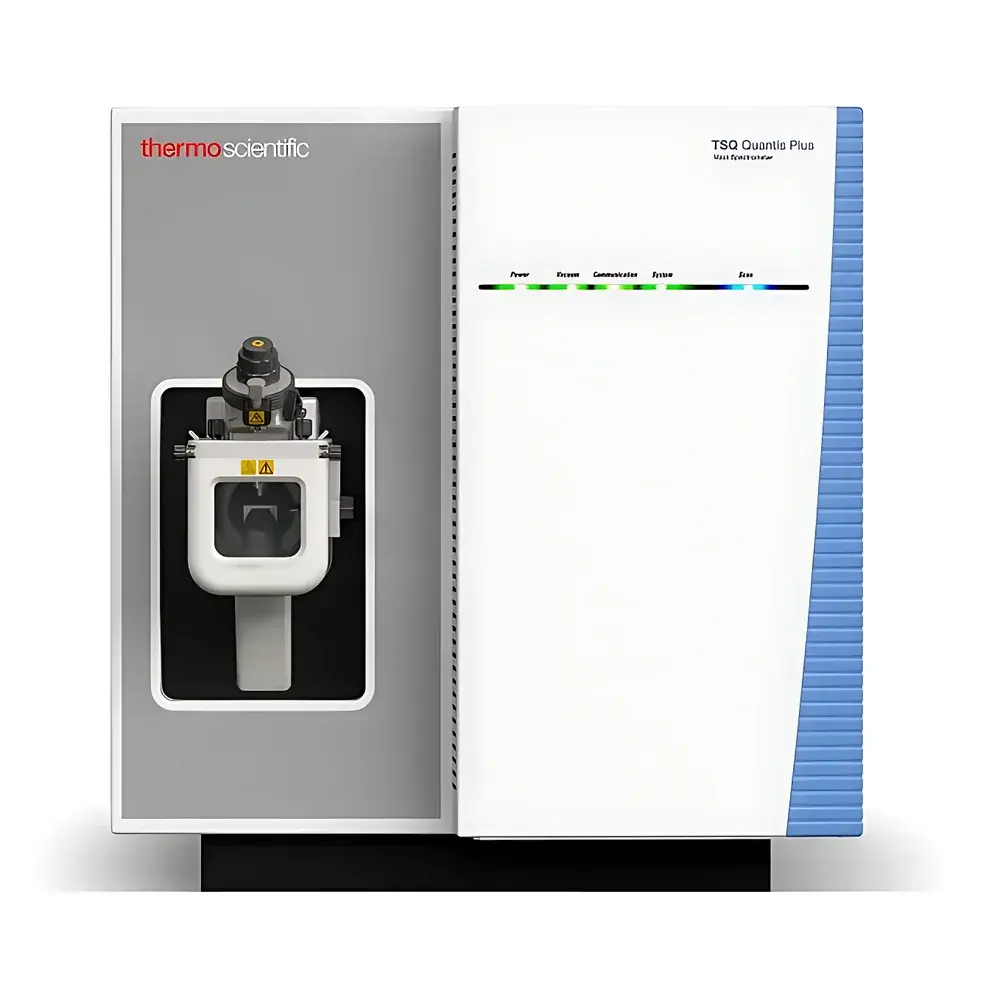
Thermo Fisher TSQ Quantis Plus Triple Quadrupole Mass Spectrometer
| Brand | Thermo Fisher |
|---|---|
| Origin | Germany |
| Manufacturer Type | Original Equipment Manufacturer (OEM) |
| Origin Category | Imported Instrument |
| Model | TSQ Quantis Plus |
| Instrument Type | Tandem Quadrupole (QqQ) |
| Application Scope | Specialized Use |
| Mass Range | 2–3000 m/z |
Overview
The Thermo Fisher TSQ Quantis Plus is a high-performance triple quadrupole mass spectrometer engineered for robust, quantitative liquid chromatography–mass spectrometry (LC-MS/MS) analysis. Operating on the well-established QqQ principle—where Q1 selects precursor ions, Q2 serves as a collision-induced dissociation (CID) cell, and Q3 analyzes product ions—the TSQ Quantis Plus delivers exceptional sensitivity, specificity, and reproducibility across demanding application domains including pharmaceutical quality control, clinical toxicology, environmental contaminant monitoring, food safety testing, and forensic analysis. Designed and manufactured in Germany, the instrument integrates hardware refinements with intelligent software architecture to support regulated and research-driven laboratories requiring compliance-ready workflows and method portability.
Key Features
- Seamless Method Transfer: Fully backward-compatible with existing TSQ platform methods—no re-optimization required when migrating from legacy TSQ systems (e.g., TSQ Vantage, TSQ Altis) to TSQ Quantis Plus. Retains identical SRM transition definitions, dwell times, and scan parameters while delivering equal or improved signal-to-noise ratios.
- 5 ms Polarity Switching: Achieves stable, reproducible polarity switching—including full circuit stabilization—in ≤5 milliseconds, enabling comprehensive simultaneous positive/negative ion mode acquisition within a single LC run without sacrificing duty cycle or quantitative precision.
- Redesigned Q2 Collision Cell: Features an optimized RF-only multipole geometry and enhanced low-mass ion transmission efficiency, significantly improving detection sensitivity and stability for fragment ions below m/z 50—critical for halogenated acetic acids, genotoxic impurities, and small-molecule metabolites.
- Dwell Time Priority Scheduling: Software-controlled prioritization logic dynamically allocates longer dwell times to low-abundance analytes during scheduled MRM acquisition, ensuring consistent peak integration and inter-run reproducibility without manual dwell time redistribution.
- Integrated mzCloud Workflow Acceleration: Direct import of validated SRM transitions from the mzCloud spectral library—hosted and maintained by Thermo Fisher—eliminates manual transition selection. Each entry includes experimentally derived MS/MS spectra acquired at multiple collision energies on Thermo instruments, supporting confident method setup for unknowns and emerging contaminants.
Sample Compatibility & Compliance
The TSQ Quantis Plus is compatible with all major LC platforms, including UltiMate 3000 and Vanquish UHPLC systems, and supports electrospray ionization (ESI), atmospheric pressure chemical ionization (APCI), and optional dopant-assisted techniques. Its hardware design and firmware architecture comply with international regulatory expectations for analytical instrumentation: data integrity safeguards align with FDA 21 CFR Part 11 requirements; audit trail functionality supports GLP/GMP-compliant environments; and method validation protocols conform to ICH Q2(R2), USP <1225>, and ISO/IEC 17025 standards. The instrument is routinely deployed in laboratories undergoing regulatory inspections for pharmaceutical release testing and clinical biomarker quantification.
Software & Data Management
Controlled via Thermo Scientific Compound Discoverer and TraceFinder software suites, the TSQ Quantis Plus supports automated peak integration, batch processing, calibration curve generation, and report export in PDF, CSV, and XML formats. All raw data files adhere to the open mzML standard, facilitating third-party reprocessing and long-term archival. Built-in electronic signatures, user role-based access control, and immutable audit trails meet stringent data governance mandates. Integration with LIMS platforms is supported through standard ODBC and RESTful API interfaces, enabling traceable sample-to-result workflows in centralized QA/QC operations.
Applications
- Quantitative residue analysis of pesticides, veterinary drugs, and mycotoxins in complex food matrices (per EU SANTE/11312/2021 guidelines)
- Genotoxic impurity screening and verification in active pharmaceutical ingredients (APIs) per ICH M7(R2)
- High-throughput therapeutic drug monitoring (TDM) and endogenous biomarker quantification in plasma and urine (CLIA-waived and CAP-accredited labs)
- Targeted metabolomics and exposome studies using stable-isotope dilution assays (SIDA)
- Forensic toxicology screening for novel psychoactive substances (NPS) and designer drugs using spectral library matching against mzCloud
- Environmental analysis of PFAS, brominated flame retardants, and chlorinated hydrocarbons in water and soil extracts
FAQ
Is the TSQ Quantis Plus compatible with non-Thermo LC systems?
Yes—it accepts standard analog and digital trigger signals from third-party HPLC/UHPLC systems, provided synchronization timing and voltage levels comply with Thermo’s interface specifications.
Does mzCloud require a subscription or license fee?
No—mzCloud is freely accessible to all registered users and does not require additional licensing beyond instrument ownership.
Can the TSQ Quantis Plus perform untargeted analysis?
While primarily optimized for targeted MRM quantitation, it supports selected reaction monitoring (SRM), pseudo-MS3, and data-dependent acquisition (DDA) modes for limited semi-targeted applications; however, high-resolution accurate-mass platforms (e.g., Orbitrap systems) are recommended for broad untargeted discovery.
What is the typical maintenance interval for the ion source and detector?
Under routine operation (≤8 h/day, clean matrices), the ESI source requires cleaning every 2–4 weeks, and the electron multiplier detector typically lasts 18–24 months before replacement.
How is system suitability verified during method validation?
TraceFinder software includes automated system suitability test (SST) modules compliant with USP <1225> and EP 2.2.46, evaluating retention time stability, peak area RSD, LLOQ precision, and carryover across defined QC injections.



