
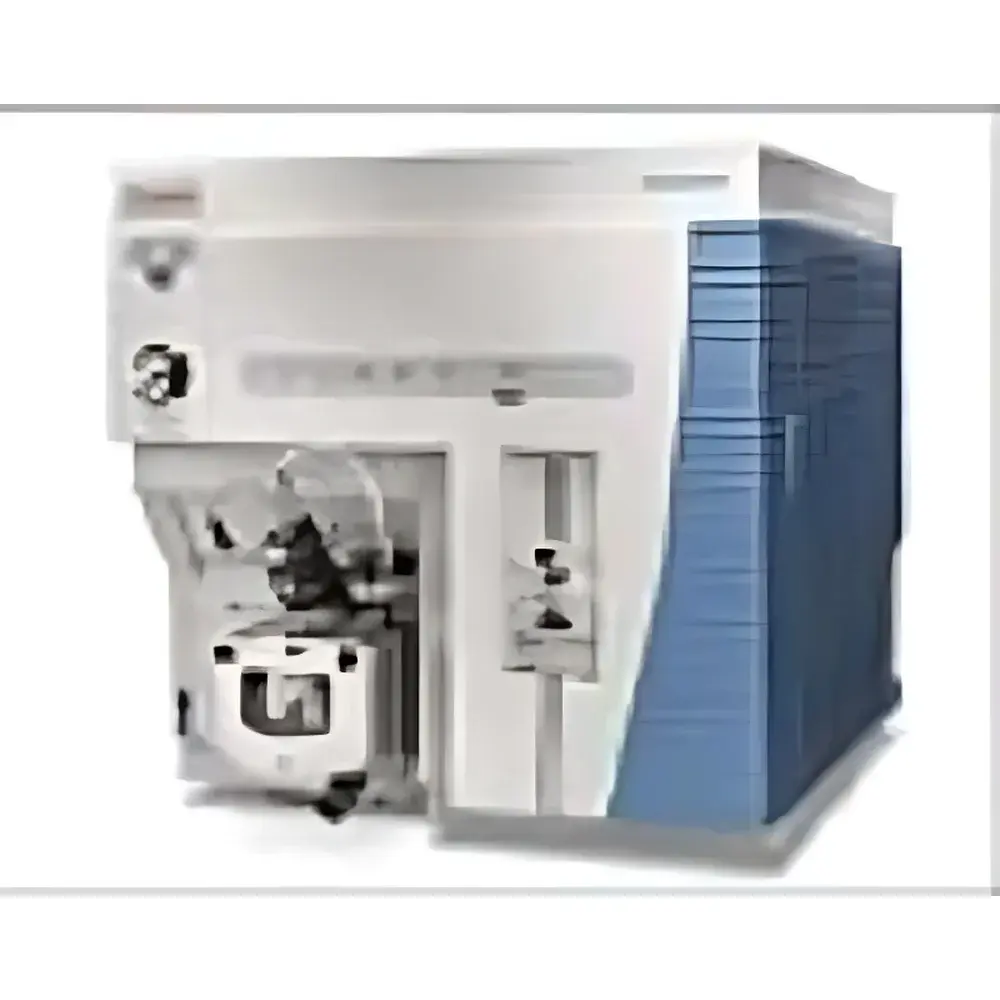
Thermo Fisher TSQ Vantage Triple Quadrupole Liquid Chromatography Mass Spectrometer
| Brand | Thermo Fisher |
|---|---|
| Origin | USA |
| Manufacturer Type | Original Equipment Manufacturer (OEM) |
| Origin Category | Imported |
| Model | TSQ Vantage |
| Instrument Type | Tandem Quadrupole (Triple Quadrupole) |
| Configuration | LC-MS/MS System |
Overview
The Thermo Fisher TSQ Vantage is a high-performance triple quadrupole liquid chromatography–mass spectrometry (LC-MS/MS) system engineered for ultra-sensitive, highly selective, and reproducible quantitative analysis of small molecules, peptides, and biotherapeutics. It operates on the principle of tandem mass spectrometry using three quadrupole mass filters in sequence: Q1 (precursor ion selection), Q2 (collision-induced dissociation cell), and Q3 (product ion analysis). This architecture enables robust Selected Reaction Monitoring (SRM) and Multiple Reaction Monitoring (MRM) workflows—cornerstone techniques for regulated bioanalysis, clinical toxicology, environmental monitoring, and pharmaceutical development.
Key Features
- G2 Ion Optics System: A second-generation electrostatic ion guide that captures and transports >90% of ions generated at the source into the high-vacuum region—significantly increasing signal intensity without amplifying chemical noise.
- S-lens Ion Optics: A curved, multi-element electrostatic lens assembly that eliminates mass discrimination across the full m/z range (5–2000 Da), improves vacuum efficiency, and reduces gas load on turbo-molecular pumps—extending maintenance intervals and sustaining long-term sensitivity.
- HESI-II Source: Heated Electrospray Ionization II probe with enhanced desolvation efficiency, enabling stable operation at flow rates up to 1.2 mL/min without signal suppression or source contamination.
- G2 Collision Cell: A high-speed, low-cross-talk collision chamber delivering up to 10× faster SRM cycle times while maintaining zero inter-channel interference—even during rapid sequential monitoring of >3,000 analytes per run.
- HyperQua Quadrupole Technology: Curved-surface hyperbolic rods providing superior resolution, reduced background chemical noise, and improved duty cycle in MRM mode—particularly beneficial for complex biological matrices.
Sample Compatibility & Compliance
The TSQ Vantage supports diverse sample types including plasma, serum, urine, tissue homogenates, cell lysates, and environmental extracts. Its robust ion transmission pathway and low-noise detection architecture deliver consistent performance across challenging matrices—enabling reliable quantification down to sub-pg/mL levels. The system complies with international regulatory requirements for method validation, including ICH M10, FDA Bioanalytical Method Validation Guidance (2018), EMA Guideline on Bioanalytical Method Validation (2011), and USP <1225>. When operated with validated software configurations (e.g., LCquan v2.10+), it meets audit-trail, electronic signature, and data integrity criteria aligned with 21 CFR Part 11 and Annex 11 for GLP/GMP environments.
Software & Data Management
Data acquisition and processing are performed using Thermo Scientific LCquan software—a purpose-built platform for quantitative LC-MS/MS workflows. LCquan supports automated calibration, peak integration, batch processing, and report generation with full traceability. Integration with Watson LIMS (Laboratory Information Management System) enables end-to-end sample tracking, audit logging, role-based access control, and electronic record retention compliant with ALCOA+ principles. All raw data files (.raw) are stored in vendor-neutral formats compatible with third-party reprocessing tools, ensuring long-term archival integrity and cross-platform interoperability.
Applications
- Quantitative bioanalysis of small-molecule drugs and metabolites in preclinical and clinical studies
- High-throughput screening of biomarkers and endogenous compounds in proteomics and metabolomics
- Residue analysis of pesticides, veterinary drugs, and mycotoxins in food and agricultural commodities
- Environmental monitoring of pharmaceuticals, personal care products, and industrial contaminants in water and soil
- Support of biosimilar characterization through peptide mapping and post-translational modification analysis
FAQ
What distinguishes the TSQ Vantage from earlier TSQ Quantum systems?
The TSQ Vantage introduces G2 ion optics, S-lens architecture, HESI-II source, and HyperQua quadrupoles—collectively delivering up to 10× higher signal-to-noise ratio, improved scan speed, lower chemical noise, and extended operational stability compared to TSQ Quantum platforms.
Does the TSQ Vantage support 21 CFR Part 11 compliance?
Yes—when deployed with LCquan software configured in validated mode and integrated with Watson LIMS, the system supports electronic signatures, audit trails, user authentication, and data security controls required under 21 CFR Part 11 and EU Annex 11.
Can the TSQ Vantage handle high-flow LC methods (>1 mL/min)?
Yes—the HESI-II ion source is specifically optimized for robust ionization at flow rates up to 1.2 mL/min, eliminating the need for flow splitting or post-column dilution in many applications.
How does the G2 collision cell eliminate cross-talk in fast MRM methods?
By actively clearing residual product ions from the collision cell before introducing the next precursor ion, the G2 design prevents carryover between adjacent MRM transitions—ensuring zero inter-channel interference even at cycle times below 50 ms.
Is the TSQ Vantage suitable for regulated bioanalysis in GLP laboratories?
Yes—it has been widely adopted in contract research organizations (CROs) and pharmaceutical QA/QC labs for validated bioanalytical assays supporting IND/NDA submissions, with documented performance in accordance with ICH M10 and FDA BMV guidelines.




