
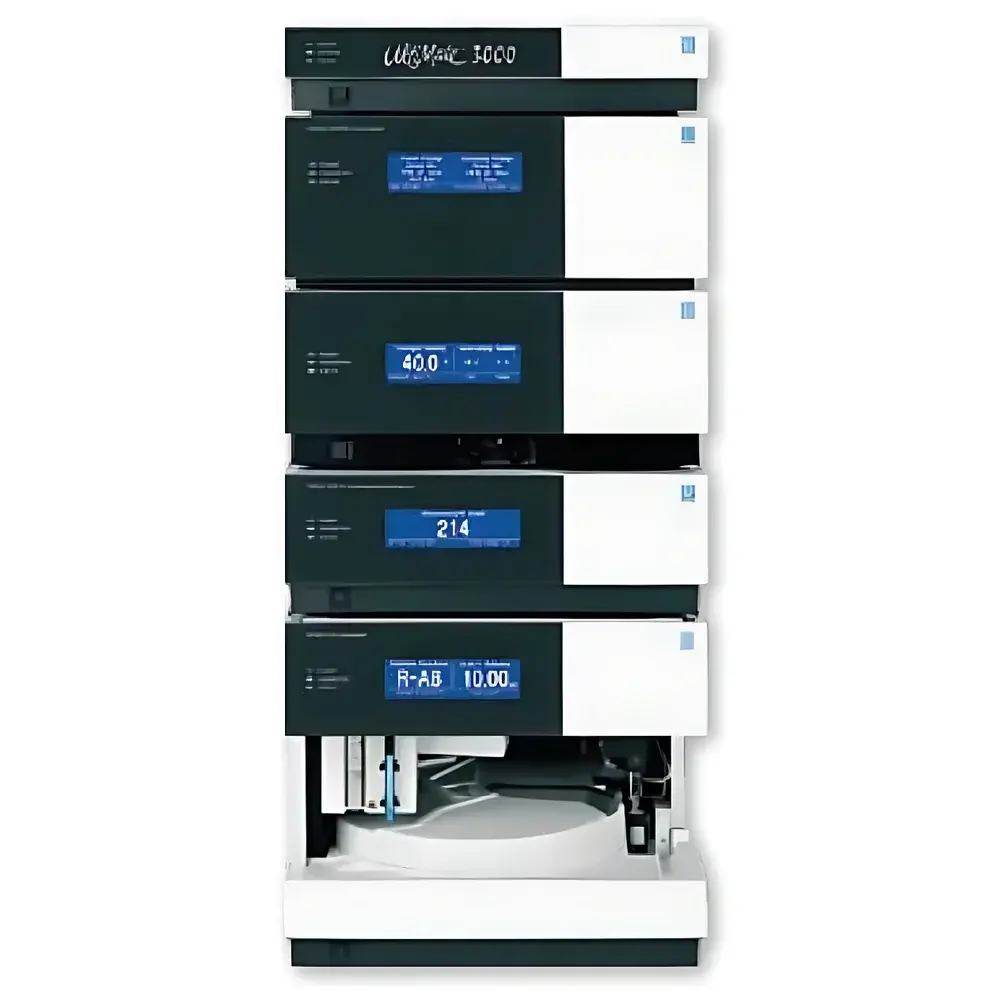
Thermo Fisher UltiMate 3000 UHPLC+ High-Performance Liquid Chromatography System
| Brand | Thermo Fisher |
|---|---|
| Origin | Germany |
| Manufacturer Type | Original Equipment Manufacturer (OEM) |
| Product Category | Imported Instrument |
| Model | UHPLC+ |
| Instrument Type | Conventional HPLC with Full UHPLC Compatibility |
| Maximum System Pressure | 620 bar (Standard Analytical), 1000 bar (RSLC), 800 bar (RSLCo Column Rating) |
| Flow Rate Range | 20 nL/min – 10 mL/min |
| Data Acquisition Rate | Up to 100 Hz |
| Detector Options | UV-Vis, Fluorescence, Refractive Index, Corona CAD, Coulometric Electrochemical, MS (via DCMSLINK™) |
Overview
The Thermo Fisher UltiMate 3000 UHPLC+ is a modular, high-fidelity liquid chromatography platform engineered for seamless transition between conventional HPLC and ultra-high-performance liquid chromatography (UHPLC) operational regimes. Unlike legacy systems constrained by fixed pressure or flow architecture, the UHPLC+ integrates multiple pump configurations—binary, quaternary, dual-triple, and nano-capillary—within a unified hardware and software ecosystem. Its core design principle centers on pressure- and flow-agnostic method transfer: analytical methods developed on standard HPLC instruments can be directly deployed on UHPLC+ modules without re-optimization, provided column dimensions and particle size comply with system hydraulic constraints. This interoperability stems from consistent dwell volume control, low dispersion fluidic pathways, and real-time pressure-compensated gradient delivery—critical for reproducible retention time alignment across platforms. The system operates on the fundamental chromatographic principle of differential partitioning in a pressurized mobile phase, enabling separation of complex mixtures based on polarity, size, charge, or affinity. It is validated for routine use in regulated environments including pharmaceutical QC, environmental monitoring, clinical research, and proteomics workflows.
Key Features
- Modular architecture supporting four distinct operational tiers: RSLCo (nano/capillary), RSLC (ultra-high-pressure binary/quaternary/dual-triple), Standard Analytical, and Basic Automated configurations—all sharing common firmware, software interface, and consumables compatibility.
- Dual-triple gradient system enables true two-dimensional LC (2D-LC) operation with automated fraction collection, online SPE coupling, and parallel/serial column switching—eliminating manual intervention between runs.
- Viper™ and oViper™ fingertight fitting system delivers zero-dead-volume connections across stainless steel, fused silica, and PEEK tubing; compatible with columns from all major vendors and rated to 1000 bar.
- NanoViper™ fittings standard on RSLCo systems ensure leak-free, repeatable connections at sub-µL/min flow rates—essential for reproducible peptide mapping and bottom-up proteomics.
- Integrated ACC-3000 autosampler/column thermostat unit provides precise temperature control (4–80 °C) for both sample tray and analytical column, minimizing thermal band broadening and improving retention time stability.
- High-speed data acquisition (up to 100 Hz) synchronized with pressure feedback ensures accurate peak integration under steep gradient conditions typical of UHPLC methods.
Sample Compatibility & Compliance
The UltiMate 3000 UHPLC+ accommodates diverse sample matrices—including biological fluids (plasma, urine, CSF), environmental extracts (soil leachates, wastewater), pharmaceutical formulations, and synthetic polymers—without requiring hardware modification. Its wide dynamic flow range (20 nL/min to 10 mL/min) supports capillary, microbore, analytical, and preparative-scale separations using reversed-phase, HILIC, ion-exchange, SEC, and chiral stationary phases. All configurations meet ISO/IEC 17025 requirements for testing laboratories and support full audit trails per FDA 21 CFR Part 11 when deployed with Chameleon 7 software in electronic record mode. System qualification documentation includes IQ/OQ/PQ protocols aligned with ASTM E2656 (Standard Guide for Validation of Chromatographic Methods) and USP (Chromatography). Column hardware complies with ANSI/SCTE 20.1 mechanical standards for HPLC fittings.
Software & Data Management
Chameleon 7 Chromatography Data System (CDS) serves as the unified control and analysis engine for the entire UHPLC+ platform. Its eWorkflow™ module guides users through sequence setup via contextual prompts—automatically populating injection parameters, gradient profiles, and detector settings based on selected application templates. Raw data files (.raw) are stored in vendor-neutral format compliant with ASTM E1946-22 (Standard Practice for Chromatographic Data Exchange). The D-Library™ web-based application repository allows search-by-analyte, matrix, column chemistry, or regulatory guideline (e.g., ICH Q2(R2), EPA Method 8330B), returning fully executable Chameleon method files with embedded calibration curves and reporting templates. Audit trail functionality logs all user actions—including method edits, sequence modifications, and result reprocessing—with immutable timestamps and operator ID linkage. Integration with LIMS is supported via OPC UA and HL7 interfaces.
Applications
The UHPLC+ platform demonstrates proven utility across multiple regulated and discovery-driven domains. In biopharmaceutical development, it enables intact mAb analysis using SEC-UHPLC at 0.3 mL/min with 1.7 µm particles, achieving baseline resolution of aggregates within 8 minutes. For clinical toxicology, dual-triple RSLC configurations perform online SPE-LC-MS/MS quantification of benzodiazepines in whole blood with <5% CV inter-day precision. Environmental labs utilize RSLCo systems for untargeted screening of PFAS compounds in drinking water at sub-ng/L levels using 75 µm × 15 cm Acclaim PepMap RSLC columns. Food safety applications include mycotoxin profiling in cereals via gradient HILIC-UHPLC with Corona CAD detection—delivering linear response over three orders of magnitude (0.1–100 ng/mL). All applications benefit from identical data processing logic across instrument tiers, ensuring method scalability from research to release testing.
FAQ
Is the UHPLC+ system compliant with 21 CFR Part 11 for electronic records and signatures?
Yes—when configured with Chameleon 7 in secure mode, full audit trail logging, user access controls, and electronic signature capture are enabled per FDA requirements.
Can I run legacy HPLC methods on UHPLC+ hardware without revalidation?
Method transfer is supported under defined conditions: column geometry must remain unchanged, dwell volume differences accounted for, and system dispersion verified per USP . Full revalidation is required only for changes impacting critical quality attributes.
What is the maximum allowable backpressure for the RSLCo configuration?
The RSLCo pump is rated to 800 bar continuous pressure; however, column hardware (e.g., Acclaim PepMap RSLC) is rated to 1000 bar, permitting use with sub-2 µm particles at elevated flow rates.
Does the Viper fitting system require torque tools or specialized training?
No—Viper and oViper fittings are manually tightened to finger-tight specification; no torque wrenches or calibration are needed, reducing operator variability and maintenance overhead.
How does the dual-triple configuration improve throughput in regulated QC labs?
It enables uninterrupted analysis via parallel column regeneration: while one column elutes, the second equilibrates—reducing cycle time by up to 40% versus single-pump systems without compromising method robustness.
Related Products






