
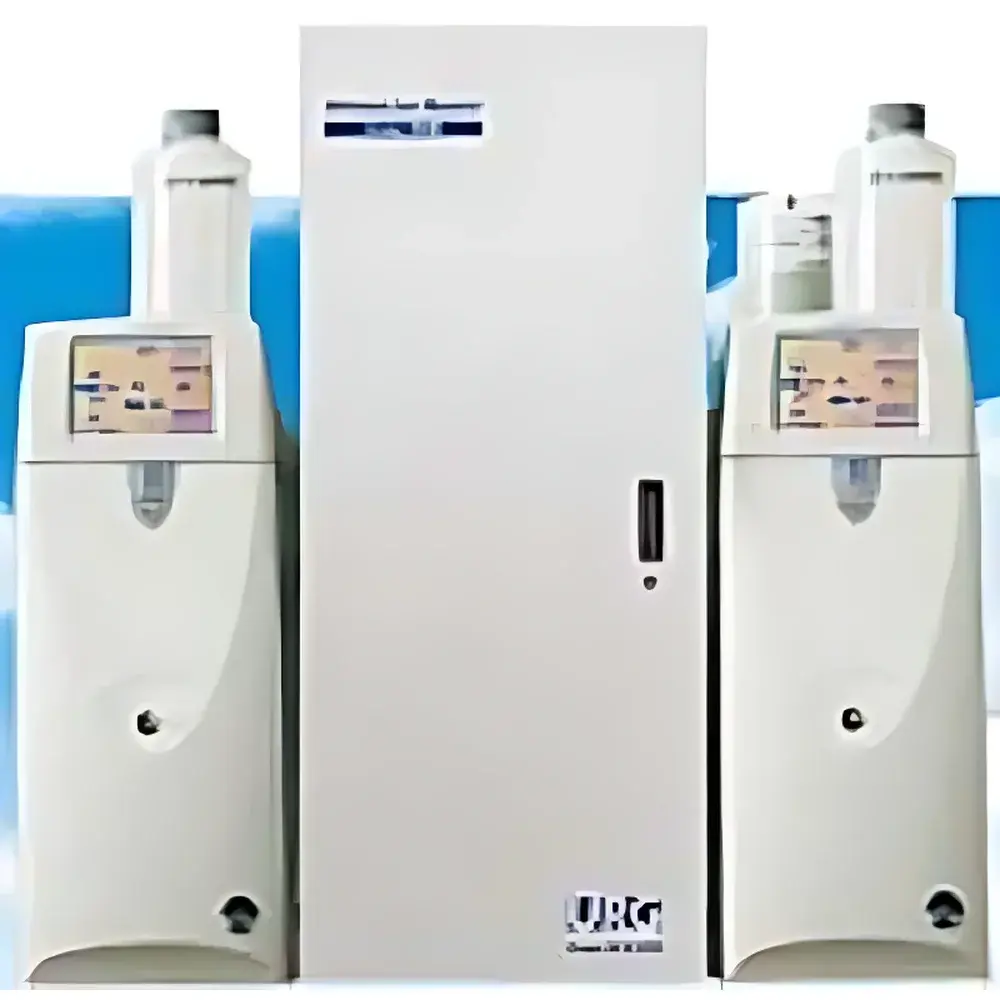
Thermo Fisher URG-9000 Series Online Ion Chromatography System for Real-Time Atmospheric Aerosol and Gaseous Ion Monitoring
| Brand | Thermo Fisher |
|---|---|
| Origin | USA |
| Manufacturer Type | Original Equipment Manufacturer (OEM) |
| Origin Category | Imported |
| Model | URG-9000 |
| Instrument Type | Aerosol and Gaseous Ion Monitor |
| Detection Principle | Dual-Channel Suppressed Ion Chromatography with Wet Parallel-Plate Denuder Sampling |
Overview
The Thermo Fisher URG-9000 Series is a fully automated, real-time online monitoring system engineered for simultaneous quantification of water-soluble ionic species in both atmospheric aerosols (particulate matter) and gaseous pollutants. It integrates high-performance suppressed ion chromatography (IC) with a dual-path sampling architecture—separating aerosol and gas phases upstream—to eliminate cross-contamination and ensure analyte integrity. Unlike conventional filter-based offline methods—which suffer from post-sampling artifact formation, evaporation losses of volatile ions (e.g., NH₄⁺, NO₃⁻, HCOO⁻), and inability to resolve sub-hourly chemical dynamics—the URG-9000 delivers time-resolved data with a minimum cycle time of 15 minutes (standard operation: 60 min). Its design adheres to fundamental principles of atmospheric chemistry measurement: quantitative phase separation, kinetic-optimized gas absorption, and chromatographic resolution validated against reference methods per EPA TO-14A, ISO 10108, and ASTM D7435.
Key Features
- Dual independent IC channels: One dedicated to aerosol-derived anions/cations; the other to gaseous-phase ions—enabling concurrent, interference-free analysis
- Wet parallel-plate denuder (WPPD) with selective semi-permeable membrane: Achieves ≥99.7% absorption efficiency for SO₂ (validated at ppmv levels using 5 mM H₂O₂ absorbent); unaffected by co-present NO/NO₂ up to ambient-relevant concentrations
- Low-volume micro-injection (≤100 µL): Enhances detection sensitivity while extending column lifetime and reducing operational cost
- Chemical suppression technology: Anion suppression with CO₂ removal and cation suppression via methanesulfonic acid regeneration—enabling sub-ppb detection limits for F⁻, Cl⁻, NO₂⁻, NO₃⁻, SO₄²⁻, Na⁺, NH₄⁺, K⁺, Mg²⁺, Ca²⁺, and extended-range cations including Li⁺, Sr²⁺, Ba²⁺
- “Water-only” maintenance mode: Eliminates need for daily eluent or regenerant solution changes; typical unattended operation duration: 10–50 days depending on ambient loading and cycle frequency
- Corrosion-resistant sampling train: Cross-linked PTFE-coated aluminum tubing minimizes particle bounce, adsorption loss, and reactive surface interactions across PM₁₀, PM₂.₅, and ultrafine fractions
Sample Compatibility & Compliance
The URG-9000 is validated for ambient air matrices compliant with U.S. EPA Ambient Air Monitoring Guidance (40 CFR Part 58), EU Directive 2008/50/EC, and WHO Air Quality Guidelines. It supports regulatory reporting for secondary inorganic aerosol (SIA) precursors—including sulfate, nitrate, ammonium—and key acidic/basic gases (HCl, HNO₃, NH₃). All hardware and software components conform to IEC 61326-1 (EMC for laboratory equipment) and UL 61010-1 safety standards. Data acquisition firmware includes audit-trail logging and user-access controls aligned with GLP/GMP documentation requirements. While not FDA 21 CFR Part 11–certified out-of-the-box, optional IQ/OQ/PQ validation packages are available for regulated environmental laboratories requiring electronic record integrity.
Software & Data Management
Instrument control, sequence scheduling, peak integration, and calibration management are handled via Thermo Fisher’s Chromeleon™ CDS (Chromatography Data System) v7.3 or later. The system supports automated daily calibration verification using multi-level standard injections, drift correction algorithms, and real-time QC flagging (e.g., pressure deviation >10%, baseline noise >5 nS). Raw chromatograms and processed concentration time-series are exportable in CSV, XML, and netCDF formats compatible with EPA’s AQS database ingestion protocols and atmospheric modeling platforms (e.g., CMAQ, CAMx). Remote monitoring is enabled via secure HTTPS interface with TLS 1.2 encryption; no cloud storage is performed unless explicitly configured by the end-user.
Applications
- Long-term trend analysis of secondary aerosol formation in urban, rural, and coastal environments
- Source apportionment studies integrating with AMS, SMPS, and PTR-MS datasets
- Evaluation of emission control policy effectiveness (e.g., coal-fired power plant scrubber upgrades, agricultural NH₃ mitigation)
- Process monitoring at industrial fence-line locations subject to Title V permitting
- Field validation of satellite-derived aerosol optical depth (AOD) and chemical transport model outputs
- Health effects research correlating time-resolved ionic composition with emergency department admissions
FAQ
What is the minimum detectable concentration for common ions such as NO₃⁻ and NH₄⁺?
Typical method detection limits (MDLs) are 0.03 µg/m³ for NO₃⁻ and 0.05 µg/m³ for NH₄⁺ under standard 60-min sampling cycles, based on EPA Method IO-3.6 validation data.
Can the system operate unattended during extreme temperature or humidity conditions?
Yes—the analyzer enclosure meets NEMA 4X rating; internal thermal management maintains column oven stability within ±0.2°C from −20°C to +45°C ambient; relative humidity tolerance: 10–95% non-condensing.
Is it possible to add custom analytes beyond the standard ion list?
Yes—method development support is provided for additional species including formate, acetate, iodide, and transition metal cations, subject to selectivity validation using certified reference materials (CRMs) and inter-laboratory comparison.
How is data traceability ensured for regulatory submissions?
All raw detector signals, calibration curves, integration parameters, and operator actions are timestamped and cryptographically hashed in the CDS audit log; reports include digital signatures compliant with ISO/IEC 17025 clause 7.8.2.
Does the system require external gas supplies or vacuum sources?
No—integrated peristaltic pumps and electrochemical suppressors eliminate need for compressed gas cylinders or mechanical vacuum pumps; only connection to standard 110/220 V AC and deionized water is required.
Related Products







