
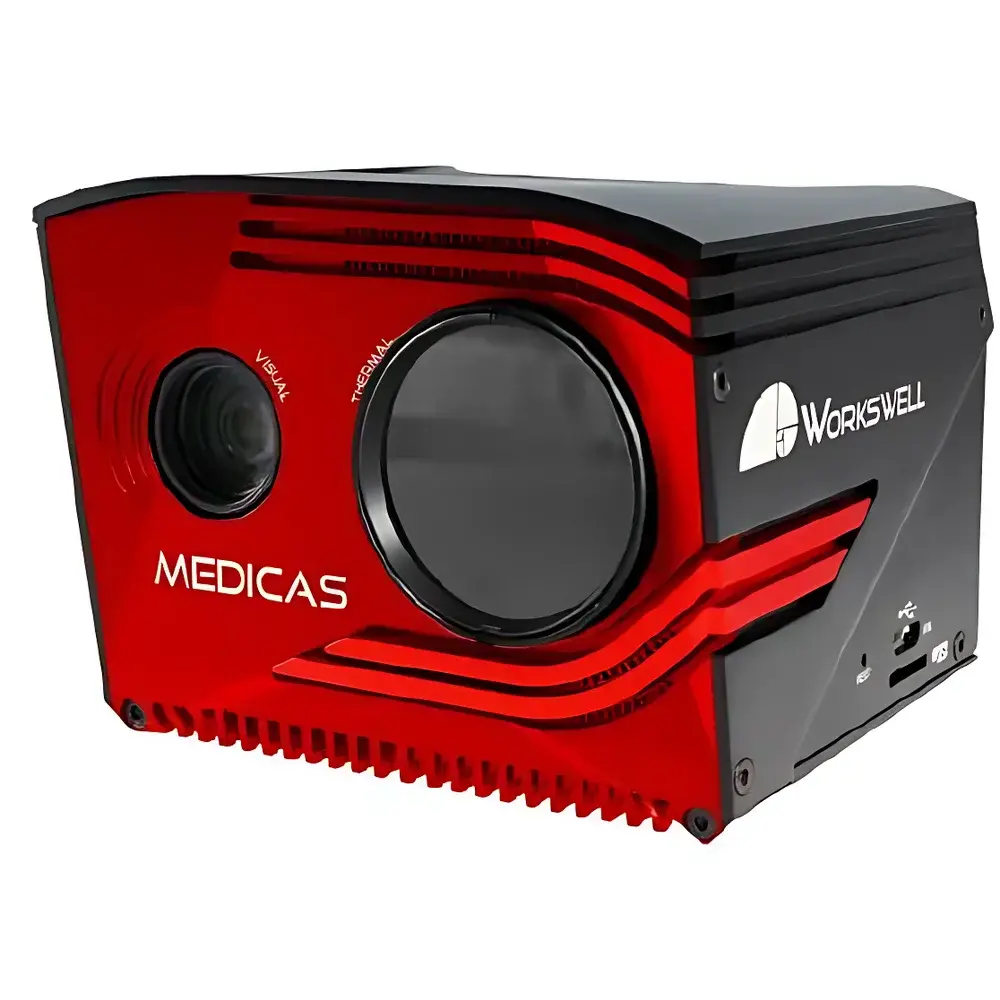
Thermo-RGB Medical Dual-Spectrum Infrared Thermal Imaging System by Workswell
| Brand | Workswell |
|---|---|
| Origin | Czech Republic |
| Model | Thermo-RGB |
| Detector Type | Uncooled VOx Microbolometer FPA (Scanning-Type) |
| Spectral Range | 7.5–13.5 µm |
| Thermal Resolution | 640 × 512 pixels |
| Visible Resolution | 1920 × 1080 pixels |
| NETD | ≤0.03 °C |
| Accuracy | ±0.3 °C @ 35 °C, ±1 °C across full range |
| Temperature Range | 0 °C to +50 °C (face-optimized calibration) |
| Frame Rate | 9 Hz (standard export version), 30 Hz (commercial-use optional) |
| Measurement Method | Non-contact infrared radiometry |
| Operating Mode | Uncooled |
| Lens FOV | 45° |
| Digital Zoom | 1–14× continuous |
| Built-in SSD | 256 GB |
| Interface | micro-HDMI (720p), micro-USB 2.0, Gigabit Ethernet (RJ-45) |
| Power | 110/230 VAC, 12 W avg. |
| Weight | <450 g |
| Dimensions | 83 × 85 × 68 mm |
| Enclosure | Anodized aluminum housing |
| Compliance | CE, RoHS, IEC 61000-6-3/-4, EN 62471 (LED safety for visible channel) |
Overview
The Thermo-RGB Medical Dual-Spectrum Infrared Thermal Imaging System by Workswell is a purpose-engineered, regulatory-aware thermal imaging platform designed for non-invasive, real-time facial thermography in clinical research, epidemiological surveillance, and point-of-care physiological monitoring. Unlike general-purpose thermal cameras, this system integrates synchronized long-wave infrared (LWIR) radiometry with high-fidelity visible-spectrum imaging—enabling pixel-aligned, quantitative thermal mapping overlaid on anatomically contextual RGB data. Its measurement principle is based on calibrated infrared radiometry compliant with Planck’s law and Stefan–Boltzmann theory, with traceable blackbody reference calibration performed every 5 seconds during operation. The uncooled vanadium oxide (VOx) microbolometer focal plane array operates within the atmospheric transmission window (7.5–13.5 µm), optimized for human skin emissivity (ε ≈ 0.97–0.98) and ambient temperature stability. The system does not require cryogenic cooling or external stabilization, making it suitable for mobile deployment in triage zones, outpatient clinics, animal behavior labs, and field epidemiology units.
Key Features
- Dual-spectrum synchronization: Simultaneous acquisition of radiometric LWIR data (640 × 512 px) and full-HD visible imagery (1920 × 1080 px) with sub-frame temporal alignment and geometric co-registration.
- Onboard blackbody calibration: Integrated portable blackbody source (included) enables automated, traceable radiometric recalibration at 5-second intervals—ensuring long-term measurement stability without drift compensation algorithms.
- Clinical-grade thermal performance: NETD ≤0.03 °C (30 mK) at f/1.0, enabling detection of subtle vasomotor responses; accuracy maintained at ±0.3 °C within the clinically relevant 30–40 °C range.
- Embedded MEDICAS OS: Real-time operating system with deterministic latency for thermal analytics, eliminating dependency on external PCs; supports USB keyboard, wireless remote, and Ethernet-based control.
- Hardware-accelerated processing: On-device h.264 encoding for full-frame radiometric video streaming, JPEG radiometric image export, and metadata-rich thermal data logging (including emissivity, reflected ambient temperature, and humidity compensation flags).
- Robust mechanical design: CNC-machined aluminum chassis (IP52-rated ingress protection), dual 1/4″-20 UNC mounting threads, and anti-scratch protective filter on both optical paths.
Sample Compatibility & Compliance
The Thermo-RGB system is validated for non-contact surface temperature assessment of human facial regions—including periorbital, nasal, oral, and cervical zones—as well as animal epidermal surfaces under controlled ambient conditions (15–30 °C, RH <90%, no condensation). It complies with IEC 61000-6-3 (EMI emission) and IEC 61000-6-4 (immunity), CE marking per Directive 2014/30/EU (EMC) and 2014/35/EU (LVD), and RoHS 2011/65/EU. While not classified as a Class II medical device under FDA 21 CFR Part 870 or EU MDR Annex VIII, its radiometric output meets ASTM E1933-19 (Standard Test Methods for Measuring and Compensating for Emissivity Using Infrared Imaging Systems) and ISO/TR 13154:2017 (Medical use of infrared thermographs). Data integrity features—including timestamped audit logs, firmware-signed calibration records, and write-once storage mode—support GLP/GMP-aligned documentation workflows.
Software & Data Management
MEDICAS software provides a unified interface for real-time thermal analytics, including region-of-interest (ROI) temperature profiling, dynamic hotspot tracking, and two-tier threshold-based alerting (e.g., fever screening at 37.5 °C baseline with secondary escalation at 38.0 °C). Optional Thermo-RGB Fusion Module enables quantitative color-coded overlay rendering with adjustable transparency, pseudo-color LUTs (ironbow, grayscale, rainbow), and export of georeferenced thermal matrices in IEEE C37.118-compliant .mat or HDF5 formats. An Ethernet SDK (C/C++, Python bindings) supports integration into hospital information systems (HIS), laboratory information management systems (LIMS), or custom epidemiological dashboards. All raw thermal frames retain full radiometric metadata (integration time, lens ID, calibration epoch, detector gain state), satisfying traceability requirements under ISO/IEC 17025:2017 Clause 7.7.
Applications
- Clinical thermophysiology studies: Quantitative assessment of autonomic nervous system responses via facial thermal asymmetry, post-prandial thermogenesis, or pharmacological challenge (e.g., capsaicin-induced vasodilation).
- Epidemiological triage: Rapid, passive screening in airports, border checkpoints, or emergency departments using configurable alarm logic aligned with WHO or ECDC thermal surveillance guidelines.
- Veterinary and ethological research: Non-invasive monitoring of stress indicators, thermoregulatory behavior, or inflammatory responses in companion animals and laboratory models.
- Regulatory-compliant validation: Reference-grade thermal mapping for HVAC validation in cleanrooms (ISO 14644), cold chain monitoring of biologics transport, or environmental chamber characterization.
- Biometric correlation studies: Synchronization with EEG, ECG, or galvanic skin response (GSR) hardware via TTL triggers for multimodal autonomic assessment.
FAQ
Is the Thermo-RGB certified for clinical diagnostic use?
No—it is intended for research, screening, and physiological monitoring purposes only. It is not FDA-cleared or CE-marked as an in vitro diagnostic (IVD) device.
Can the system operate continuously for extended periods?
Yes. With passive thermal management and <12 W power draw, it supports 24/7 operation in ambient temperatures from –30 °C to +60 °C (storage) and 10–40 °C (operational).
What is the minimum measurable temperature difference between adjacent facial regions?
At optimal focus and 35 °C ambient, spatial thermal contrast resolution is ≤0.05 °C over 2×2 pixel clusters (validated per ISO 18434-1 Annex B).
Does the system support NIST-traceable calibration?
The included blackbody source is factory-calibrated against NPL-traceable standards; users may perform in-field verification using secondary reference sources per ISO/IEC 17025 procedures.
Is raw thermal data export supported for third-party analysis?
Yes—radiometric JPEGs contain embedded temperature arrays (16-bit per pixel), and full-frame binary streams (.raw) are accessible via SDK for MATLAB, Python (scikit-image, OpenCV), or custom thermal modeling pipelines.





