
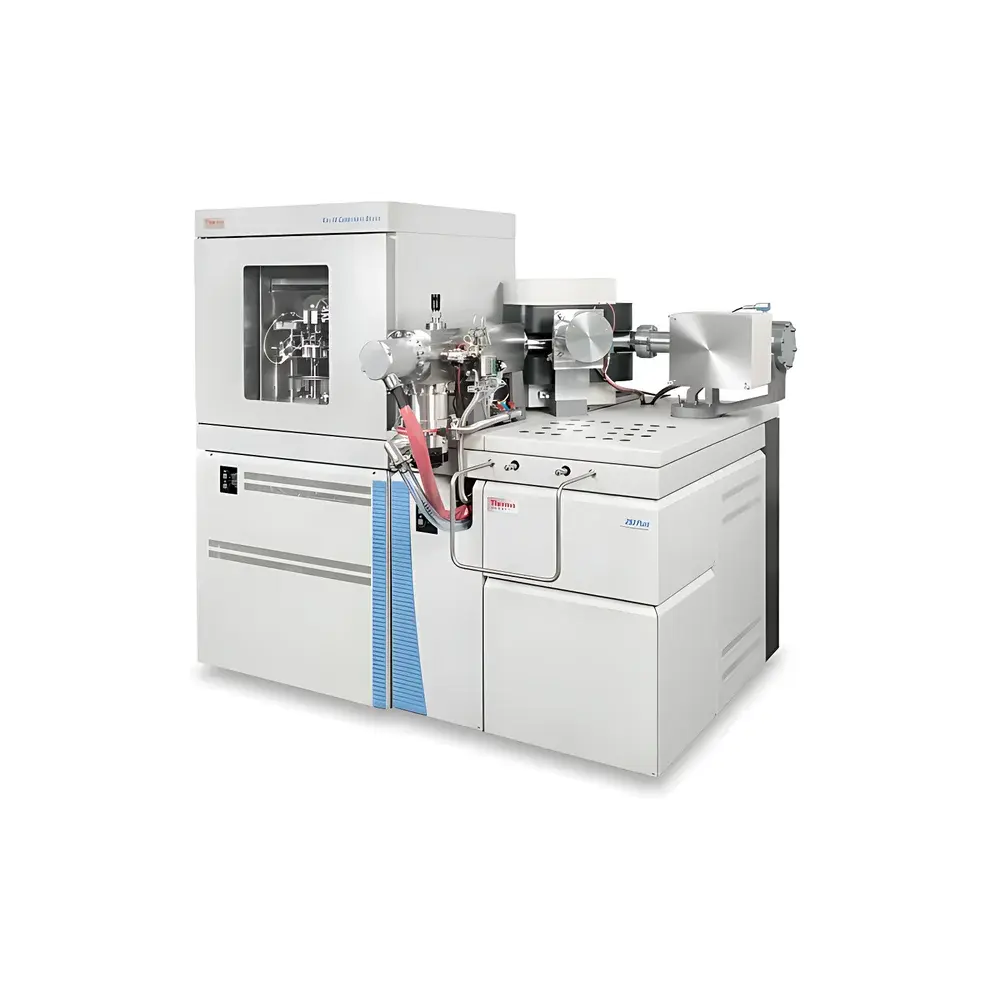
Thermo Scientific 253 Plus Stable Isotope Ratio Mass Spectrometer
| Brand | Thermo Fisher |
|---|---|
| Origin | Germany |
| Manufacturer Type | Original Equipment Manufacturer (OEM) |
| Product Origin | Imported |
| Model | 253 Plus |
| Instrument Type | Stable Gas-Source Isotope Ratio Mass Spectrometer |
| Key Technology | 10 kV IRMS Platform |
| Amplifier Resistance | 10¹³ Ω |
| Detector Configuration | Dual-Path, Semi-Mass Baseline Monitoring |
| Magnet Design | High-Stability Electromagnet with Optimized Pole Geometry |
| Workflow Integration | Built-in LIDI (Long Integration Dual-Inlet) Protocol |
| Sample Utilization Efficiency | Up to 3× Higher vs. MAT 253 |
| Minimum Sample Requirement | Reduced by up to 67% vs. MAT 253 |
| Signal-to-Noise Ratio | Enhanced for Low-Abundance Ions (e.g., m/z 47, 48, 49) |
Overview
The Thermo Scientific 253 Plus is a next-generation stable isotope ratio mass spectrometer (IRMS) engineered for ultra-high-precision gas-source isotopic analysis. Building upon the legacy of the MAT 253 platform, the 253 Plus integrates a proprietary 10 kV ion acceleration architecture — the industry benchmark for stability, linearity, and sensitivity in high-resolution isotope ratio measurements. It operates on the fundamental principle of magnetic sector mass separation, where ions generated from thermally or chemically converted sample gases (e.g., CO2, N2, CO, CH4, SO2, H2) are accelerated, focused, and resolved according to their mass-to-charge (m/z) ratios under precisely controlled magnetic and electrostatic fields. Designed specifically for δ13C, δ15N, δ18O, δ2H, δ34S, and clumped isotope (e.g., Δ47, Δ48) applications, the system delivers reproducible sub-permil and sub-0.01‰ precision under routine laboratory conditions — essential for paleoclimatology, biogeochemical cycling studies, forensic geochemistry, and metabolic tracer research.
Key Features
- 1013 Ω Faraday Amplifier Technology: Enables robust detection of ultra-low-intensity ion beams (e.g., m/z 47, 48, 49), critical for clumped isotope analysis where signal abundance may be <0.1% of major isotopologues.
- Optimized Multi-Collector Array Layout: Features semi-mass detector positioning for real-time baseline monitoring and active background subtraction, minimizing scattering artifacts during high-flux ion source operation.
- Redesigned High-Stability Electromagnet: Incorporates refined pole geometry and thermal inertia management to maintain peak shape integrity and mass calibration stability over multi-hour integrations — supporting extended dwell times without drift-induced bias.
- Built-in LIDI (Long Integration Dual-Inlet) Workflow: Fully automated dual-gas inlet sequencing with synchronized valve timing, pressure regulation, and integration gating — increasing effective sample utilization by up to 3× while reducing required sample size by ≥67% versus legacy MAT 253 configurations.
- Enhanced Vacuum Architecture: Dual-stage turbomolecular pumping with cryo-trapping capability ensures ultra-low hydrocarbon and water vapor background, critical for achieving <10−15 A base current stability during long integrations.
Sample Compatibility & Compliance
The 253 Plus interfaces seamlessly with a broad range of Thermo Scientific and third-party preparation systems, including the GasBench II, Kiel IV, Titan, and TC/EA elemental analyzers — enabling standardized conversion of solid, liquid, and gaseous samples into analyte gases (CO2, N2, CO, H2, SO2). All hardware and firmware comply with ISO/IEC 17025:2017 requirements for testing and calibration laboratories. The instrument supports audit-ready data acquisition with timestamped metadata, electronic signatures, and full traceability per FDA 21 CFR Part 11 and EU Annex 11 guidelines when deployed in GLP/GMP-regulated environments. Routine performance verification follows ASTM D7925 (δ13C in CO2), ASTM D8217 (clumped isotopes), and IUPAC Technical Reports on isotopic reference materials.
Software & Data Management
Controlled via Thermo Scientific Delta V Software v3.0+, the 253 Plus provides integrated method development, real-time beam monitoring, automatic peak centering, and offline data reduction using standard reference material normalization (e.g., VPDB, AIR-N2, VSMOW). The software includes built-in uncertainty propagation algorithms compliant with ISO Guide 98-3 (GUM), supports batch processing of >1000 analyses per session, and exports fully annotated .csv and .xls files compatible with MATLAB, R, and Python-based isotope data pipelines (e.g., Easotope, Isodat Legacy Emulator). Raw data archives are stored in vendor-neutral HDF5 format with embedded instrument configuration logs, ensuring long-term FAIR (Findable, Accessible, Interoperable, Reusable) compliance.
Applications
- Paleotemperature reconstruction via carbonate Δ47 thermometry in foraminifera, brachiopods, and speleothems
- Carbon source attribution in atmospheric CO2 and methane using δ13C–δ18O–Δ47 multi-isotope systematics
- Nitrogen cycle tracing in soils, sediments, and wastewater using δ15N–δ18O of NO3− and N2O
- Hydrogen and oxygen isotope fingerprinting of water sources in hydrological modeling and food authenticity verification
- High-precision sulfur isotope analysis (δ34S, Δ33S, Δ36S) for ore genesis and microbial sulfate reduction studies
FAQ
What sample types are compatible with the 253 Plus?
Solid carbonates, organic matter, nitrates, sulfates, water, and purified gases — following conversion to CO2, N2, CO, H2, or SO2 via offline or online preparation systems.
Does the 253 Plus support clumped isotope analysis out-of-the-box?
Yes — the 1013 Ω amplifiers, optimized collector array, and LIDI workflow are factory-configured and validated for Δ47, Δ48, and Δ49 measurements per IUPAC-recommended protocols.
How is instrument calibration maintained across long-term operation?
Through daily bracketing with certified reference gases (e.g., NBS-19 CO2, USGS24, IAEA-CH-7), automated peak centering routines, and quarterly magnet hysteresis correction using internal tuning standards.
Can the 253 Plus be integrated into an existing laboratory LIMS?
Yes — Delta V Software provides ODBC-compliant database connectivity and REST API endpoints for bidirectional data exchange with major LIMS platforms (e.g., LabWare, STARLIMS, Thermo Fisher SampleManager).
Is remote diagnostics and service support available?
All 253 Plus systems include Thermo Fisher Connect-enabled telemetry, allowing authorized service engineers to perform real-time health monitoring, firmware updates, and guided troubleshooting while maintaining data security under ISO 27001-certified infrastructure.





