
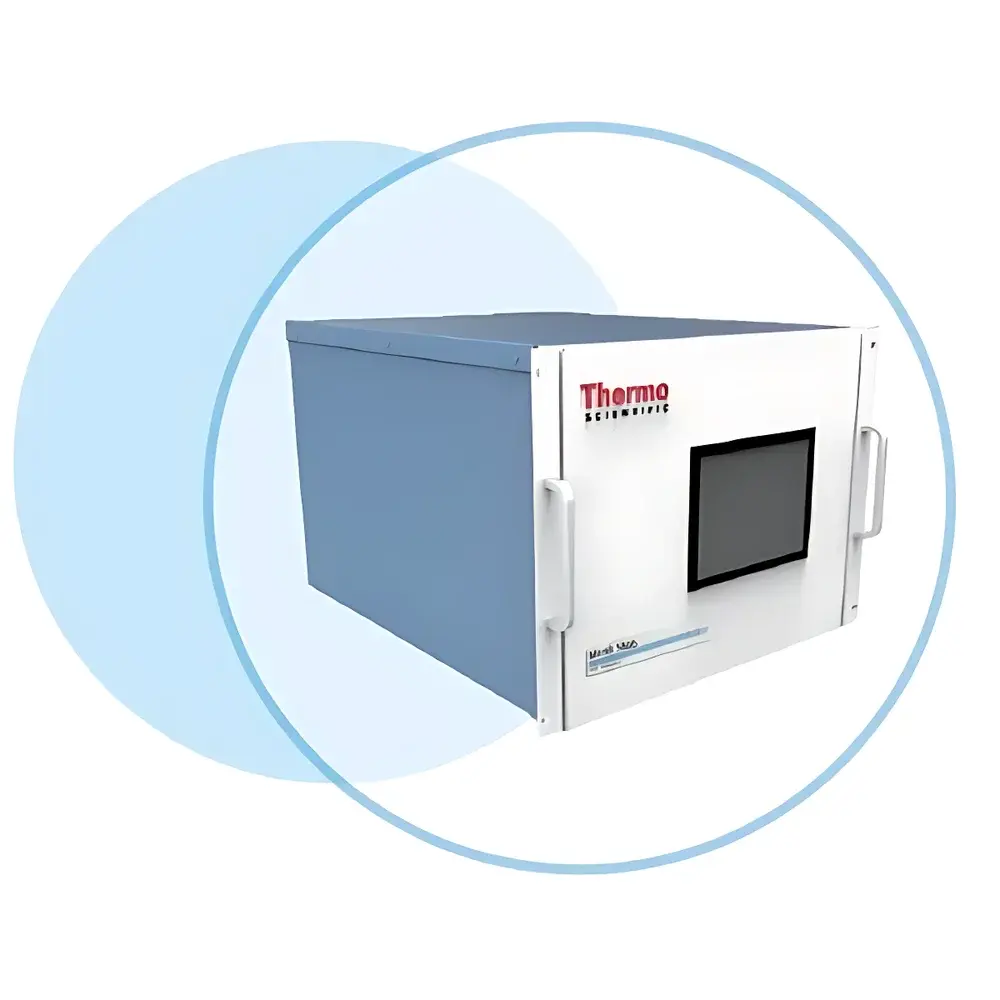
Thermo Scientific 5800 Online Gas Chromatograph with FID
| Brand | Thermo Fisher |
|---|---|
| Origin | Imported |
| Model | Thermo Scientific 5800 |
| Detection Principle | Gas Chromatography–Flame Ionization Detection (GC-FID) |
| Instrument Type | Online Analyzer |
| Typical Configuration | Multi-component VOC Analyzer |
| Detection Range | 0–50 ppm / 500 ppm / 5,000 ppm / 50,000 ppm / 500,000 ppm (as methane) |
| Resolution | 50 ppb |
| Accuracy | ±1% of full scale or ±0.1 ppm (whichever is greater) |
| Response Time | <1 minute for NMHC analysis |
Overview
The Thermo Scientific 5800 Online Gas Chromatograph is an industrial-grade, continuous-emission monitoring (CEM) system engineered for real-time quantification of hydrocarbons and volatile organic compounds (VOCs) in process and ambient gas streams. Built upon the robust separation science of capillary gas chromatography and coupled with a high-stability flame ionization detector (FID), the 5800 delivers trace-level sensitivity, long-term baseline stability, and repeatable retention time alignment—critical for regulatory compliance and process control applications. Unlike laboratory-based GC systems, the 5800 is designed for unattended, 24/7 operation in demanding industrial environments—including refinery flare stacks, semiconductor fab exhaust ducts, pharmaceutical reactor vents, and municipal wastewater treatment off-gas lines. Its architecture supports both total hydrocarbon (THC) and non-methane hydrocarbon (NMHC) reporting per EPA Method 25A and EN 12619, while enabling compound-specific identification and quantification across a broad spectrum of C2–C12 VOCs.
Key Features
- Integrated negative-pressure sampling system with heated sample line (up to 150 °C), minimizing condensation and adsorption losses for high-boiling-point analytes such as xylenes and styrene.
- Automated dual-range calibration capability: independent low- and high-range calibration curves for each target compound, with seamless auto-switching based on signal amplitude to maintain optimal signal-to-noise ratio across five decades of concentration (0.05–500,000 ppm as methane).
- Onboard performance verification: scheduled or manual injection of internal standard and zero gas enables automated system suitability checks—including retention time shift, peak area precision, and detector response linearity—without interrupting routine analysis.
- Modular column oven with precise temperature ramp control (±0.1 °C) and rapid cool-down, supporting method flexibility for PAMS (Photochemical Assessment Monitoring Stations), TO-14/TO-15, and custom speciation protocols.
- Embedded Linux-based controller with dual Ethernet ports, SNMP v3 support, and native Modbus TCP integration for seamless SCADA and DCS connectivity.
Sample Compatibility & Compliance
The 5800 accommodates a wide range of gas matrices—including humid air, nitrogen-purged process streams, and hydrocarbon-rich refinery off-gases—via configurable sample conditioning (particulate filtration, moisture removal, and pressure regulation). It meets key international standards for stationary source emission monitoring: EPA Performance Specification 8 (PS-8), EN 15267-3 (QAL1 certified), ISO 8573-1 (Class 2 compressed air quality), and ASTM D6420 for VOC speciation. Data integrity complies with FDA 21 CFR Part 11 requirements through audit-trail-enabled user authentication, electronic signatures, and immutable raw-data archiving. All calibration and maintenance events are timestamped and logged with operator ID, ensuring full traceability for GLP/GMP and ISO/IEC 17025 audits.
Software & Data Management
Thermo Scientific ChromaView™ software provides a browser-accessible interface for method development, remote diagnostics, trend visualization, and report generation. Real-time chromatograms, component-specific concentration plots, and historical overlay charts are rendered without plug-ins. Data export supports CSV, PDF, and XML formats compliant with EEA’s E-PRTR and US EPA’s CDX submission requirements. The system supports secure TLS 1.2 encrypted communications and role-based access control (RBAC) with four-tier privilege levels—from operator to administrator. Raw acquisition files (.chd) retain full spectral and timing metadata, enabling retrospective reprocessing using updated calibration models or retention time alignment algorithms.
Applications
- Refining & Petrochemicals: Continuous NMHC monitoring at flare gas headers, FCCU regenerator vents, and tank farm breathing emissions per API RP 500 and LDAR protocols.
- Semiconductor Manufacturing: Sub-ppb detection of isopropanol, acetone, and ethylbenzene in cleanroom purge gases and abatement system effluents.
- Pharmaceutical Production: Residual solvent verification in reactor off-gas and lyophilizer exhaust per ICH Q3C guidelines.
- Automotive Coating Lines: Real-time tracking of xylene, toluene, and methyl ethyl ketone (MEK) during spray booth ventilation to ensure OSHA PEL and ACGIH TLV conformance.
- Environmental Monitoring Networks: Deployment in urban air quality stations for PAMS-speciated VOC measurements aligned with EPA’s Photochemical Modeling Framework.
FAQ
What regulatory methods does the 5800 support out-of-the-box?
The instrument ships with pre-validated methods for EPA Method 25A (THC/NMHC), EPA Method 18 (VOC speciation), and EN 12619 (industrial stack emissions), including certified calibration kits and retention time libraries.
Can the 5800 analyze samples above ambient temperature?
Yes—the heated sample transfer line and inlet module operate up to 150 °C, enabling direct analysis of hot process streams without external cooling or dilution.
Is remote firmware update supported?
Yes—ChromaView™ allows over-the-air (OTA) updates via HTTPS with cryptographic signature verification to ensure system integrity and version traceability.
How is data security enforced during transmission?
All network communications use TLS 1.2 encryption; local storage employs AES-256 disk encryption, and audit logs record all configuration changes with SHA-256 hashed timestamps.
What maintenance intervals are recommended for routine operation?
FID nozzle cleaning and detector gas filter replacement every 6 months; GC column reconditioning every 12 months; full system performance verification (QAL2) annually per EN 14181.
Related Products







