
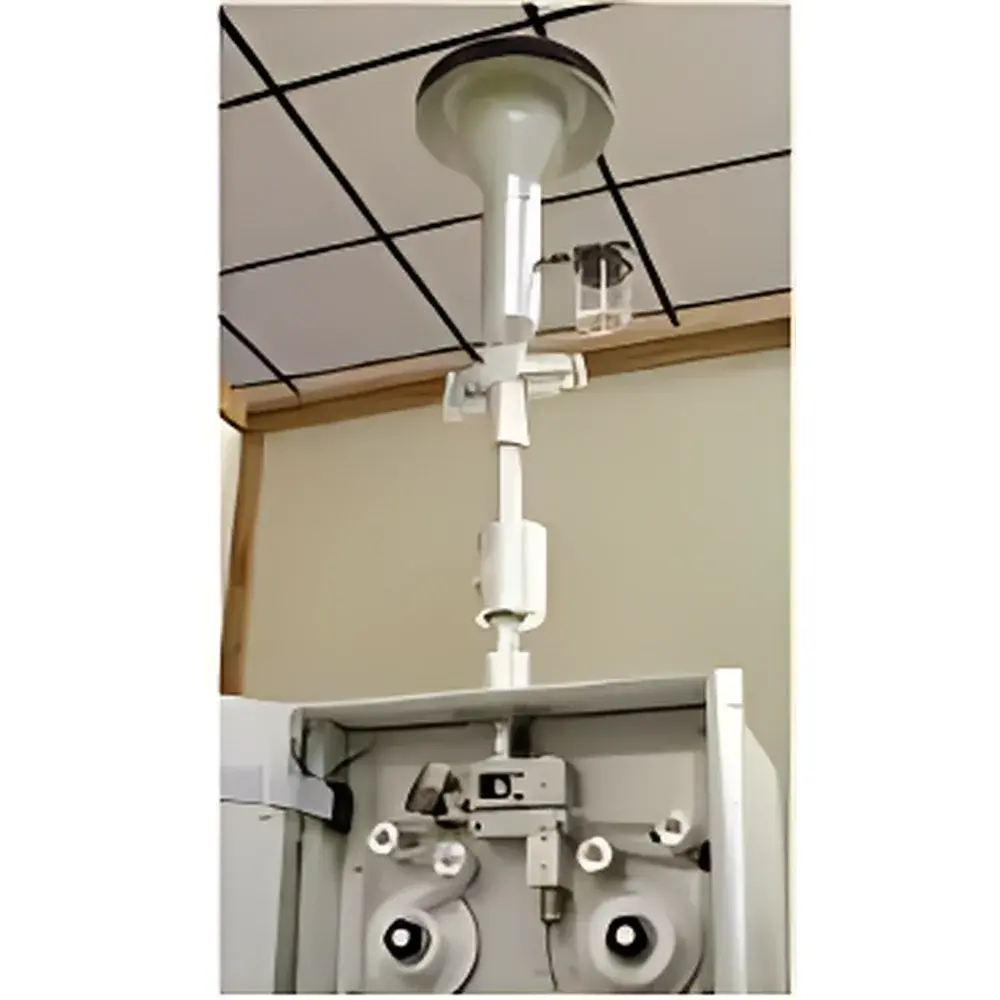
Thermo Scientific BAM-1020 Beta Attenuation Monitor for PM2.5 and PM10
| Origin | USA |
|---|---|
| Manufacturer Type | Authorized Distributor |
| Origin Category | Imported |
| Model | BAM-1020 |
| Measurement Method | Beta Ray Attenuation |
| Measured Parameters | PM10 / PM2.5 |
Overview
The Thermo Scientific BAM-1020 Beta Attenuation Monitor is a regulatory-grade, continuous ambient air particulate mass concentration analyzer engineered for high-reliability monitoring of PM2.5 and PM10 in fixed-site and mobile environmental monitoring networks. It operates on the fundamental physical principle of beta ray attenuation: as airborne particles deposit onto a moving filter tape, they attenuate beta radiation emitted from a 14C source; the reduction in detected beta particle count is directly proportional to the mass loading on the filter, enabling precise gravimetric-equivalent mass concentration calculation (µg/m³) without dependence on particle size distribution, refractive index, or color. This method satisfies U.S. EPA Reference Method (RM) and Equivalent Method (EQPM) requirements under 40 CFR Part 53, and the BAM-1020 is formally certified as an EPA EQPM (Certificate No. EQPM-0798-122). Its design conforms to international performance standards including ISO 10473 (ambient air — measurement of PM10 and PM2.5) and EN 12341, supporting compliance with national air quality directives across the UK, South Korea, and China.
Key Features
- Fully automated, unattended operation with integrated microprocessor control, LCD interface, and alphanumeric keypad for local configuration and diagnostics.
- Real-time instrument health monitoring with automatic fault detection, error logging, and data validity flagging (e.g., power loss, flow deviation, calibration failure).
- Hourly zero and span drift correction using certified FRM calibration membranes—no external calibration gases or manual intervention required.
- Humidity-controlled sampling: integrated heater maintains sample air at constant relative humidity (typically 35–40% RH) upstream of the filter to minimize volatile artifact and ensure stable mass measurement.
- Programmable hourly filter change cycle to mitigate semi-volatile organic compound (SVOC) evaporation losses during sampling and analysis.
- Onboard data logger with non-volatile memory storing up to 182 days of 1-hour averaged PM2.5/PM10 concentrations, meteorological inputs, diagnostic logs, and calibration records.
- RS-232 serial interface for direct connection to PCs, modems, printers, or SCADA systems; supports ASCII-based data retrieval and remote firmware updates.
- Expandable sensor integration: accommodates up to six external meteorological sensors (wind speed/direction, temperature, pressure, RH, rainfall) via analog/digital inputs.
- Remote web-enabled access supporting secure, password-protected data viewing, configuration changes, and log downloads for up to 60 days without local operator presence.
Sample Compatibility & Compliance
The BAM-1020 accepts standard 47-mm or 80-mm diameter quartz or Teflon-coated glass fiber filters and is compatible with both PM2.5 (using WINS impactor or similar cut-point device) and PM10 (using VSCC or cyclone inlet) sampling configurations. With optional TSP inlet, it can also quantify total suspended particulates. All operational protocols—including flow rate verification (16.7 L/min nominal), filter tape advancement timing, and beta source decay compensation—are traceable to NIST-certified reference standards. The system meets U.S. EPA Performance Specification 11 (PS-11) for continuous ambient PM monitors and supports audit-ready data integrity through built-in timestamped event logging, electronic signatures, and full audit trail functionality aligned with GLP and 21 CFR Part 11 principles when deployed with validated software platforms.
Software & Data Management
Data output adheres to standardized formats (e.g., EPA AQS, EEA AirBase, ISO/IEC 17025-compliant reporting structures) and includes raw beta counts, corrected mass concentrations, flow rates, temperature/humidity metadata, and QA/QC flags. Optional Thermo Scientific Environmental Data Management Software (EDMS) provides centralized database ingestion, automated report generation (daily/weekly/monthly summaries), statistical validation (e.g., data completeness ≥95%, precision ≤10% RSD), and integration with national air quality information systems. All stored data include immutable timestamps, operator IDs (if logged), and revision history—ensuring full traceability for regulatory submissions and third-party audits.
Applications
The BAM-1020 serves as a primary reference monitor in national ambient air quality monitoring networks (e.g., U.S. AQS, UK AURN, Korea NIER network), urban background and traffic-oriented stations, industrial fence-line monitoring, and long-term epidemiological exposure assessment studies. Its robustness, low maintenance burden, and regulatory acceptance make it suitable for deployment in harsh outdoor environments—from arctic field sites to tropical coastal zones—while maintaining metrological consistency across multi-year datasets. It is routinely used for trend analysis, source apportionment modeling input, regulatory compliance verification, and real-time public air quality index (AQI) dissemination.
FAQ
What regulatory certifications does the BAM-1020 hold?
It is certified by the U.S. EPA as an Equivalent Method (EQPM-0798-122) for PM2.5 and PM10, and has received type approval from the UK Department for Environment, Food & Rural Affairs (DEFRA), Korea’s National Institute of Environmental Research (NIER), and China’s Ministry of Ecology and Environment (MEE).
How frequently is zero and span calibration performed?
Automatic zero checks occur before and after each hourly sampling cycle; span drift correction uses a certified reference membrane inserted into the beta path every 24 hours or upon user-defined schedule.
Can the BAM-1020 measure both PM2.5 and PM10 simultaneously?
No—it requires physical reconfiguration of the inlet (e.g., swapping between PM2.5 impactor and PM10 cyclone); however, dual-channel configurations with parallel BAM units are supported for co-located simultaneous monitoring.
What is the minimum detectable concentration and measurement range?
The instrument achieves a lower limit of detection (LLD) of ≤1 µg/m³ (1-hour average) with a linear dynamic range of 0–5000 µg/m³, fully covering ambient and elevated pollution scenarios.
Is remote data access compliant with cybersecurity standards?
Yes—when deployed with enterprise-grade firewalls and TLS 1.2+ encrypted web interfaces, remote access meets IEC 62443-3-3 and NIST SP 800-53 Rev. 5 requirements for critical environmental infrastructure.
Related Products







