
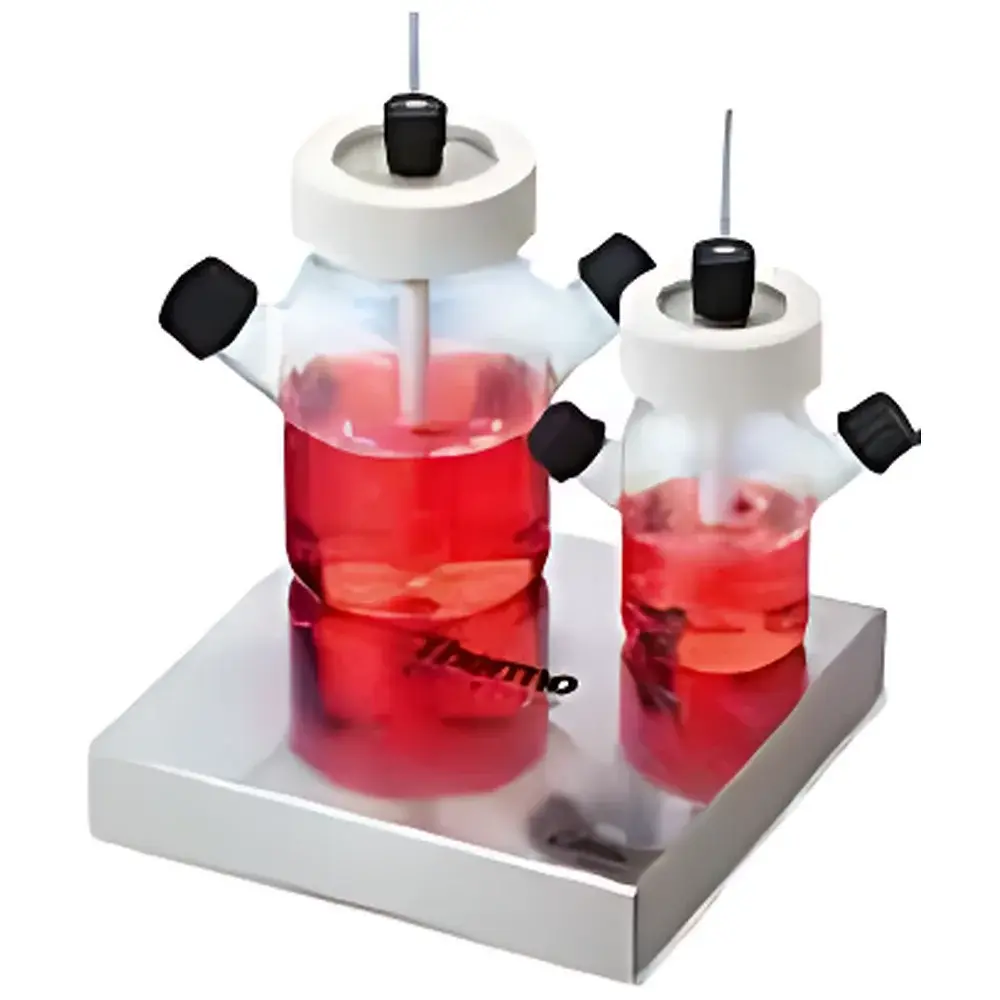
Thermo Scientific Cimarec Biosystem Magnetic Stirrer
| Brand | Thermo Fisher Scientific |
|---|---|
| Origin | Germany |
| Manufacturer Type | Original Equipment Manufacturer (OEM) |
| Product Category | Imported Instrument |
| Model | Biosystem (Single-Position, Controller Not Included) / Biosystem 4-Position (Controller Not Included) |
| Stirring Capacity | 20 L (single position) / 5 L per position (4-position) |
| Speed Range | 5–120 rpm |
| Temperature Operating Range | –10 °C to +56 °C (at 100% relative humidity) |
| Controller Requirement | External Biomodul 40B controller (one unit supports up to two Biosystem units) |
| Construction | Seamless stainless-steel housing, CO₂ incubator-compatible design |
| Power Regulation | Independent power adjustment per stir position |
Overview
The Thermo Scientific Cimarec Biosystem Magnetic Stirrer is an engineered solution for precise, low-heat agitation of cell cultures and other thermosensitive biological samples within controlled-environment incubators—particularly CO₂ incubators. Unlike conventional magnetic stirrers, the Biosystem integrates a fully sealed, seamless stainless-steel chassis with no external control interface on the unit itself, eliminating potential microbial ingress pathways and enabling safe placement directly inside humidified, sterile incubation chambers. Its operation relies on contactless magnetic coupling between an external rotating magnet drive (housed in the Biomodul 40B controller) and internal PTFE-coated stir bars, ensuring zero mechanical wear, minimal heat generation (<0.5 °C temperature rise at 120 rpm under standard load), and stable rotational torque across the full speed range. Designed specifically for life science laboratories adhering to GLP and GMP-aligned workflows, the Biosystem meets stringent requirements for environmental integrity, process reproducibility, and equipment traceability in cell culture, fermentation, and bioprocess development applications.
Key Features
- Seamless, one-piece stainless-steel housing (AISI 316L-grade) with IP65-rated ingress protection—resistant to corrosion from ethanol, isopropanol, and 70% v/v disinfectants commonly used in cleanroom and biosafety environments.
- Zero-integrated electronics: No internal circuitry, displays, or buttons—eliminates electromagnetic interference (EMI) risks and thermal drift inside CO₂ incubators; all control signals transmitted via shielded low-voltage cabling from the external Biomodul 40B unit.
- Independent power regulation per stirring position (4-position model): Enables simultaneous optimization of torque and energy efficiency across heterogeneous sample volumes (e.g., 50 mL to 5 L flasks), reducing overall power draw by up to 38% versus fixed-output systems.
- Ultra-low-speed stability: Maintains consistent rotation at 5 rpm ± 0.3 rpm (measured via optical tachometer under 2 L aqueous load), critical for shear-sensitive suspension cultures including hybridoma, CHO, and primary neuronal cells.
- Full operational compatibility with standard CO₂ incubator conditions: Certified for continuous use at –10 °C to +56 °C ambient temperature and 100% relative humidity—validated per IEC 60529 and EN 61000-6-3 emission standards.
Sample Compatibility & Compliance
The Biosystem accommodates standard laboratory vessels—including Erlenmeyer flasks (up to 5 L per position), baffled bioreactor bottles, and custom-designed culture chambers—when paired with appropriately sized magnetic stir bars (diameter 8–12 mm, length 30–60 mm). Its non-invasive design avoids direct contact with media, eliminating contamination risk from seals or shafts. The system complies with ISO 13485:2016 (medical device quality management), supports FDA 21 CFR Part 11-compliant electronic record workflows when integrated with validated Biomodul 40B firmware (v3.2+), and aligns with EU Annex 1 (sterile manufacturing) requirements for equipment placed within classified environments. Routine calibration documentation and IQ/OQ protocols are available upon request for regulated QC/QA departments.
Software & Data Management
While the Biosystem itself contains no embedded software, it functions as a hardware endpoint within Thermo Fisher’s Cimarec Connect ecosystem when paired with the Biomodul 40B controller. The Biomodul 40B features USB-C and RS-485 interfaces for integration into laboratory information management systems (LIMS) and supervisory control and data acquisition (SCADA) platforms. It logs timestamped speed setpoints, actual RPM feedback (sampled at 10 Hz), runtime duration, and thermal status—data exportable in CSV or XML format. Audit trails include user ID, parameter changes, and session start/stop events, satisfying ALCOA+ principles for data integrity in regulated biomanufacturing environments.
Applications
- Continuous low-shear agitation of mammalian and insect cell cultures during expansion and maintenance phases.
- Homogenization of viscous hydrogels (e.g., Matrigel®, collagen I solutions) prior to 3D scaffold seeding without inducing premature polymerization.
- Stirring of anaerobic culture media in hypoxia workstations where internal heat sources must be minimized.
- Long-term stability testing of protein therapeutics under accelerated storage conditions (e.g., 25 °C/60% RH), where convection-driven thermal gradients must be avoided.
- Integration into automated cell culture platforms requiring synchronized, multi-vessel agitation with centralized control and event logging.
FAQ
Is the Biosystem compatible with standard CO₂ incubators from major manufacturers (e.g., Thermo Fisher, Eppendorf, Panasonic)?
Yes—the unit has been verified for mechanical fit and thermal/electromagnetic compatibility with all Class II A2 and Class III biosafety cabinets and CO₂ incubators meeting IEC 61000-4-3 immunity thresholds.
Can the Biosystem operate without the Biomodul 40B controller?
No—no local controls exist on the Biosystem unit. Operation requires connection to either the Biomodul 40B (for single- or dual-unit control) or third-party programmable logic controllers (PLCs) via its 0–10 V analog input interface.
What maintenance is required for long-term reliability?
Annual verification of magnetic coupling efficiency (using supplied test stir bar and reference tachometer) and visual inspection of housing integrity are recommended. No lubrication or internal servicing is required due to the brushless, gear-free actuation architecture.
Does Thermo Fisher provide validation support for GxP environments?
Yes—comprehensive IQ/OQ documentation packages, including protocol templates, acceptance criteria, and raw test data worksheets, are available under Thermo Fisher’s Validation Services Agreement (VSA-2023).



