
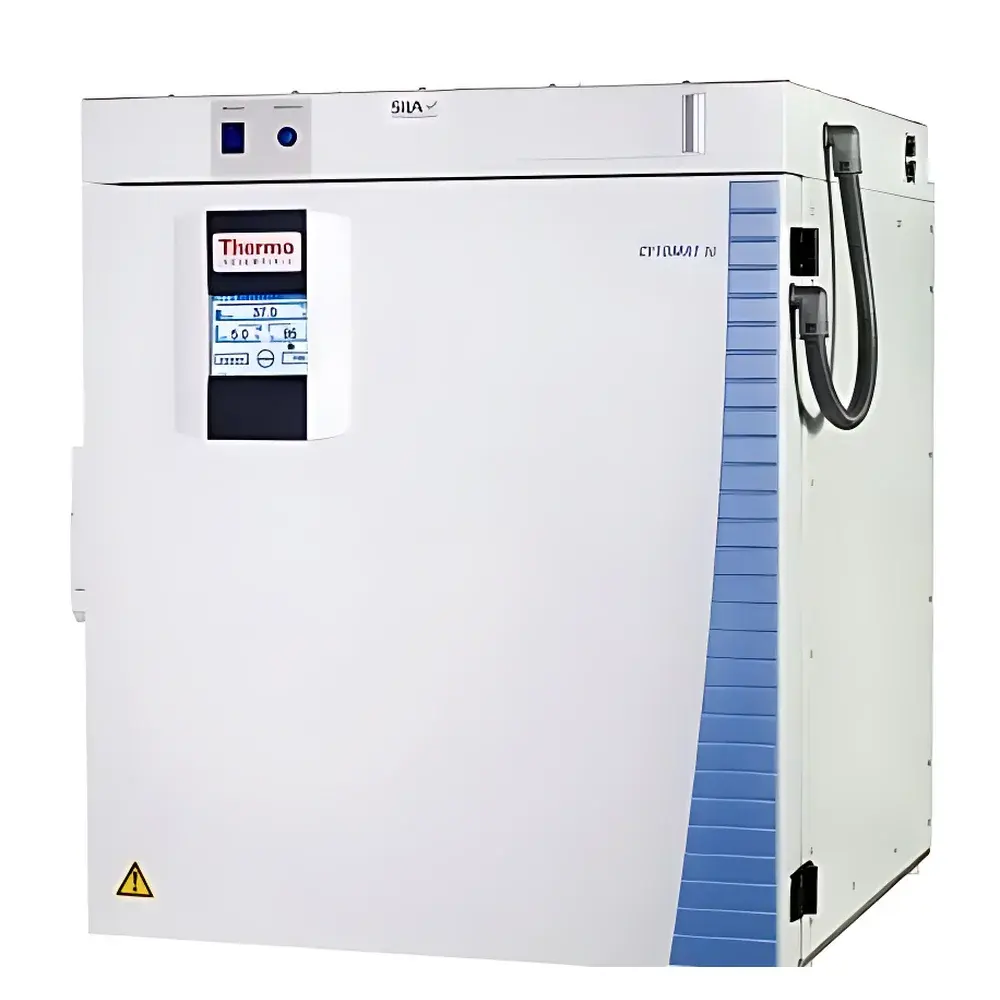
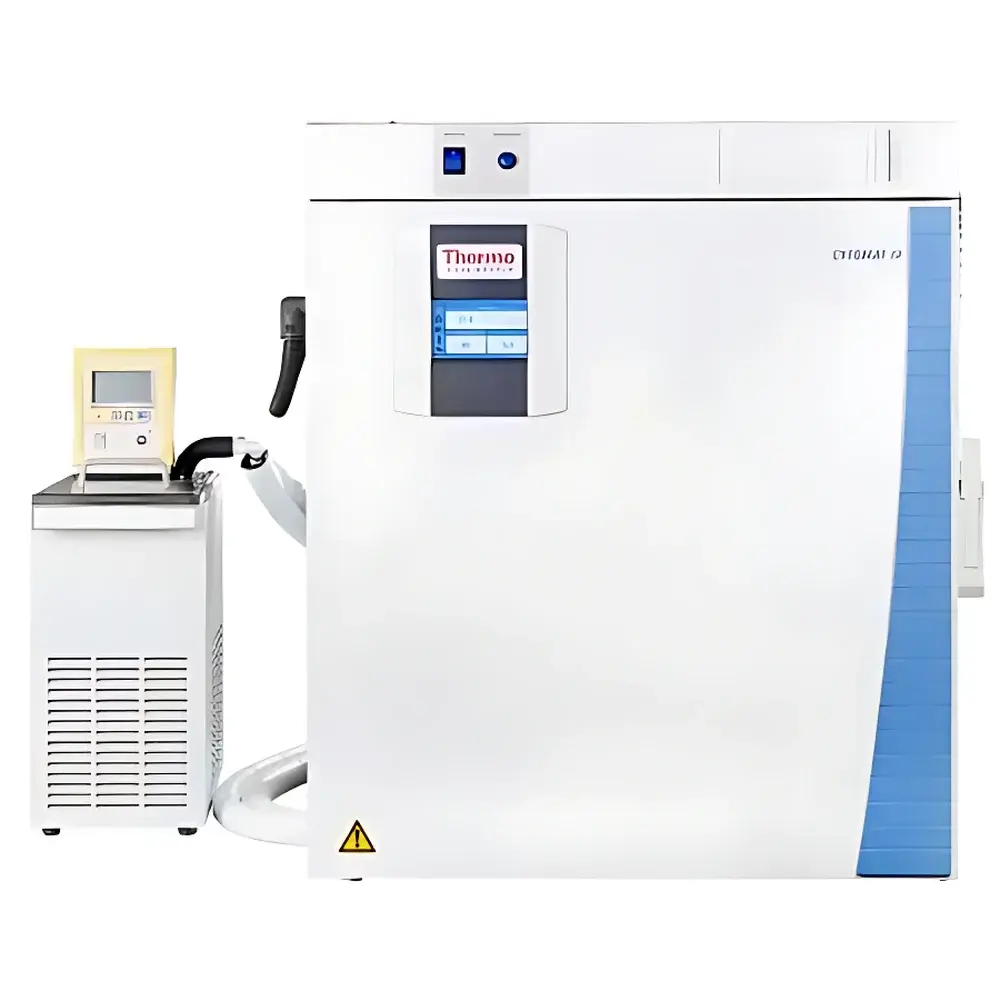
Thermo Scientific Cytomat 10C Automated CO₂ Incubator
| Brand | Thermo Fisher |
|---|---|
| Origin | Canada |
| Manufacturer | Thermo Fisher Scientific |
| Product Type | Imported |
| Model | Cytomat 10C |
| Temperature Range & Accuracy | +4 to 50 °C, ±0.1 °C setpoint stability |
| Temperature Uniformity | ±0.2 °C across chamber volume |
| Humidity Control | Up to 98% rH, Hydra-Smart active humidification with sterile water reservoir and particulate filtration |
| Capacity | 210 microplate positions (standard 96-/384-well format) |
| Decontamination | Fully automated ContraCon dry-heat decontamination cycle (180 °C, validated for low-bioburden heat-resistant microorganisms) |
| Optional Configuration | Copper-lined interior for enhanced antimicrobial surface performance |
Overview
The Thermo Scientific™ Cytomat 10C™ Automated CO₂ Incubator is a high-capacity, fully integrated environmental control platform engineered for unattended, long-term cell culture maintenance and assay incubation in regulated life science environments. Designed around a dual-chamber architecture with independent temperature, CO₂, and humidity regulation, the system operates on a proven convection-free air jacket heating principle—eliminating thermal gradients and minimizing recovery time after door access. Its core measurement and control architecture complies with ISO 13485–aligned manufacturing practices and supports GLP/GMP-aligned workflows through traceable parameter logging, audit-ready event history, and configurable user access levels. The Cytomat 10C is not a standalone incubator but a modular node within automated laboratory ecosystems—compatible with standard robotic arms (e.g., Hamilton STAR, Tecan Fluent) via RS-232, Ethernet/IP, and Modbus TCP interfaces.
Key Features
- High-throughput plate handling: Integrated robotic interface enables access to any of 210 microplate positions in 5–9 seconds—optimized for 96-well and 384-well formats without manual reorientation or tray adjustment.
- Stable environmental control: Air-jacketed thermal system maintains ±0.2 °C uniformity across full chamber volume; humidity delivered via Hydra-Smart technology using sterilized, filtered water from an external reservoir to prevent condensation and microbial ingress.
- Validated decontamination: ContraCon dry-heat cycle heats internal surfaces to 180 °C for ≥30 minutes, achieving >6-log reduction of Bacillus atrophaeus spores—fully documented with cycle logs and thermal mapping reports per ISO 14644-1 Class 5 cleanroom requirements.
- Material science integration: Optional copper-clad interior lining provides continuous antimicrobial surface activity per ISO 22196:2011, reducing viable colony-forming units (CFU) by ≥99.9% over 24 h under static conditions.
- Regulatory-compliant operation: Firmware supports 21 CFR Part 11–compliant electronic signatures, role-based permissions, and immutable audit trails—including all parameter changes, door events, alarm triggers, and decontamination cycles.
Sample Compatibility & Compliance
The Cytomat 10C accommodates standard SBS-format microplates (including deep-well, PCR, and assay-specific plates), as well as compatible cell culture vessels up to 175 cm² T-flasks when mounted on optional carriers. It meets IEC 61010-1 safety standards for laboratory equipment and conforms to EN 60601-1 for medical device–adjacent applications. Environmental validation protocols—including temperature mapping (ASTM E2297), humidity distribution testing (ISO 14644-3 Annex B), and CO₂ concentration linearity verification (USP )—are supported by Thermo Fisher’s Validation Support Package. All factory calibrations are NIST-traceable, and calibration certificates include uncertainty budgets per ISO/IEC 17025.
Software & Data Management
Control and monitoring are managed via Thermo Scientific™ Cytomat Connect™ software—a Windows-based application supporting multi-unit fleet management, remote diagnostics, and scheduled reporting. Data export adheres to ASTM E1384 and HL7 v2.x standards for LIMS integration. All operational parameters—including real-time temperature/humidity/CO₂ traces, robotic handshake logs, and decontamination cycle metadata—are stored locally on encrypted onboard storage and synchronized to network shares or cloud repositories (AWS S3 or Azure Blob Storage) using TLS 1.2+ encryption. Alarms trigger SNMP traps and email notifications with embedded diagnostic context—not generic alerts.
Applications
- Long-term maintenance of primary human cells and iPSC-derived lines under stable 5% CO₂, 37 °C, and >95% rH conditions
- Automated high-content screening (HCS) workflows requiring precise temporal incubation between imaging steps
- Bioprocess intermediate storage during multi-day monoclonal antibody production campaigns
- Cell-based assay staging in GLP toxicology studies (OECD TG 487, ICH S2(R2))
- Stem cell expansion protocols requiring uninterrupted environmental continuity across operator shifts
FAQ
Does the Cytomat 10C support CO₂ concentration control?
Yes—it features dual infrared CO₂ sensors with automatic span calibration and maintains setpoints from 0–20% CO₂ with ±0.1% accuracy and ±0.2% uniformity.
Can humidity be maintained at 98% rH continuously across the full chamber volume?
Yes—Hydra-Smart technology delivers dynamic vapor saturation with feedback-controlled ultrasonic humidification and condensate recapture, verified per ISO 14644-3 Annex B mapping protocols.
Is the ContraCon decontamination cycle compliant with EU GMP Annex 1 requirements?
The cycle satisfies Annex 1 Section 8.76 for periodic decontamination of critical process equipment; full validation documentation—including thermocouple placement rationale and biological indicator placement—is available upon request.
What robotic standards does the Cytomat 10C interface with?
It implements ANSI/SLAS 4-2004 (SBS footprint), ANSI/SLAS 2-2004 (plate height tolerance), and provides native drivers for Hamilton Method Editor, Tecan FluentControl, and Beckman Biomek methods.
Is copper-lining available as a field upgrade?
No—copper cladding is a factory-installed option only, integrated during final assembly and subjected to electrochemical compatibility testing with stainless-steel structural components.



