
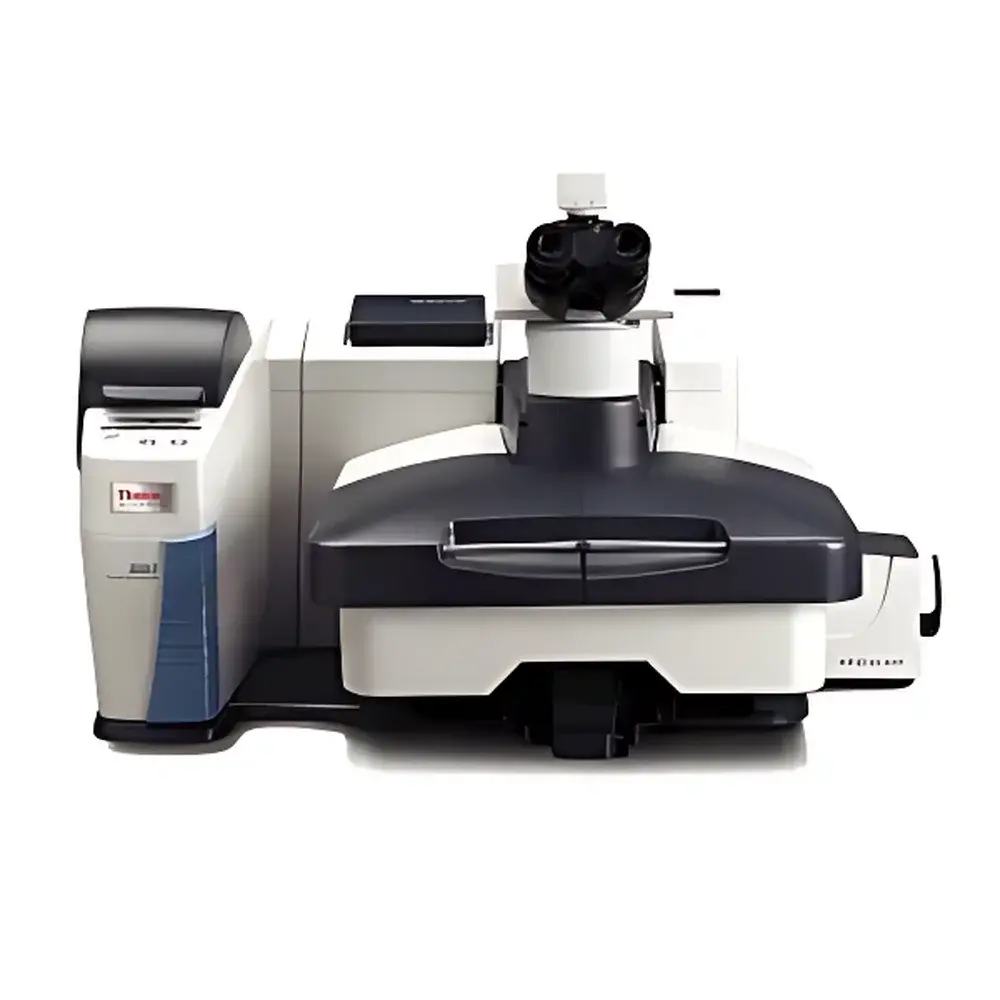
Thermo Scientific DXR3 Micro-Raman Spectrometer
| Brand | Thermo Fisher |
|---|---|
| Origin | USA |
| Manufacturer Type | Original Equipment Manufacturer (OEM) |
| Product Origin | Imported |
| Model | DXR3 |
| Instrument Type | Confocal Micro-Raman Spectrometer |
| Spectral Range | 50–6000 cm⁻¹ |
| Spectral Resolution | 1 cm⁻¹ |
| Spatial Resolution | 3500 nm |
| Minimum Wavenumber | 50 cm⁻¹ |
| Spectral Reproducibility | ±0.1 cm⁻¹ |
Overview
The Thermo Scientific™ DXR3 Micro-Raman Spectrometer is a research-grade confocal Raman imaging platform engineered for precision, reproducibility, and operational efficiency in regulated and high-throughput laboratory environments. It operates on the principle of inelastic light scattering—where monochromatic laser excitation induces vibrational energy transitions in molecular bonds—and captures the resulting Raman-shifted photons to generate chemically specific spectral fingerprints. Designed with a triple-stage spectrograph architecture, the DXR3 delivers high-fidelity peak shapes across the full spectral range (50–6000 cm⁻¹), enabling robust low-wavenumber analysis critical for inorganic lattice modes, phonon dispersion in 2D materials, and crystalline phase identification. Its confocal optical design supports both lateral (x-y) and axial (x-z) Raman mapping with sub-micron spatial resolution, making it suitable for depth-profiling multilayer thin films, coating integrity assessment, subsurface defect localization, and inclusion analysis in transparent or semi-transparent matrices—including through glass, polymer packaging, and protective barriers.
Key Features
- Confocal micro-Raman architecture with automated alignment and real-time laser power stabilization for day-to-day performance consistency
- Triple-grating spectrograph with wavelength-optimized gratings for 532 nm, 633 nm, and 780 nm excitation—eliminating cross-wavelength performance compromise
- Single-acquisition full-spectrum coverage from 50 to 3500 cm⁻¹ (or up to 6000 cm⁻¹ with 532 nm excitation), avoiding stitching artifacts
- Patented cosmic-ray rejection algorithm and intelligent dark-current subtraction for artifact-free spectra
- Depolarized laser excitation mode to minimize orientation-dependent spectral bias in anisotropic samples
- User-replaceable smart modules: lasers, filters, and gratings—interchangeable across the DXR platform family
- Class 1 laser safety-certified microscope; fiber-optic probes and select accessories classified as Class 3B (requiring appropriate eyewear and procedural controls)
- GO-button workflow automation: one-touch acquisition, processing, and report generation directly from the microscope interface—no post-acquisition PC interaction required
Sample Compatibility & Compliance
The DXR3 accommodates diverse sample geometries and physical states—from microparticles and thin sections to bulk solids, packaged evidence, and fragile cultural heritage artifacts. Its non-destructive, label-free measurement capability enables direct analysis through polyethylene evidence bags, borosilicate ampoules, and polymer coatings without sample preparation. The system meets international regulatory expectations for analytical instrumentation: it ships with a comprehensive DQ/IQ/OQ/PQ validation package supporting GLP, GMP, and ISO/IEC 17025 compliance workflows. All data handling, user access control, electronic signatures, and audit trail functionality are implemented in accordance with FDA 21 CFR Part 11 requirements via OMNIC™ D/S software.
Software & Data Management
OMNIC D/S software provides a validated, secure environment for spectral acquisition, multivariate analysis (PCA, cluster analysis), hyperspectral image processing, and quantitative mapping. It includes automated fluorescence background subtraction, intensity normalization across instruments and excitation wavelengths, multi-point wavenumber calibration, and instrument-specific spectral response correction. Raw and processed data are stored in vendor-neutral HDF5 format with embedded metadata (instrument parameters, user ID, timestamp, calibration history), ensuring long-term traceability and interoperability with third-party chemometric platforms. Audit trails record all user actions—including spectral modification, report export, and parameter changes—with immutable timestamps and operator attribution.
Applications
- Forensics: Identification of trace particulates, illicit drugs, explosives residues, and counterfeit pharmaceuticals in evidentiary packaging
- Pharmaceuticals: Polymorph screening, API distribution mapping, crystallinity assessment, and contaminant identification in dosage forms
- Materials Science: Graphene layer counting, carbon nanotube chirality assignment, Si crystallinity quantification, and DLC coating stress analysis
- Cultural Heritage: Non-invasive pigment identification, varnish degradation monitoring, and ceramic glaze composition profiling
- Semiconductors & Photovoltaics: Strain mapping in Si wafers, passivation layer uniformity, and defect-associated phonon modes
- Polymers & Composites: Phase separation visualization, filler dispersion homogeneity, interfacial adhesion evaluation, and UV-induced oxidation profiling
- Geosciences & Gemology: Mineral phase discrimination, fluid inclusion characterization, and synthetic vs. natural diamond differentiation
FAQ
Is the DXR3 compliant with 21 CFR Part 11 for regulated laboratories?
Yes—the OMNIC D/S software includes role-based access control, electronic signatures, and a tamper-evident audit trail meeting FDA requirements for electronic records and signatures.
Can the system perform depth profiling on multilayer polymer films?
Yes—its confocal optical design enables precise x-z Raman mapping with axial resolution better than 1.7 µm, allowing sequential layer interrogation without physical sectioning.
What laser safety certifications apply to the base configuration?
The integrated microscope is Class 1 laser-safe; however, optional fiber probes and external sampling accessories operate at Class 3B and require documented laser safety protocols and certified eyewear.
How does the system handle fluorescence interference in biological or aged organic samples?
It applies real-time, excitation-wavelength-specific fluorescence background subtraction algorithms, combined with tunable laser power and depolarized excitation to suppress intrinsic fluorescence contributions.
Are calibration standards and validation documentation included?
Yes—the system ships with NIST-traceable polystyrene and silicon calibration standards, plus a complete DQ/IQ/OQ/PQ package including test protocols, acceptance criteria, and editable validation reports.





