
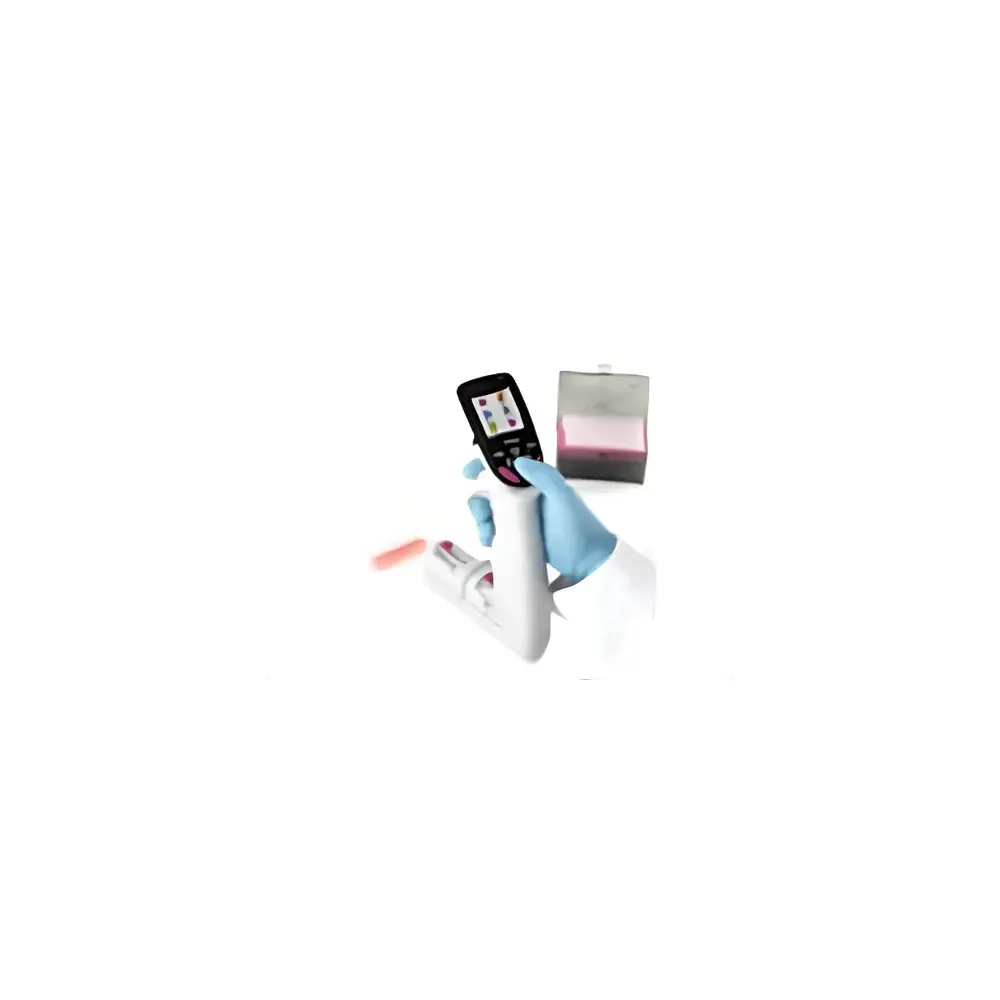
Thermo Scientific E1-ClipTip Equalizer Adjustable-Spacing Electronic Multichannel Pipette
| Brand | Thermo Fisher |
|---|---|
| Origin | USA |
| Model | E1-ClipTip Equalizer Adjustable-Spacing Electronic Multichannel Pipette |
| Type | Electronic Multichannel Pipette with ClipTip Tip Attachment System |
| Compliance | ISO 8655–6 (2022), USP <859>, GLP/GMP-ready audit trail support via Thermo Fisher Connect Software |
| Power | Rechargeable Li-ion battery (≥10,000 pipetting cycles per charge) |
| Tip Compatibility | Thermo Scientific ClipTip low-retention tips only |
| Channel Count | 8- or 12-channel variants available |
| Spacing Adjustment Range | 4.5 mm to 14.2 mm (continuous, motorized, programmable) |
| Display | High-contrast OLED touchscreen with multi-language UI (EN/DE/FR/ES/CN/JP/KO) |
| Connectivity | Bluetooth 5.0 + USB-C for firmware updates and data export |
Overview
The Thermo Scientific E1-ClipTip Equalizer is an electronically actuated, multi-channel pipette engineered for high-precision liquid handling across heterogeneous labware formats. Unlike conventional fixed-spacing multichannel pipettes, the E1-ClipTip Equalizer implements a motor-driven, continuously adjustable inter-tip spacing mechanism—enabling seamless transition between standard 96-well plates (8 mm pitch), 384-well plates (4.5 mm), tube racks (9–14.2 mm), horizontal gel combs, and custom arrayed vessels. Its operation is grounded in closed-loop electro-mechanical control: integrated position sensors and stepper motors dynamically reposition each channel’s vertical axis while maintaining synchronized tip height, Z-axis alignment, and consistent aspiration/dispense force profiles. This architecture eliminates manual reconfiguration errors and ensures volumetric reproducibility (CV ≤ 0.8% at nominal volume) across all spacing configurations—critical for assay development, HTS workflow integration, and regulated QC environments.
Key Features
- Motorized, continuous inter-tip spacing adjustment (4.5–14.2 mm) with tactile feedback and on-screen calibration verification
- ClipTip tip attachment system: positive-lock, low-torque engagement ensures leak-free sealing and minimizes tip ejection force (reducing operator fatigue and tip waste)
- OLED touchscreen interface with intuitive drag-and-drop spacing presets, volume programming, and real-time error logging
- Programmable method storage: up to 20 user-defined protocols—including volume, speed, mixing cycles, and spacing profiles—retained after power-off
- Integrated battery management with state-of-charge indicator and USB-C fast-recharge (0–100% in <90 min)
- Compliance-ready firmware: supports electronic signatures, audit trails, and instrument usage logs aligned with FDA 21 CFR Part 11 requirements when paired with Thermo Fisher Connect Software
Sample Compatibility & Compliance
The E1-ClipTip Equalizer accommodates a broad spectrum of primary and secondary sample containers without adapter hardware: standard 96- and 384-well microplates (ANSI/SLAS format), PCR strip tubes, 1.5/2.0 mL conical tubes, deep-well blocks, and horizontal electrophoresis gel trays. Its spacing flexibility mitigates cross-contamination risk during parallel transfers between non-aligned vessels—e.g., from a tube rack to staggered wells in a custom assay plate. From a regulatory standpoint, the device conforms to ISO 8655–6:2022 (volumetric performance of electronic pipettes), meets USP criteria for automated liquid handlers in pharmaceutical testing, and supports GLP/GMP documentation workflows through encrypted, time-stamped operational records.
Software & Data Management
Thermo Fisher Connect Software serves as the central hub for fleet-wide configuration, calibration tracking, and data integrity management. Users can remotely push firmware updates, synchronize spacing/volume protocols across multiple E1 units, and export CSV- or PDF-formatted activity logs—including date/time stamps, operator ID, executed protocol name, and detected anomalies (e.g., tip seal failure, over-pressure event). All data exports are digitally signed and tamper-evident. For laboratories operating under 21 CFR Part 11, the software enforces role-based access control, electronic signature capture, and immutable audit trails—ensuring full traceability from pipette actuation to final report generation.
Applications
- High-throughput screening: rapid reformatting of compound libraries from source tubes into assay plates with variable well patterns
- Molecular biology workflows: parallel setup of PCR/qPCR master mixes across staggered tube arrays or gradient plates
- Cell culture & bioprocessing: uniform seeding or media exchange across multi-well inserts with non-standard geometries
- Quality control labs: standardized transfer of reference standards between vials and validation plates under ISO 17025-accredited procedures
- Academic core facilities: shared-instrument scheduling with preloaded, experiment-specific spacing profiles to minimize setup time and user training burden
FAQ
Does the E1-ClipTip Equalizer require recalibration when changing tip spacing?
No. The system performs automatic mechanical self-checks during startup and spacing adjustment; volumetric accuracy remains validated across the full 4.5–14.2 mm range per ISO 8655–6.
Can non-ClipTip tips be used with this pipette?
No. The E1-ClipTip Equalizer is mechanically and functionally designed exclusively for Thermo Scientific ClipTip tips; use of third-party tips voids calibration certification and compromises sealing integrity.
Is spacing adjustment possible mid-protocol?
Yes—spacing can be modified between steps within a stored method, enabling sequential transfers to multiple labware types in a single run.
How is traceability maintained for regulated environments?
All operations generate timestamped, operator-tagged records stored locally and optionally synced to Thermo Fisher Connect; audit trails include parameter settings, tip lot numbers, and system health diagnostics.
What maintenance is required beyond routine cleaning?
Annual factory calibration is recommended; internal motor and sensor diagnostics are performed automatically during each power cycle and reported via the OLED interface.



