
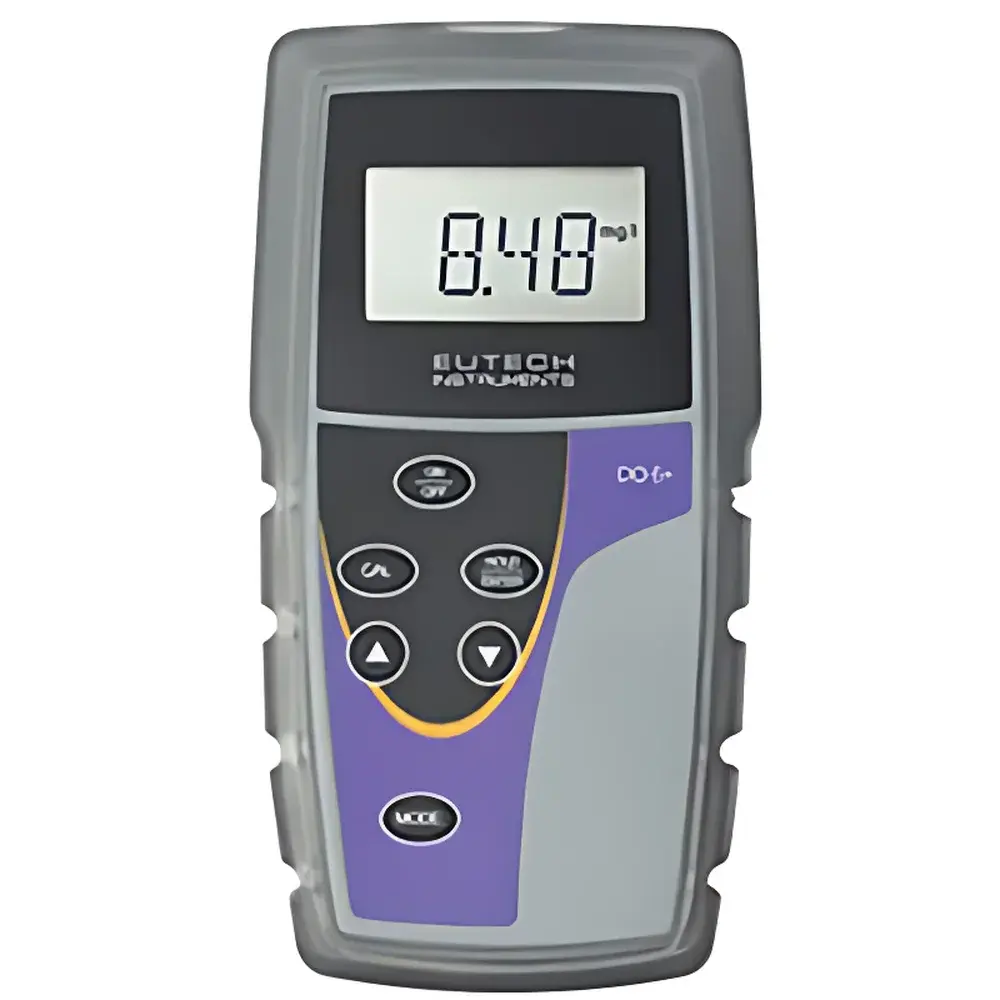
Thermo Scientific Eutech DO6+ Portable Dissolved Oxygen Meter
| Brand | Eutech |
|---|---|
| Origin | USA |
| Manufacturer Type | Authorized Distributor |
| Product Origin | Imported |
| Model | DO6+ |
| Instrument Type | Portable |
| Dissolved Oxygen Range | 0.00–19.99 mg/L (ppm) |
| Resolution | 0.01 mg/L |
| Accuracy | ±1.5% of full scale |
| Saturation Range | 0.0–199.9% |
| Saturation Resolution | 0.1% |
| Salt Compensation | 0.0–50.0 ppt (manual entry, auto-applied) |
| Atmospheric Pressure Compensation | 500–1499 mmHg / 66.6–199.9 kPa (manual entry, auto-applied) |
| Temperature Range | 0.0–50.0 °C |
| Temp Resolution | 0.1 °C |
| Temp Accuracy | ±0.5 °C |
| Auto-Off Delay | 20 min |
| Power | 4×AAA alkaline batteries (≥700 h life) |
| Dimensions (unit) | 15.7 × 8.5 × 4.2 cm |
| Weight (unit) | 255 g |
| Display | LCD (4.5 × 2.3 cm) |
| Input Connectors | BNC + 2.5 mm phono sockets |
Overview
The Thermo Scientific Eutech DO6+ Portable Dissolved Oxygen Meter is a field-deployable electrochemical analyzer engineered for reliable, on-site measurement of dissolved oxygen (DO) concentration in aqueous environments. It employs a galvanic (primary-cell) oxygen sensor—requiring no polarization time—enabling immediate stabilization and rapid response to dynamic DO changes in natural waters, wastewater effluents, aquaculture systems, and process streams. Unlike polarographic sensors, the DO6+’s self-powered electrode eliminates the need for external voltage application or warm-up delays, ensuring consistent baseline stability and reduced operator dependency. The instrument integrates dual compensation algorithms—temperature, salinity, and barometric pressure—all applied in real time using user-entered values, thereby conforming to standard correction protocols outlined in ASTM D888 and ISO 5814 for accurate reporting of mg/L (ppm) and % saturation. Its rugged, IP67-rated housing (when equipped with protective cap), compact footprint, and extended battery life (>700 hours) make it suitable for routine monitoring under variable ambient conditions—from riverbanks to industrial outfalls.
Key Features
- Galvanic DO sensor with zero-polarization startup: delivers stable readings within seconds without pre-conditioning.
- Simultaneous dual-unit display: mg/L (ppm) and % saturation, both updated in real time with active compensation.
- Manual input and automatic application of salinity (0.0–50.0 ppt) and atmospheric pressure (500–1499 mmHg), enabling traceable correction per US EPA Method 360.1 and APHA Standard Methods 4500-O.
- Two-point calibration protocol: supports 0% (sodium sulfite) and 100% (air-saturated water) standards; optional single-point mg/L calibration for field verification.
- Data integrity safeguards: automatic power-off after 20 minutes of inactivity; non-volatile memory retains calibration constants and last-measured values during battery replacement.
- Intuitive LCD interface (4.5 × 2.3 cm) with high-contrast digits and status icons for temperature mode, compensation activation, and electrode health indicators.
- Dedicated diagnostic code system: displays alphanumeric error codes (e.g., “E03”, “E12”) corresponding to documented fault conditions in the operator manual—facilitating rapid troubleshooting without service dispatch.
Sample Compatibility & Compliance
The DO6+ is validated for use with freshwater, seawater, brackish water, treated wastewater, and low-conductivity process water (≥50 µS/cm). It complies with fundamental requirements of ISO/IEC 17025 for field instrumentation used in accredited environmental testing laboratories when operated within specified environmental limits (0–50 °C, non-condensing humidity). While not certified for GLP or GMP-regulated release testing, its calibration traceability—via NIST-traceable DO standards—and audit-ready calibration logs (when paired with optional PC software) support data defensibility in regulatory submissions under 40 CFR Part 136 and EU Water Framework Directive monitoring programs. Electrode compatibility includes standard 12-mm diameter galvanic DO probes with Teflon membrane and integrated thermistor—no proprietary transducer required.
Software & Data Management
The DO6+ operates as a standalone meter with no embedded Bluetooth or USB interface; however, it supports manual data transcription into LIMS or spreadsheet platforms via its clear, unambiguous readout. For laboratories requiring electronic records, Thermo Scientific offers complementary desktop software (Eutech LogPro v3.x, sold separately) that interfaces via RS-232 cable (adapter required) to capture timestamped DO, temperature, salinity, and pressure inputs. Exported CSV files include column headers compliant with ASTM E1447 metadata conventions, enabling direct import into statistical process control (SPC) tools. All calibration events—including date, operator ID (manually entered), standard values used, and slope/offset diagnostics—are stored onboard and retrievable via menu navigation, satisfying basic FDA 21 CFR Part 11 record-keeping expectations for non-critical environmental monitoring.
Applications
- Regulatory surface water quality surveys (EPA Region-specific NPDES compliance checks)
- Aquaculture pond management: DO profiling across diel cycles to prevent hypoxia-induced mortality
- Wastewater treatment plant (WWTP) influent/effluent monitoring per ISO 15839
- Drinking water distribution system validation—especially post-chlorination zones where DO rebound indicates residual oxidant decay
- Environmental impact assessments (EIAs): baseline DO mapping in wetland restoration projects
- Educational laboratory instruction: hands-on demonstration of Henry’s Law, respiration kinetics, and oxygen sag curve modeling
FAQ
Does the DO6+ require electrode polarization before first use?
No. The galvanic sensor is operational immediately upon connection—no warm-up or polarization period is needed.
Can the instrument store multiple calibration histories?
It retains the most recent calibration parameters only; historical logs require external recording or optional LogPro software.
Is the DO6+ suitable for measuring DO in high-viscosity or suspended-solid-laden samples?
Yes—provided the sensor membrane remains free of fouling; users should perform mechanical cleaning (soft brush, mild detergent) between measurements in turbid matrices.
What is the recommended recalibration frequency for field deployments?
Daily two-point calibration is advised for critical applications; weekly verification suffices for trend monitoring when ambient conditions remain stable.
Does the meter meet IP rating requirements for outdoor use?
The base unit meets IP54; with the supplied protective cap installed, it achieves IP67 ingress protection against dust and temporary immersion.







