
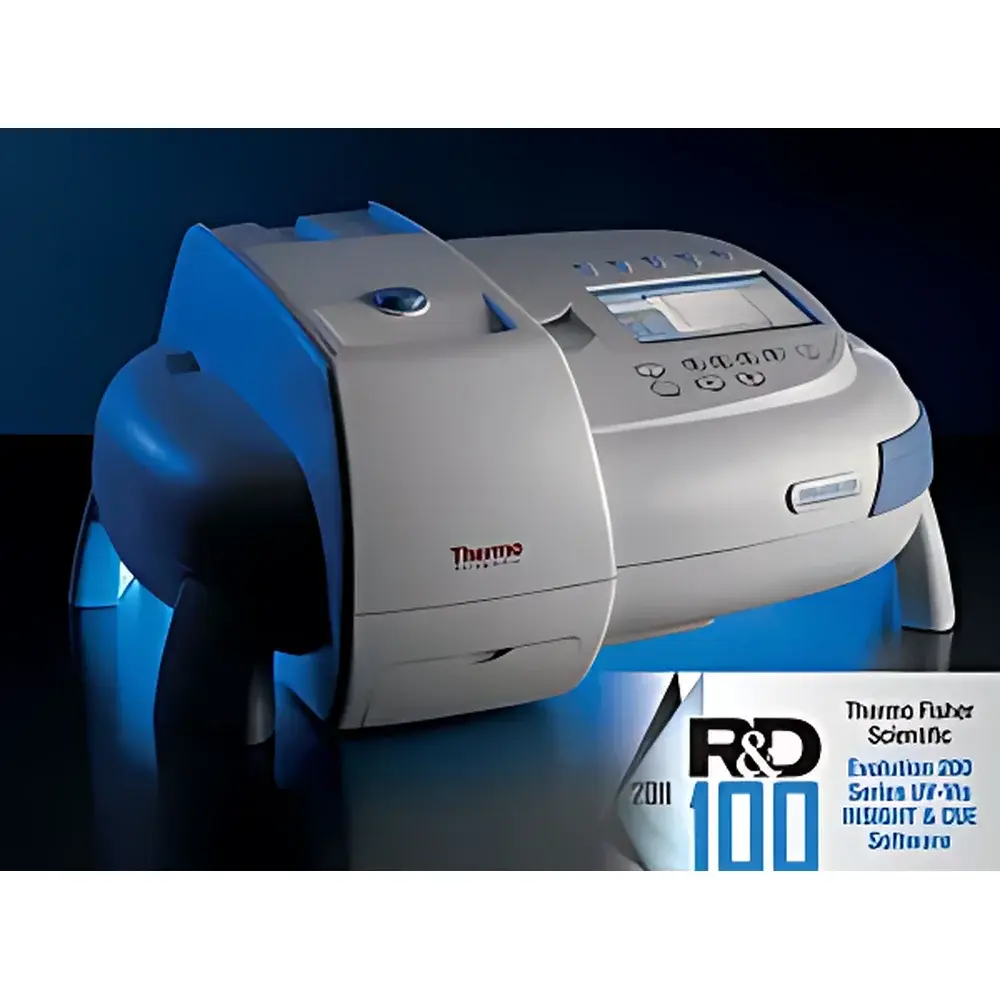
Thermo Scientific Evolution 200 Series UV-Vis Spectrophotometer
| Brand | Thermo Fisher |
|---|---|
| Origin | Shanghai, China |
| Manufacturer Type | Original Equipment Manufacturer (OEM) |
| Regional Classification | Domestic |
| Model | Evolution 200 Series |
| Instrument Architecture | Double-Beam |
| Detector Type | Photodiode Array (PDA) |
| Wavelength Range | 190–1100 nm |
| Automation Level | Automatic Wavelength Selection |
| Spectral Bandwidth | Variable at 1 nm or 2 nm |
| Wavelength Accuracy | ±0.5 nm |
| Stray Light | <0.05% T at 220 nm and 340 nm |
Overview
The Thermo Scientific Evolution 200 Series UV-Vis Spectrophotometer is a high-performance, double-beam optical instrument engineered for precision absorbance, transmittance, and reflectance measurements across the ultraviolet, visible, and near-infrared spectral regions (190–1100 nm). It operates on classical Beer–Lambert law-based photometric principles, utilizing a stable xenon flash lamp source and a high-fidelity holographic grating monochromator to deliver reproducible spectral data with minimal photometric drift. Its double-beam architecture continuously compares sample and reference beam intensities at every data point—enabling real-time compensation for source fluctuations, detector drift, or environmental perturbations. This design is particularly critical for kinetic studies, long-duration stability monitoring, and analysis of turbid, scattering, or heterogeneous samples where conventional single-beam systems exhibit significant baseline instability.
Key Features
- Double-beam optical path with real-time reference correction, ensuring high photometric reproducibility (±0.002 A at 0.5 A) and robustness against instrumental drift.
- Variable spectral bandwidth (1 nm or 2 nm) optimized for resolution–sensitivity trade-offs in routine QA/QC and research-grade applications.
- Xenon flash lamp with 3-year full warranty: zero warm-up time, low power consumption, and uniform intensity across 190–1100 nm—eliminating the need for lamp alignment or recalibration after replacement.
- Advanced Focusing Optics (AFBG): dynamically concentrates light into micro-volume cells (e.g., 40 µL pathlength), solid samples, or fiber-coupled probes—improving signal-to-noise ratio by up to 4× in low-transmission scenarios.
- High-speed scanning: monochromator drive speed up to 31,000 nm/min; spectral acquisition at up to 6,000 nm/min—among the fastest in its class for double-beam UV-Vis platforms.
- Integrated 7-inch color touchscreen running Windows XP Embedded, with 320 GB SSD storage, four USB 2.0 ports, and native support for external peripherals (keyboard, mouse, thermal printer, network adapter).
Sample Compatibility & Compliance
The Evolution 200 accommodates diverse sample formats—including cuvettes (10 mm to 50 mm pathlength), microvolume cells, integrating spheres (ISA-220), fiber-optic probes, temperature-controlled Peltier sample changers (0–100 °C), and diffuse reflectance accessories. Its modular design supports ASTM E275, ISO 6262, USP , and EP 2.2.25 compliance workflows via certified CVC performance verification kits and mercury lamp validation modules. The system meets electromagnetic compatibility requirements per EN 61326-1 and carries CE, ETL, cETL, UL/EN 61010-1, and CSA C22.2 No. 61010 safety certifications. All firmware and software comply with GLP/GMP documentation standards, including full audit trail capability and electronic signature support under FDA 21 CFR Part 11 when deployed with validated INSIGHT configurations.
Software & Data Management
INSIGHT software serves as the unified control and analysis environment—supporting wavelength scanning, fixed-wavelength kinetics, quantitative analysis (6 algorithm options), and multi-step reaction modeling (zero-, first-, and second-order kinetics). Its workbook-based architecture stores instrument configuration, accessory metadata, calibration curves, and report templates as portable .wbk files—ensuring method portability and traceable re-execution. The Customer-Defined Environment (CUE) scripting module enables QA/QC labs to automate complex multi-instrument workflows without programming expertise: users define custom UI panels, sequence actions (e.g., auto-zero → load standard → measure → calculate → export PDF), and enforce parameter constraints—all validated for regulatory compliance. Simulation mode facilitates operator training and SOP validation without consuming instrument runtime. Data export supports CSV, XML, PDF, and direct email transmission via SMTP integration.
Applications
The Evolution 200 is routinely deployed in pharmaceutical quality control (assay, dissolution, impurity profiling per ICH Q2(R2)), life sciences (protein quantification via Bradford/Lowry, nucleic acid purity A260/A280), materials science (thin-film thickness, bandgap estimation), environmental analysis (COD, nitrate/nitrite, phosphate), and food safety (colorimetric enzyme assays, antioxidant capacity). Its AFBG-enhanced optics enable reliable measurement of opaque suspensions (e.g., cell cultures, nanoparticle colloids), reflective coatings, and fiber-optic sensor outputs—extending usability beyond conventional liquid-phase spectroscopy. Kinetic modules support enzyme kinetics (Michaelis–Menten), polymerization monitoring, and redox reaction tracking with dwell-time-adjustable sampling up to 100 Hz per channel.
FAQ
Does the Evolution 200 require lamp warm-up before measurement?
No—the xenon flash lamp activates only during acquisition, eliminating warm-up delays and enabling immediate start-up.
Can the instrument perform USP/EP-compliant system suitability testing?
Yes—when equipped with the certified CVC wheel and mercury lamp accessory, it automates wavelength accuracy, photometric linearity, and stray light verification per USP and EP 2.2.25.
Is INSIGHT software compliant with FDA 21 CFR Part 11?
Yes—when installed in a validated environment with enabled audit trail, electronic signatures, and role-based access control, INSIGHT satisfies Part 11 requirements for electronic records and signatures.
What is the minimum detectable sample volume using AFBG optics?
With the Micro AFBG adapter, reliable spectra can be acquired from as little as 40 µL in a 2 mm × 2 mm pathlength cell.
How does the double-beam architecture improve measurement stability?
By continuously referencing the sample beam against a matched reference beam, it compensates for temporal variations in source intensity, detector sensitivity, and ambient conditions—critical for sub-hour kinetic experiments and low-absorbance measurements.




