
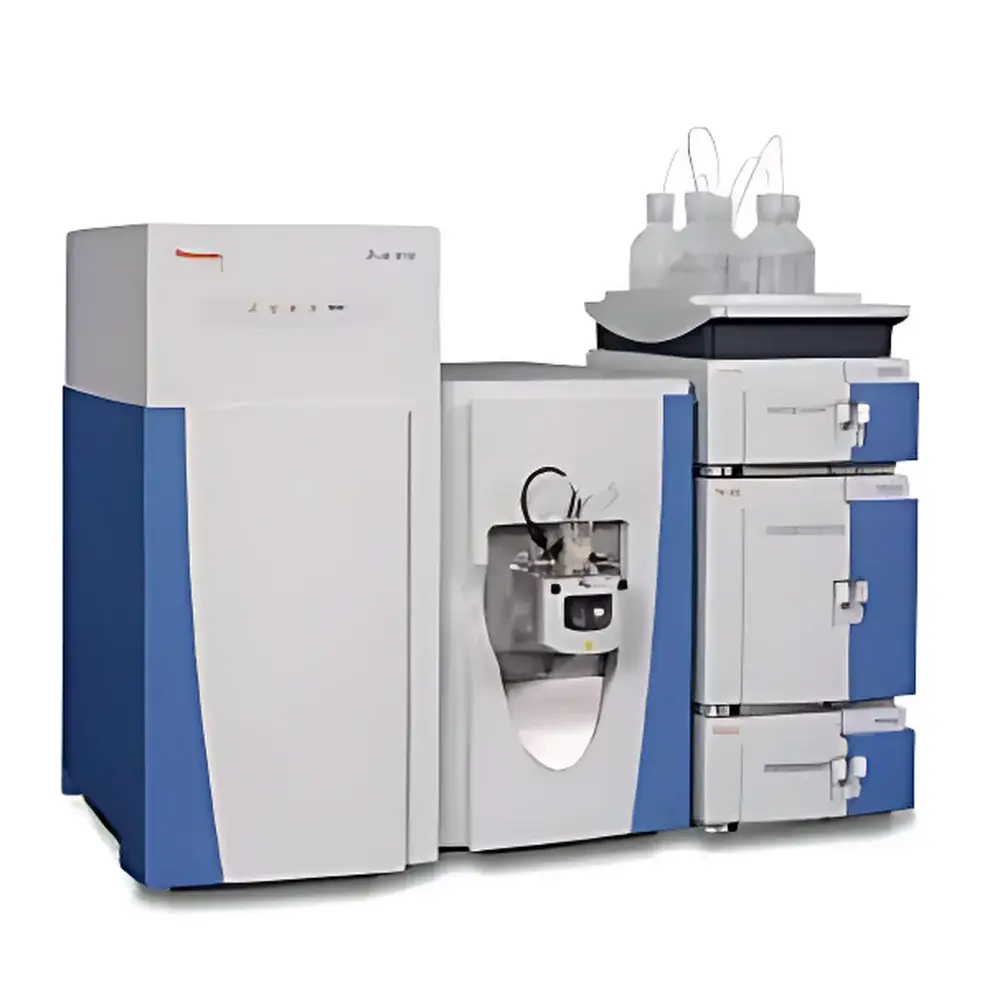
Thermo Scientific Exactive LC/MS – Benchtop Fourier Transform High-Resolution Liquid Chromatography Mass Spectrometer
| Brand | Thermo Fisher |
|---|---|
| Origin | USA |
| Manufacturer | Thermo Fisher Scientific |
| Product Type | Imported Instrument |
| Model | Exactive LC/MS – Benchtop FT Orbitrap High-Resolution LC-MS |
| Instrument Category | Ion Trap |
| Price Range | USD 140,000 – 280,000 (based on configuration and regional duties/taxes) |
Overview
The Thermo Scientific Exactive LC/MS is a benchtop high-resolution liquid chromatography mass spectrometry (LC-MS) system engineered for precision molecular characterization in research, pharmaceutical development, and quality control laboratories. At its core lies the Orbitrap mass analyzer—a Fourier transform-based electrostatic trap that delivers high mass accuracy (< 3 ppm RMS mass error with external calibration; < 1 ppm with internal lock mass), exceptional resolution (up to 100,000 FWHM at m/z 200), and robust dynamic range. Unlike time-of-flight or quadrupole-based platforms, the Orbitrap operates via image current detection of orbiting ions, enabling simultaneous acquisition of full-scan MS and MS/MS spectra without duty cycle loss. Its integration with ultra-high-performance liquid chromatography (UHPLC) systems supports narrow peak widths (< 1 s FWHM), and the instrument achieves up to 10 Hz full-scan acquisition—ensuring ≥10 data points across typical UHPLC peaks while retaining accurate mass and elemental composition assignment per scan.
Key Features
- Orbitrap mass analyzer delivering resolution up to 100,000 (FWHM at m/z 200) and sub-ppm mass accuracy under routine operation
- Real-time, full-scan high-resolution MS and MSn acquisition at 10 Hz—enabling comprehensive coverage of fast UHPLC separations
- Sub-second polarity switching (< 1 s cycle time) between positive and negative ion modes with maintained mass accuracy and sensitivity
- No averaging required: accurate mass determination and elemental composition assignment generated per individual scan
- Integrated HCD (Higher-Energy Collisional Dissociation) cell for structural elucidation, providing fragment ion spectra with high mass accuracy across broad m/z ranges
- Benchtop footprint with minimal infrastructure requirements—no liquid nitrogen or high-vacuum pumping stations needed
Sample Compatibility & Compliance
The Exactive LC/MS accommodates diverse sample types including small molecules (e.g., metabolites, impurities, synthetic intermediates), peptides, and intact proteins (via top-down or middle-down workflows). It supports reversed-phase, HILIC, ion-pairing, and SEC-based LC methods. From a regulatory standpoint, the system is designed to support GLP- and GMP-compliant environments: raw data files are immutable and timestamped; software audit trails meet FDA 21 CFR Part 11 requirements when deployed with Thermo Scientific Chromeleon CDS v7.3+ and appropriate IT governance controls. Method validation protocols align with ICH Q2(R2) and USP , while mass accuracy performance adheres to ASTM E2690–22 (Standard Practice for Mass Spectrometry Data Quality Assessment).
Software & Data Management
Data acquisition and processing are managed through Thermo Scientific Tune and Xcalibur software platforms. Tune provides intuitive instrument control—including real-time parameter optimization for resolution, AGC target, and injection time—while Xcalibur delivers post-acquisition workflows for compound identification, formula generation, and spectral library matching. The Formula Finder algorithm applies isotopic pattern recognition, element probability filtering (C, H, N, O, S, P, Cl, Br, F, I), and intensity-weighted scoring to propose elemental compositions without user-defined constraints in most cases. All raw data are stored in proprietary .raw format, fully compatible with third-party open-source tools (e.g., MZmine 3, OpenMS) via vendor-neutral mzML export. Data integrity is enforced through SHA-256 checksums and hierarchical project-based file organization.
Applications
- Non-targeted metabolomics and exposomics profiling requiring unambiguous formula assignment in complex biological matrices
- Impurity identification and structural confirmation per ICH Q5 and Q3 guidelines in pharmaceutical development
- Peptide mapping and post-translational modification analysis in biopharmaceutical characterization
- Environmental contaminant screening (e.g., PFAS, pesticides, emerging toxins) with retrospective data mining capability
- Forensic toxicology workflows where high mass accuracy differentiates isobaric drugs and metabolites (e.g., amphetamines vs. cathinones)
- Food authenticity testing and adulterant detection using accurate-mass databases and spectral libraries
FAQ
What mass analyzer technology does the Exactive LC/MS employ?
The system uses an Orbitrap mass analyzer—a high-field Fourier transform ion trap that measures image currents from orbiting ions, enabling high resolution and mass accuracy without scanning magnetic or electric fields.
Is internal calibration required for routine accurate mass measurement?
External calibration suffices for most applications; however, lock-mass correction (e.g., using polysiloxane or caffeine) enables continuous real-time recalibration during acquisition, achieving sub-1 ppm mass error over extended runs.
Can the Exactive LC/MS perform quantitative analysis?
Yes—it supports label-free and labeled (e.g., SILAC, TMT) quantitation workflows with high reproducibility (CV < 10% across technical replicates) when coupled with optimized UHPLC gradients and scheduled SRM-like extraction in full-scan mode.
Does the system comply with 21 CFR Part 11 for regulated environments?
When configured with validated Chromeleon CDS v7.3+, electronic signatures, audit trail logging, and role-based access control, the platform meets baseline requirements for Part 11 compliance—subject to site-specific validation documentation.
What is the typical maintenance interval for the Orbitrap analyzer?
Under standard operating conditions and proper vacuum management, the Orbitrap requires no routine servicing; preventive maintenance focuses on ion source cleaning, column replacement, and pump oil changes every 6–12 months per Thermo’s recommended schedule.
Related Products




