
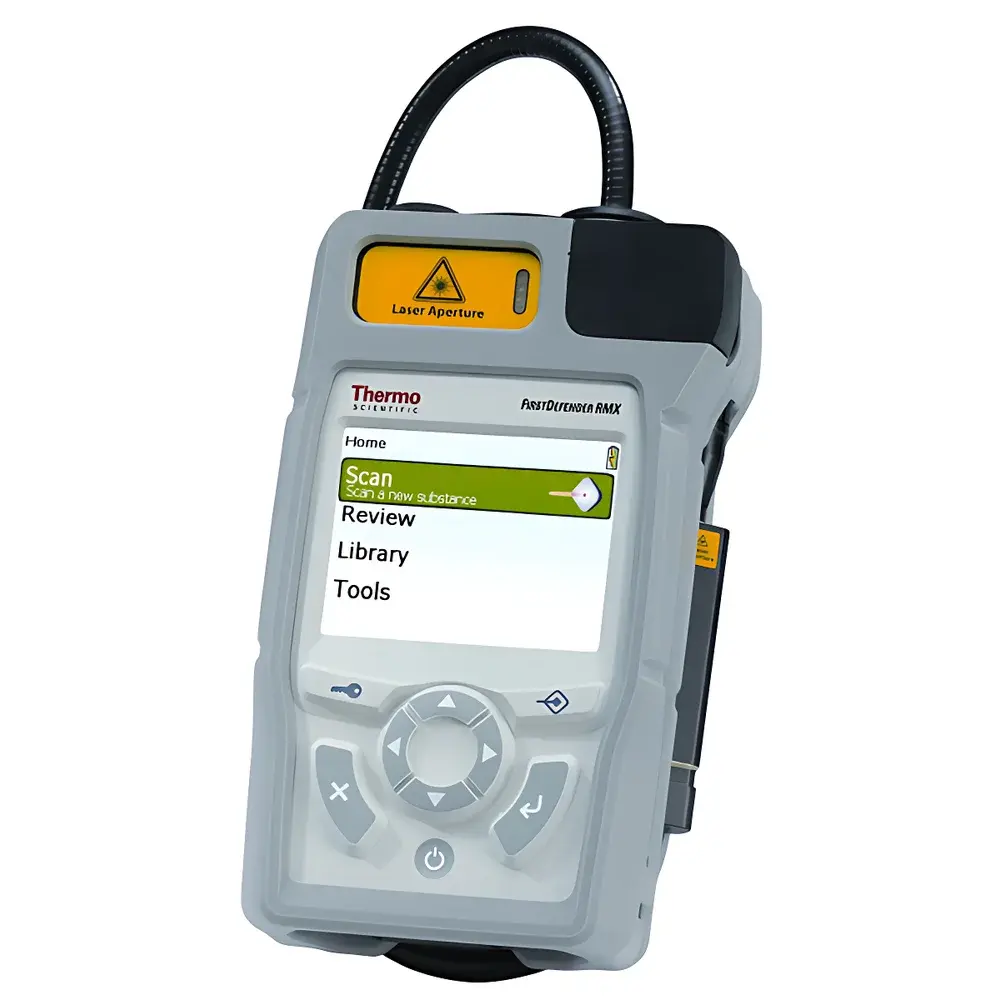
Thermo Scientific FirstDefender RMX Handheld Raman Spectrometer
| Brand | Thermo Fisher |
|---|---|
| Origin | USA |
| Manufacturer | Thermo Fisher Scientific |
| Product Type | Imported |
| Model | FirstDefender RMX |
| Instrument Category | Portable/Handheld Raman Spectrometer |
| Spectral Range | 250 cm⁻¹ to 2875 cm⁻¹ |
| Spectral Resolution | 7–10.5 cm⁻¹ (FWHM) |
| Minimum Wavenumber | 250 cm⁻¹ |
| Spectral Repeatability | ≤ ±0.5 cm⁻¹ |
Overview
The Thermo Scientific FirstDefender RMX Handheld Raman Spectrometer is an advanced, field-deployable analytical instrument engineered for rapid, non-contact identification of unknown chemical substances in real-world operational environments. It operates on the principle of spontaneous Raman scattering—where monochromatic laser excitation (typically 785 nm) induces molecular vibrational transitions, generating a unique spectral fingerprint for each compound. Designed specifically for first responders, hazardous materials (HAZMAT) teams, military CBRN units, and customs/border protection personnel, the FirstDefender RMX delivers laboratory-grade spectral discrimination in a ruggedized, battery-powered platform. Its optical architecture incorporates thermoelectrically cooled CCD detection, optimized fiber-optic coupling, and adaptive background subtraction algorithms to ensure high signal-to-noise ratio across diverse sample matrices—including opaque solids, viscous liquids, and particulates—without requiring physical sampling or preparation.
Key Features
- Point-and-shoot™ operation: Enables direct analysis through transparent and semi-transparent barriers (e.g., glass vials, plastic bags, laminated packaging), minimizing operator exposure and sample contamination.
- Multi-modal deployment: Supports handheld scanning, fixed-position bottle-mode interrogation, and robotic integration via standardized mounting interfaces (e.g., ISO 9409-1-50-4-M6 flange compatibility).
- Ruggedized industrial design: Certified to MIL-STD-810F for shock, vibration, temperature extremes, and humidity; rated IP67 for dust and water immersion resistance (1 m for 30 min).
- Enhanced mixture detection: Leverages iterative multivariate curve resolution (MCR) and constrained least-squares fitting to deconvolve overlapping spectra and report constituent identities with confidence metrics.
- Real-time spectral validation: Onboard chemometric engine performs automated library matching against >15,000 reference spectra—including explosives (e.g., RDX, PETN, TNT), toxic industrial chemicals (TICs), toxic industrial materials (TIMs), chemical warfare agents (CWAs), pharmaceutical precursors, and white powder threats.
- Regulatory-ready data handling: All spectral acquisitions include embedded metadata (GPS coordinates, timestamp, operator ID, instrument calibration status) compliant with chain-of-custody documentation requirements.
Sample Compatibility & Compliance
The FirstDefender RMX accommodates solid powders, crystalline aggregates, gels, emulsions, and low-fluorescence liquids without dilution or pretreatment. Fluorescence suppression is achieved via adaptive laser power modulation and dark-current compensated integration. The system complies with ASTM E2591–22 (Standard Practice for Field Detection of Chemical Warfare Agents and Toxic Industrial Chemicals Using Portable Raman Spectrometers) and supports audit-ready workflows aligned with ISO/IEC 17025:2017 for testing laboratories. All spectral libraries are curated using NIST-traceable reference standards and validated per IUPAC guidelines for spectroscopic identification confidence levels.
Software & Data Management
Instrument control and spectral interpretation are managed through Thermo Scientific OMNIC Mobile software (v3.x), featuring offline library updates, customizable reporting templates (PDF/CSV), and encrypted local storage. Data export supports LIMS integration via ASTM E1384-compliant XML schema. Audit trail functionality records all user actions—including spectrum acquisition, library edits, and result approvals—with immutable timestamps and digital signature support. Software architecture conforms to FDA 21 CFR Part 11 requirements for electronic records and signatures when deployed in regulated environments (e.g., DHS-certified screening protocols).
Applications
- Hazardous material incident response: Immediate identification of suspicious powders, liquids, or residues at crime scenes, clandestine labs, or transportation hubs.
- Border security and customs inspection: Non-invasive verification of declared cargo contents, including precursor chemicals subject to international export controls (e.g., UN Schedule 2 compounds).
- Military CBRN defense: Tactical identification of degraded or masked agents under field conditions, including soil-contaminated samples and aerosol deposits.
- Pharmaceutical supply chain integrity: Verification of active pharmaceutical ingredients (APIs) and excipients in unopened blister packs or HDPE containers.
- Environmental emergency response: Rapid characterization of unknown spills or leaks involving volatile organic compounds (VOCs), pesticides, or heavy metal complexes.
FAQ
Does the FirstDefender RMX require routine calibration with certified standards?
Yes—calibration verification is performed automatically at startup using an internal polystyrene reference; full wavelength and intensity calibration is recommended every 90 days or after mechanical shock events, per Thermo’s documented calibration procedure TR-012-2023.
Can it identify mixtures containing more than two components?
It reliably resolves binary and ternary mixtures when component concentrations exceed 5% w/w and spectral features are non-degenerate; performance diminishes with highly fluorescent or spectrally congested systems (e.g., dyed polymers).
Is spectral data export compatible with third-party chemometric platforms?
Yes—raw spectra (.spc format) and processed results (.csv) are fully interoperable with MATLAB, Python (scikit-learn, PyMca), and commercial tools such as Unscrambler X and GRAMS AI.
What is the typical battery life during continuous operation?
Up to 6 hours with standard Li-ion battery pack (model FBAT-785); hot-swappable battery option extends operational time indefinitely in mobile command configurations.
How does the system handle ambient light interference outdoors?
The optical path includes narrow-band laser line filters (±0.5 nm bandwidth) and notch rejection filters (>OD6 rejection at 785 nm), enabling stable operation under direct sunlight and variable lighting conditions.
Related Products





