
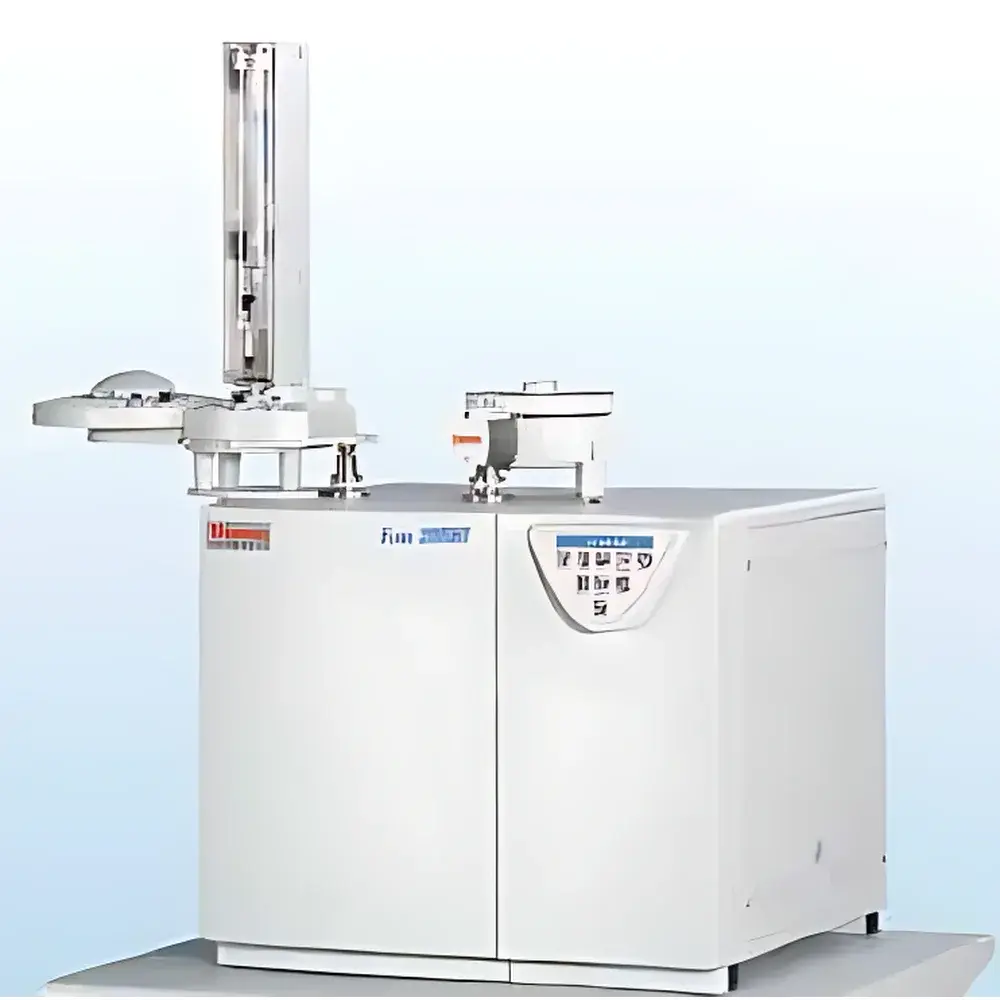
Thermo Scientific Flash 2000HT Isotope Ratio Elemental Analyzer Coupled to IRMS
| Brand | Thermo Fisher |
|---|---|
| Origin | Germany |
| Manufacturer Type | Original Equipment Manufacturer (OEM) |
| Origin Category | Imported Instrument |
| Model | Flash 2000HT |
| Price Range | USD 420,000 – 700,000 |
| Instrument Type | Stable Gas-Source Isotope Ratio Mass Spectrometry (IRMS) Interface System |
| Analytical Precision | High-precision δ-value reproducibility (typical 1σ < 0.2‰ for δ¹³C, δ¹⁵N, δ³⁴S, δ²H, δ¹⁸O) |
Overview
The Thermo Scientific Flash 2000HT is a high-performance, dual-furnace elemental analyzer engineered for seamless hyphenation with isotope ratio mass spectrometers (IRMS). It operates on the principle of quantitative combustion and high-temperature conversion—enabling precise, offline or online determination of stable isotope ratios (δ¹³C, δ¹⁵N, δ³⁴S, δ²H, δ¹⁸O) in solid and liquid samples. Unlike conventional single-furnace systems, the Flash 2000HT integrates two independent, thermally isolated reaction zones within one compact chassis: a dynamic flash combustion furnace (up to 1,150 °C) optimized for total carbon, nitrogen, and sulfur analysis; and a high-temperature pyrolysis furnace (up to 1,400 °C) dedicated to oxygen and hydrogen isotope analysis via water generation from organics or direct H₂/O₂ release from inorganic matrices. This architecture eliminates cross-contamination risks and ensures stoichiometric completeness across diverse sample types—including soils, sediments, plant tissues, pharmaceuticals, geological carbonates, and aqueous standards—without manual reconfiguration.
Key Features
- Dual-furnace design with independent temperature control and gas flow management—enabling concurrent method optimization for C/N/S and H/O analyses
- Full automation via Thermo Scientific EASY software: sequence-driven sample loading, furnace switching, gas chromatographic separation (GC), and cryogenic trapping—all synchronized with IRMS data acquisition
- Integrated solid and liquid autosamplers (EA-Liqui and EA-Solid modules) supporting microgram-to-milligram sample masses with sub-µg precision
- Catalytic post-combustion scrubbing (CuO, NiO, Co₃O₄) and selective GC columns (e.g., Porapak Q, Hayesep D) for baseline-resolved CO₂, N₂, SO₂, H₂, and CO peaks
- Robust architecture compliant with ISO/IEC 17025 laboratory accreditation requirements; designed for 24/7 operation in GLP- and GMP-regulated environments
Sample Compatibility & Compliance
The Flash 2000HT accommodates a broad spectrum of certified reference materials (CRMs) and real-world matrices, including but not limited to USGS40 (L-glutamic acid), IAEA-CH-6 (sucrose), NBS-127 (BaSO₄), and VSMOW/SLAP water standards. Its sample introduction system meets ASTM D7934 (carbon isotopic analysis of petroleum products), ISO 10260 (nitrogen in soils), and EN 15936 (δ¹⁵N in foodstuffs). All hardware interfaces—including He carrier gas lines, transfer tubing, and IRMS-compatible ion source coupling—are calibrated per Thermo’s Traceable Calibration Protocol (TCP), ensuring traceability to NIST SRMs. The system supports audit-ready electronic records aligned with FDA 21 CFR Part 11 requirements when operated with optional EASY-IRMS software modules.
Software & Data Management
Control and data reduction are managed through Thermo Scientific EASY-IRMS v3.x, a validated platform offering method templating, real-time peak integration, multi-point normalization (using internal and external standards), and delta-value calculation against user-defined reference gases (e.g., VPDB, AIR-N₂, VCDT, VSMOW). Raw spectral files (.raw) are stored in vendor-neutral mzML format; processed results export to CSV, Excel, or LIMS-compatible XML. The software includes built-in uncertainty propagation algorithms (based on ISO Guide 98-3), automatic drift correction using bracketing standards, and configurable reporting templates for ISO/IEC 17025 technical records.
Applications
- Ecological tracing: δ¹³C and δ¹⁵N in food webs, soil organic matter turnover, and methane source partitioning
- Geochemical provenancing: δ¹⁸O and δ¹³C in carbonates for paleoclimate reconstruction and diagenetic assessment
- Pharmaceutical authenticity: isotopic fingerprinting of active pharmaceutical ingredients (APIs) to detect counterfeiting or synthetic adulteration
- Environmental forensics: δ³⁴S in sulfate aerosols and δ²H in groundwater for pollution source identification
- Metabolic studies: compound-specific isotope analysis (CSIA) of amino acids, fatty acids, and carbohydrates following preparative GC fractionation
FAQ
Can the Flash 2000HT be used with non-Thermo IRMS systems?
Yes—its analog/digital output ports and standardized helium carrier interface support integration with Delta V, MAT 253, IsoPrime, and other gas-source IRMS platforms via third-party interface kits.
What is the typical analysis time per sample?
Average cycle time is 8–12 minutes for C/N/S modes and 10–15 minutes for H/O modes, depending on sample homogeneity and required signal-to-noise ratio.
Is routine maintenance documented and traceable?
All service logs, calibration certificates, and performance verification reports are automatically timestamped and archived within EASY-IRMS, fulfilling GLP documentation requirements.
Does the system support unattended overnight operation?
Yes—equipped with robotic autosampler (up to 120 positions), automated gas supply monitoring, and thermal runaway protection, it supports fully unattended batch runs under validated SOPs.
How is oxygen isotope analysis performed for silicates or metal oxides?
Via high-temperature fluorination (using BrF₅ or ClF₃) in external reactors; the Flash 2000HT then quantitatively converts liberated O₂ for IRMS measurement—protocol validated per ASTM D7213 and ISO 11299.




