
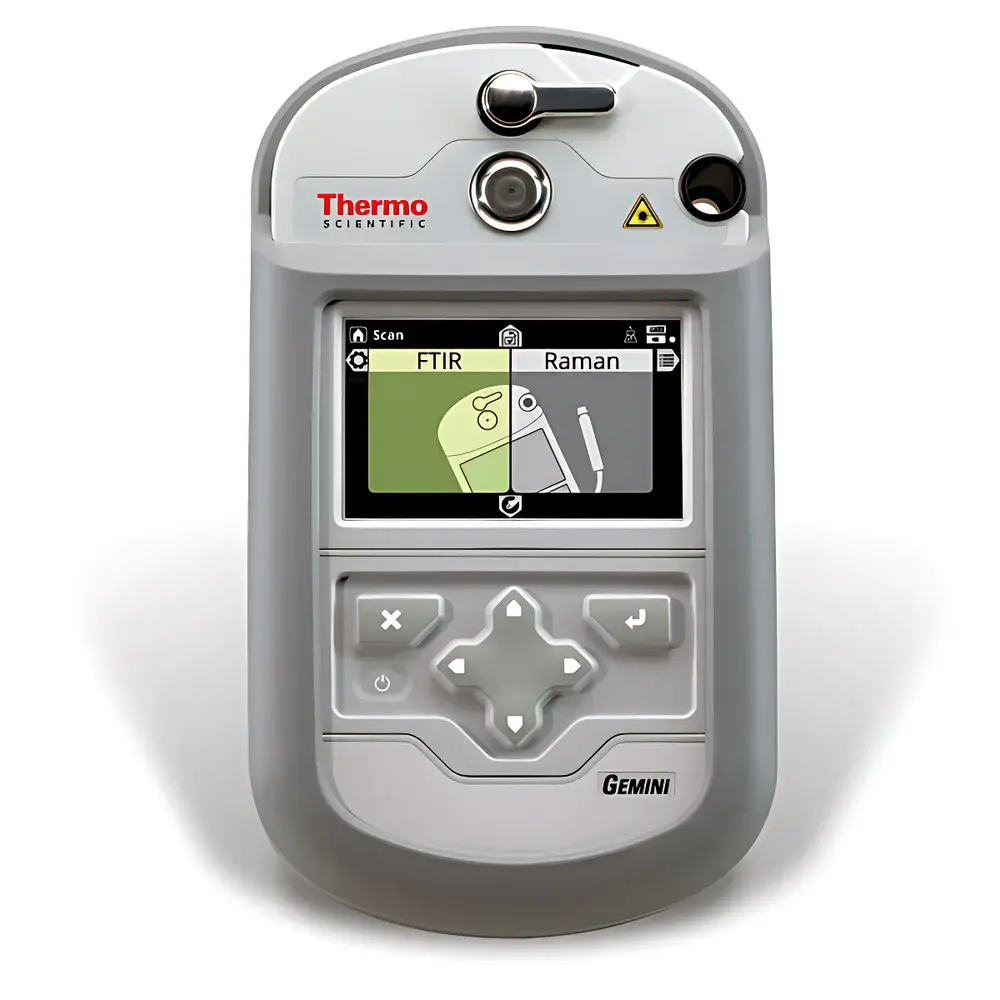
Thermo Scientific Gemini Handheld Raman-FTIR Dual-Mode Spectrometer
| Brand | Thermo Fisher |
|---|---|
| Origin | USA |
| Manufacturer | Thermo Fisher Scientific |
| Product Type | Handheld Dual-Mode Spectrometer (Raman + FTIR) |
| Model | Gemini |
| Spectral Range (Raman) | 250–2875 cm⁻¹ |
| Spectral Resolution (Raman) | 7–10.5 cm⁻¹ (FWHM, full range) |
| Spectral Resolution (FTIR) | 4 cm⁻¹ |
| Minimum Wavenumber (Raman) | 250 cm⁻¹ |
| Minimum Wavenumber (FTIR) | 650 cm⁻¹ |
| Spectral Reproducibility | ≤ ±0.5 cm⁻¹ shift across three consecutive scans of identical sample under fixed acquisition conditions |
Overview
The Thermo Scientific™ Gemini™ Handheld Raman-FTIR Dual-Mode Spectrometer is an engineered field-deployable analytical platform that integrates two complementary vibrational spectroscopic techniques—dispersive Raman spectroscopy and Fourier Transform Infrared (FTIR) spectroscopy—into a single, ruggedized instrument. Unlike conventional handheld spectrometers limited to one modality, the Gemini leverages the physical principles of inelastic photon scattering (Raman) and molecular dipole absorption (FTIR) to deliver orthogonal chemical identification data. This dual-technique architecture enables unambiguous compound verification where spectral ambiguities arise—such as distinguishing polymorphs, hydrates, or structurally similar isomers—without requiring laboratory confirmation. Designed for operational continuity in high-stakes environments—including hazardous material response, border security screening, forensic evidence triage, and industrial quality control—the Gemini meets MIL-STD-810G for shock, vibration, and environmental resilience, and operates reliably across –10 °C to +50 °C ambient conditions.
Key Features
- Dual-Modal Acquisition Engine: Seamless switching between Raman and attenuated total reflectance (ATR)-based FTIR modes via motorized ATR crystal positioning and laser/IR source selection—no manual hardware reconfiguration required.
- Field-Optimized Optomechanics: Thermally stabilized Raman laser diode (785 nm), low-noise CCD detector, and high-throughput Michelson interferometer with dynamically aligned mirror system ensure consistent signal-to-noise ratio across temperature gradients.
- Tactile-Ready Interface: 7-inch resistive touchscreen with glove-compatible actuation, integrated QWERTY virtual keyboard, and context-sensitive soft keys reduce cognitive load during time-critical operations.
- Profile-Driven Workflow: Predefined analytical profiles—each embedding optimized laser power (10–500 mW), integration time, co-additions, ATR pressure, and spectral processing algorithms—enable rapid deployment without on-site parameter tuning.
- Embedded Safety Architecture: Real-time laser power monitoring, automatic beam shuttering upon lid opening, Class 3B laser compliance (IEC 60825-1), and IR source interlock prevent unintended exposure during operation.
Sample Compatibility & Compliance
The Gemini accommodates solid, liquid, gel, and powder samples via interchangeable ATR crystals (ZnSe, diamond, or Ge) and non-contact Raman sampling at working distances up to 15 mm. Its design adheres to ASTM E2529-22 (Standard Guide for Field Portable Raman Spectrometers), ISO 8549 (Vibrational Spectroscopy Terminology), and IEC 61000-6-2/6-3 (EMC immunity/emission). For regulated environments, the instrument supports audit-trail-enabled data capture compliant with FDA 21 CFR Part 11 requirements when used with Thermo Scientific™ OMNIC™ Mobile software v3.2 or later. All spectral libraries—including DHS Chemical Threat Library, NATO ED-222, and USP Reference Standards—are preloaded and version-controlled per NIST SP 800-53 Rev. 5 configuration management protocols.
Software & Data Management
Powered by OMNIC Mobile firmware, the Gemini provides real-time spectral processing including cosmic ray removal, baseline correction (asymmetric least squares), peak deconvolution, and library search using correlation-based matching (Pearson coefficient ≥ 0.92 threshold). Search results display color-coded confidence indicators (green: ≥95%, yellow: 85–94%, red: <85%) alongside first-response guidance derived from NFPA 704 hazard diamonds and GHS pictograms. Raw and processed spectra export in ASTM E131-compliant JCAMP-DX format; metadata includes GPS coordinates, operator ID, timestamp, environmental sensor readings (humidity, barometric pressure), and instrument calibration status. Data synchronization occurs over Wi-Fi or LTE to Thermo’s secure cloud infrastructure, supporting role-based access control and automated backup to on-premise servers per ISO/IEC 27001-certified policies.
Applications
- Hazardous material identification during CBRNE incident response
- Non-destructive verification of pharmaceutical raw materials and finished dosage forms
- Forensic analysis of illicit drugs, explosives precursors, and counterfeit consumer goods
- In-field quality assurance of polymer resins, coatings, and battery electrolytes
- Customizable threat detection workflows for customs and border protection agencies
FAQ
Does the Gemini require external calibration standards for routine operation?
No. The instrument performs automated internal wavelength calibration before each Raman and FTIR acquisition using built-in reference sources (silicon Raman peak at 520.7 cm⁻¹ and polystyrene FTIR bands). NIST-traceable verification is recommended annually or after mechanical shock events.
Can the Gemini identify mixtures or only pure substances?
It detects major components in binary or ternary mixtures when spectral contributions are >15% w/w and exhibit non-overlapping signature bands. Quantitative mixture analysis requires method-specific partial least squares (PLS) models developed offline in OMNIC Specta.
Is the device compatible with existing Thermo Scientific spectral libraries?
Yes. All licensed libraries—including FirstDefender™, TruDefender™, and HazMat databases—are natively supported. Library updates are delivered via encrypted OTA firmware patches validated through SHA-256 checksum verification.
What is the battery life under continuous scanning mode?
Up to 6 hours with standard Li-ion battery (14.4 V, 8.4 Ah); hot-swappable secondary battery extends operation to 12+ hours. Battery health diagnostics report remaining cycles and capacity degradation per IEEE 1625 standards.
How does the Gemini handle fluorescence interference in Raman measurements?
The 785 nm excitation source minimizes fluorescence in most organic matrices. If residual fluorescence persists, the instrument applies iterative polynomial baseline subtraction with user-adjustable order (2nd to 6th degree) and adaptive smoothing window sizing.





