
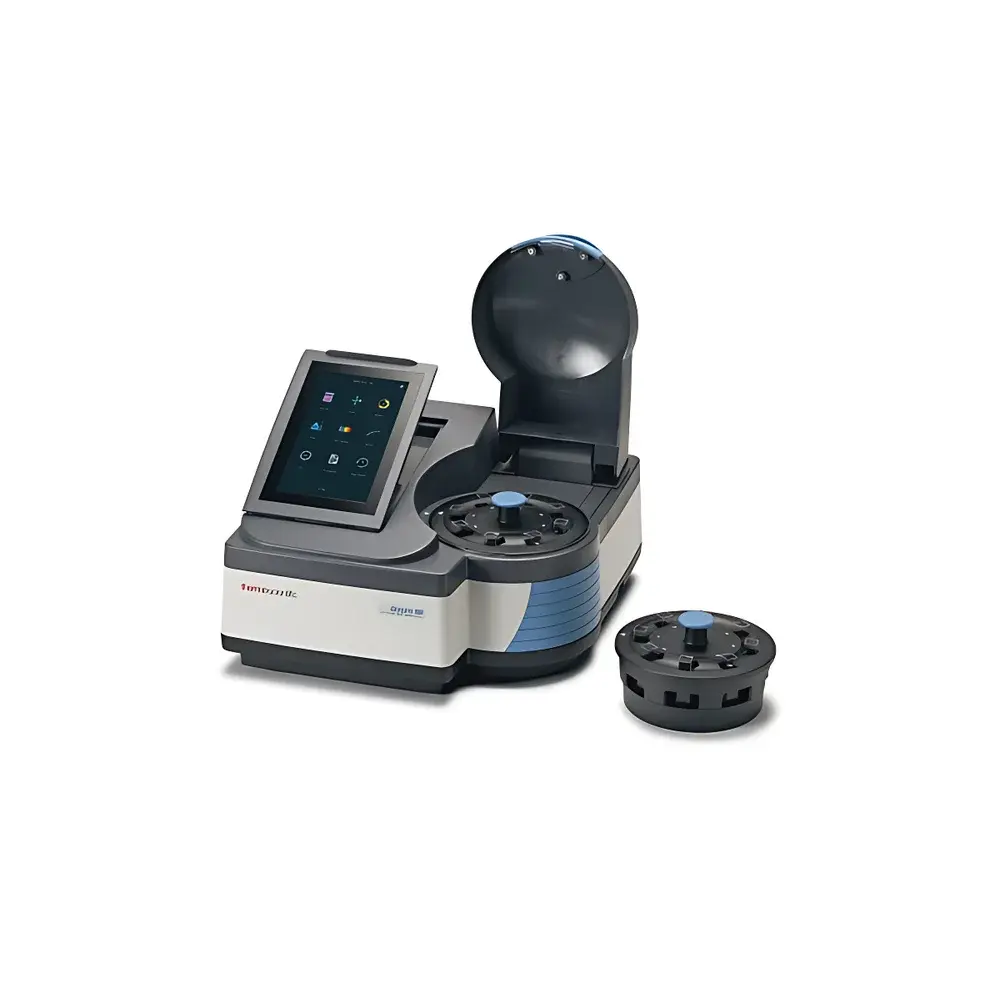
Thermo Scientific GENESYS 150 UV-Visible Spectrophotometer
| Brand | Thermo Fisher |
|---|---|
| Origin | USA |
| Manufacturer | Thermo Fisher Scientific |
| Product Type | Imported Instrument |
| Model | GENESYS 150 |
| Optical Design | Double-Beam |
| Detector | Photodiode Array (PDA) |
| Wavelength Range | 190–1100 nm |
| Wavelength Selection | Manual |
| Spectral Bandwidth | 2 nm |
| Wavelength Accuracy | ±0.5 nm |
| Stray Light | <1.0%T at 198 nm (KCl), <0.05%T at 220 nm (NaI), <0.03%T at 340 nm (NaNO₂) |
Overview
The Thermo Scientific™ GENESYS™ 150 UV-Visible Spectrophotometer is a high-performance, double-beam scanning spectrophotometer engineered for routine and advanced quantitative analysis in pharmaceutical, environmental, academic, and quality control laboratories. It operates on the fundamental principle of Beer–Lambert law-based absorbance measurement, utilizing a stable, flash-type xenon lamp as its broadband light source. Unlike continuous-deuterium/tungsten systems, the xenon lamp activates only during spectral acquisition—reducing thermal drift, extending source lifetime (>10⁹ flashes), and minimizing baseline instability. The instrument employs a fixed-grating monochromator coupled with a photodiode array detector, enabling rapid full-spectrum acquisition (190–1100 nm) without mechanical wavelength scanning. Its double-beam optical architecture continuously corrects for source intensity fluctuations and cuvette path-length variations, delivering high photometric reproducibility (<0.002 A at 0.5 A) and long-term stability essential for regulated workflows.
Key Features
- 7-inch high-resolution, tiltable touchscreen tablet interface with glove-compatible multi-touch operation and anti-glare surface coating—optimized for ergonomic use under varied lab lighting conditions.
- Flash-type xenon lamp with intelligent power management: energized exclusively during measurement cycles, ensuring >5 years of typical operational life without degradation in spectral output or intensity stability.
- Double-beam optical design with real-time reference beam compensation, eliminating the need for frequent zeroing and improving inter-day repeatability across extended assay runs.
- Spectral bandwidth of 2 nm (FWHM) ensures adequate resolution for most small-molecule and biomolecular applications while maintaining sufficient photon flux for low-concentration measurements.
- Wavelength accuracy of ±0.5 nm (verified per NIST-traceable standards) supports compliance with pharmacopeial methods requiring strict spectral alignment (e.g., USP <857>, EP 2.2.25).
- Low stray light performance—<0.03%T at 340 nm (NaNO₂)—enables reliable quantitation in high-absorbance regions critical for DNA/RNA analysis and colored compound assays.
Sample Compatibility & Compliance
The GENESYS 150 accommodates standard 10-mm rectangular quartz, glass, or plastic cuvettes (including disposable and micro-volume variants), as well as flow cells and fiber-optic probes via optional adapters. Its optical path is compatible with all common solvent systems (aqueous, organic, acidic, and basic media), provided cuvette material transmits within the 190–1100 nm range. The system meets key international regulatory expectations: it supports audit-trail-enabled data capture when operated with VISIONlite™ Software under 21 CFR Part 11-compliant configurations (with appropriate IT infrastructure and procedural controls). Instrument qualification documentation—including IQ/OQ templates aligned with ISO/IEC 17025 and ASTM E275—can be supplied upon request. Routine performance verification follows ASTM E926 (wavelength accuracy), E275 (stray light), and E169 (photometric accuracy) protocols.
Software & Data Management
Control and data handling are managed through Thermo Scientific™ VISIONlite™ Software—a validated, Windows-based application supporting method development, kinetic profiling, multi-wavelength quantitation, and spectral library matching. Raw absorbance, transmittance, and derivative spectra are stored in vendor-neutral .csv and .jdx formats. Data export is supported via USB drive, Ethernet, or Wi-Fi—enabling seamless integration into LIMS or ELN platforms. Direct printing of compliant reports (including instrument ID, date/time stamp, operator ID, and measurement parameters) is available over networked printers. The embedded tablet OS allows local method storage, Smart Start one-click launch of pre-validated SOPs, and secure user-level access control (administrator, analyst, viewer roles). All software updates are distributed through Thermo Fisher’s secure support portal and include version-controlled release notes and validation impact assessments.
Applications
- Pharmaceutical QC: Active pharmaceutical ingredient (API) assay, dissolution testing, excipient compatibility screening, and cleaning validation swab extract analysis.
- Life sciences: Nucleic acid quantification (A260/A280 ratios), protein concentration (BCA/Lowry), enzyme kinetics (NADH/NADPH monitoring at 340 nm), and cell culture density estimation.
- Environmental testing: Nitrate/nitrite, phosphate, heavy metal complexation (e.g., Cr(VI) with diphenylcarbazide), and COD determination.
- Academic research: Ligand-binding studies, thermodynamic parameter derivation (van’t Hoff plots), and thin-film thickness estimation via interference fringe analysis.
- Food & beverage: Colorimetric assessment (e.g., anthocyanin content in juices), preservative quantification (sulfites, benzoates), and lipid oxidation monitoring (conjugated dienes at 234 nm).
FAQ
Does the GENESYS 150 support automated sample handling?
Yes—optional accessories include a 16-position automatic sampler, Peltier temperature-controlled cuvette holder (±0.1 °C stability), and smart pipetting module for precise reagent addition directly into cuvettes.
Is the xenon lamp replaceable by the end user?
Lamp replacement requires factory calibration and must be performed by Thermo Fisher-certified service personnel to maintain wavelength and photometric accuracy specifications.
Can the instrument be integrated into a GMP-compliant environment?
When deployed with VISIONlite™ in 21 CFR Part 11 mode (electronic signatures, audit trails, role-based permissions), and supported by documented IQ/OQ/PQ, it meets baseline requirements for GMP-regulated laboratories.
What is the minimum detectable absorbance change?
Photometric noise is ≤0.0004 A RMS (at 500 nm, 1 s integration time), enabling reliable detection of sub-0.001 A changes in controlled environments.
Are spectral calibration standards included?
A NIST-traceable holmium oxide filter is supplied for wavelength verification; optional deuterium and neutral density filters are available for photometric calibration.
Related Products






