
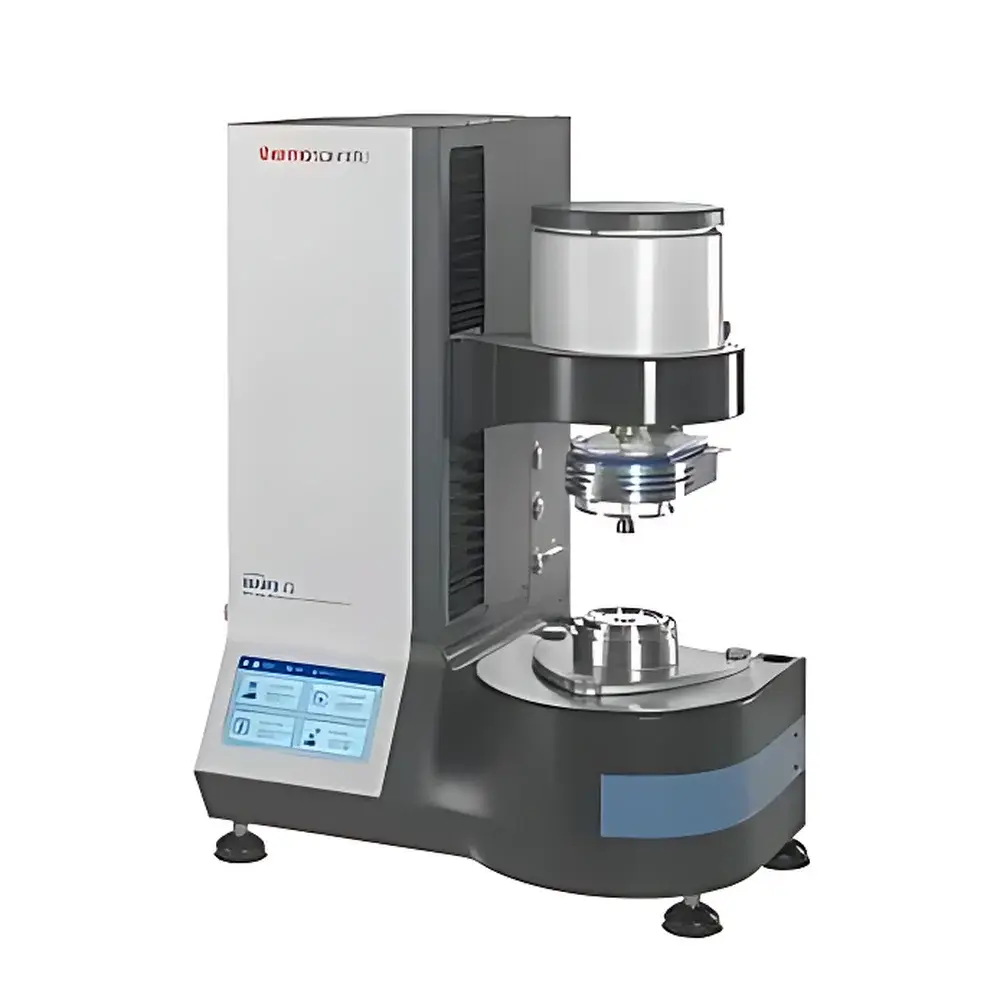
Thermo Scientific HAAKE MARS iQ AIR Air-Bearing Rotational Rheometer
| Brand | Thermo Scientific HAAKE |
|---|---|
| Origin | Germany |
| Instrument Type | Rotational Rheometer |
| Motor Bearing | Air-bearing |
| Minimum Rotational Speed | 0.001 rpm |
| Maximum Rotational Speed | 2000 rpm |
| Torque Range | 0.007 µNm – 150 mNm |
| Torque Resolution | 0.007 µNm |
| Frequency Range | 0.0001 – 209.4 rad/s |
| Frame Architecture | Folded H-Frame with Mineral Composite Base |
| Compliance | ASTM D4402, ISO 6721-10, ISO 3219, USP <911>, FDA 21 CFR Part 11 (optional software module) |
Overview
The Thermo Scientific™ HAAKE™ MARS™ iQ AIR is a high-precision air-bearing rotational rheometer engineered for quality control laboratories requiring robust, reproducible, and traceable viscoelastic characterization of complex fluids and soft solids. Operating on the principle of controlled shear deformation—applying defined rotational or oscillatory stress/strain to a sample confined between parallel plates, cone-and-plate, or concentric cylinder geometries—the instrument quantifies material responses including viscosity, storage modulus (G′), loss modulus (G″), yield stress, thixotropy, and time-dependent recovery. Its air-bearing motor eliminates mechanical friction, enabling ultra-low torque detection and exceptional signal-to-noise ratio across an extended dynamic range—from near-static conditions (0.001 rpm) to high-frequency oscillation (up to 209.4 rad/s, equivalent to ~33.3 Hz). The folded H-frame architecture, cast from high-damping mineral composite, minimizes thermal drift and vibration coupling—critical for long-term measurement stability in regulated environments.
Key Features
- Air-bearing EC motor delivering torque resolution of 0.007 µNm and continuous operation from 0.001 rpm to 2000 rpm
- Integrated 7-inch capacitive touchscreen running RheoWin iQ firmware—enabling SOP-driven workflows without external PC dependency
- “Connection Assistant” function: auto-detects geometry type (e.g., PP25, CP25, Searle-type cup), temperature module (Peltier, liquid-circulated, or electrical heating), and sensor calibration status upon attachment
- Color-coded plug system for rapid, error-proof pairing of temperature modules (blue = Peltier, red = liquid-circulated, black = high-temp electric)
- Normal force sensor with bidirectional axial force measurement (±50 N), supporting texture analysis, compressive yield, and interfacial rheology applications
- Mineral composite base offering coefficient of thermal expansion 85% at 10–100 Hz
- Modular design accommodating application-specific units: pressure-controlled cells, building materials fixtures (mortar, asphalt), tribology stages, and solvent-resistant environmental chambers
Sample Compatibility & Compliance
The MARS iQ AIR accommodates samples ranging from low-viscosity Newtonian liquids (e.g., solvents, monomers) to highly structured gels, pastes, and particle-laden suspensions (e.g., paints, cement slurries, pharmaceutical ointments). Geometric flexibility includes standard cone-plate (1°, 2°, 4°), parallel-plate (8–50 mm), and cylindrical systems (Couette, vane). All measurement protocols align with internationally recognized standards: ISO 3219 (rotational viscosity), ISO 6721-10 (dynamic mechanical analysis), ASTM D4402 (asphalt binder rheology), and USP (rheological testing of semisolid dosage forms). Optional 21 CFR Part 11-compliant software module provides electronic signatures, audit trails, and role-based access control—fully supporting GLP and GMP validation requirements.
Software & Data Management
RheoWin iQ firmware supports real-time data acquisition, automated parameter calculation (e.g., flow curves, frequency sweeps, creep-recovery), and export in ASTM E1447-compliant CSV or universal HDF5 format. The embedded OS permits local storage of ≥10,000 test records with timestamped metadata (operator ID, geometry ID, temperature setpoint, ambient humidity). For enterprise integration, optional RheoWin Connect enables secure HTTPS API access to raw torque/strain/time arrays and allows synchronization with LIMS via configurable JSON payloads. All software updates—including new compliance patches and method templates—are delivered free-of-charge via Thermo Fisher’s secure customer portal.
Applications
This rheometer serves as a primary analytical tool across regulated and industrial R&D/QC settings. In coatings formulation, it characterizes sag resistance and leveling behavior under low-shear ramping. In food science, it quantifies starch gelatinization kinetics and fat crystal network development during cooling ramps. Pharmaceutical labs use it to assess syringeability of injectables and spreadability of topical gels per Ph. Eur. 2.9.35. Polymer compounders rely on its wide frequency sweep capability to predict melt fracture onset and extrudate swell. Construction material labs apply custom-built mortar fixtures to evaluate workability retention and early-age hydration rheology. Petrochemical users deploy it for asphalt binder grading (PG classification) and oxidative aging simulation under controlled nitrogen purge.
FAQ
Does the MARS iQ AIR support automated temperature ramping during oscillatory tests?
Yes—Peltier and liquid-circulated modules allow programmable ramp rates from −40 °C to 200 °C with ±0.1 °C accuracy and hold stability < ±0.05 °C over 30 min.
Can I perform time-sweep measurements while maintaining constant normal force?
Yes—the integrated normal force feedback loop actively adjusts gap height to maintain user-defined axial load during prolonged tests, critical for studying structural recovery in thixotropic systems.
Is third-party software integration possible?
Yes—RheoWin Connect provides RESTful API endpoints for Python, MATLAB, and LabVIEW interoperability; raw torque and strain data streams are accessible in real time via TCP/IP socket.
What validation documentation is supplied with the instrument?
Each unit ships with Factory Calibration Certificate (traceable to PTB/NIST), IQ/OQ protocol templates aligned with ISO/IEC 17025, and full 21 CFR Part 11 implementation guide for regulated sites.
How is geometry alignment verified before measurement?
The system performs automatic gap calibration using capacitive gap sensing and motor current feedback—reporting alignment deviation (µm) and recommending corrective action if out of tolerance.



