
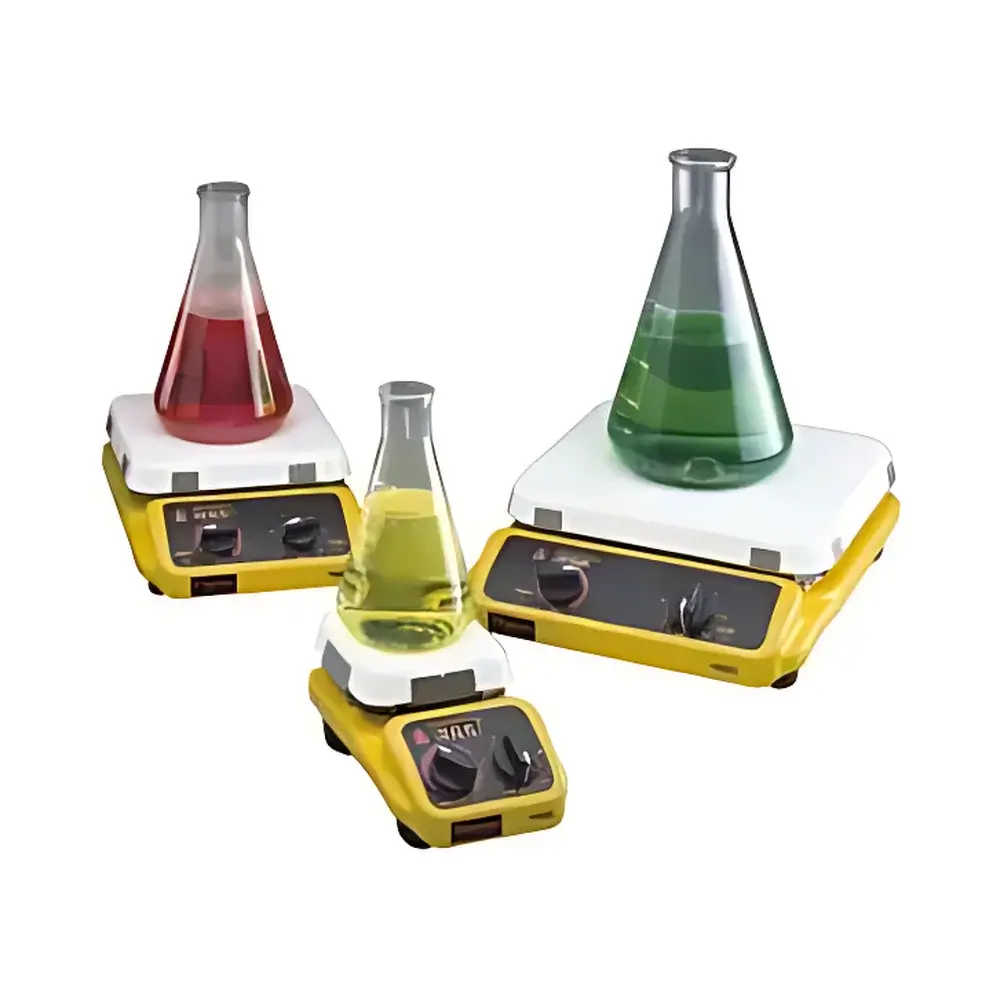
Thermo Scientific HP/SP Series Hot Plate Stirrer
| Brand | Thermo Fisher |
|---|---|
| Origin | USA |
| Manufacturer Type | Original Equipment Manufacturer (OEM) |
| Import Status | Imported |
| Model | HP/SP |
| Pricing | Available Upon Request |
Overview
The Thermo Scientific HP/SP Series Hot Plate Stirrer is an engineered laboratory workhorse designed for precise, reproducible heating and magnetic stirring of liquid samples in research, quality control, and teaching laboratories. Built upon Couette-type rotational hydrodynamics and resistive ceramic or aluminum plate heating architecture, this instrument delivers stable thermal output and consistent agitation across a wide operational envelope. Its dual-function design integrates independent control of surface temperature and stir bar rotation speed—enabling simultaneous thermal activation and homogenization critical for dissolution studies, reagent synthesis, buffer preparation, and viscosity-sensitive reactions. The unit operates on standard 120 VAC / 60 Hz power (North America) or 230 VAC / 50 Hz (international variants), with internal thermal cutoffs and overtemperature protection circuits compliant with IEC 61010-1 safety standards.
Key Features
- Ceramic or anodized aluminum heating surfaces—chemically inert, scratch-resistant, and thermally stable up to 540 °C (1004 °F)
- Three standard heating/stirring plate dimensions: 10.8 × 10.8 cm, 18.4 × 18.4 cm, and 26 × 26 cm—optimized for compatibility with common labware footprints
- Digital PID temperature controller with ±1 °C accuracy and 1 °C resolution; stir speed range: 0–1,200 rpm with ±5 rpm repeatability
- Integrated safety systems including auto-shutdown at preset max temperature, hot-surface indicator LED, and thermal runaway detection
- Modular configuration options: standalone hot plates (HP), magnetic stirrers (SP), and combined hot plate stirrers (HP/SP)—supporting single-zone or multi-zone heating variants
- Ergonomic front-panel interface with tactile buttons and high-contrast LCD display—designed for glove-compatible operation and rapid parameter recall
Sample Compatibility & Compliance
The HP/SP Series accommodates standard borosilicate glass vessels (e.g., beakers, flasks, crystallizing dishes) from 1 L to 6 L capacity, with optimal performance observed using PTFE- or glass-coated stir bars sized between 20 mm and 50 mm. The heating surface geometry supports uniform thermal distribution under ASTM E2912-22 guidelines for hot plate calibration verification. Units conform to UL 61010-1 and CSA C22.2 No. 61010-1 for electrical safety, and meet RoHS 2011/65/EU and REACH SVHC requirements. For regulated environments—including pharmaceutical QC labs operating under cGMP or ISO/IEC 17025—optional documentation packages include factory calibration certificates traceable to NIST standards and IQ/OQ protocols.
Software & Data Management
While the base HP/SP Series operates via embedded firmware without PC connectivity, optional RS-232 or USB-to-serial interfaces enable integration with laboratory information management systems (LIMS) or custom SCADA platforms. Logged parameters—including setpoint temperature, actual surface temperature, stir speed, and runtime—can be exported as CSV files for audit trails. When deployed in GLP-compliant workflows, the instrument supports 21 CFR Part 11–compatible electronic signatures via third-party middleware, provided user-defined access controls and audit logging are configured at the host system level. Firmware updates are delivered through Thermo Fisher’s validated release channel and require documented change control per internal SOPs.
Applications
- Preparation of homogeneous aqueous and organic solutions for HPLC mobile phase conditioning
- Controlled heating and mixing during polymer solubilization and nanoparticle dispersion
- Standardized dissolution testing per USP using calibrated vessel immersion protocols
- Buffer equilibration and pH adjustment prior to electrophoresis or chromatography runs
- Accelerated stability studies requiring isothermal agitation at elevated temperatures (e.g., 40–80 °C)
- Teaching laboratory demonstrations of Arrhenius kinetics, heat transfer coefficients, and fluid dynamics principles
FAQ
What is the maximum recommended operating temperature for continuous use?
Continuous operation at 500 °C is supported for ceramic-surface models; aluminum variants are rated to 350 °C. Sustained exposure above 450 °C may reduce long-term thermal stability of sensor calibration.
Can the stirrer accommodate asymmetric or tall-form vessels?
Yes—provided the vessel base remains fully within the active heating zone and center-of-mass remains low relative to stir bar position; vortex formation and thermal gradient risks increase with aspect ratios >3:1.
Is calibration verification required before GxP-regulated use?
Yes—per ISO/IEC 17025:2017 Clause 6.4.10, users must verify temperature accuracy and stir speed linearity using traceable reference standards prior to each analytical campaign.
Does Thermo Fisher provide service contracts for extended warranty coverage?
Yes—comprehensive service plans include annual preventive maintenance, thermocouple recalibration, and priority response for hardware diagnostics under Thermo Fisher Scientific’s Global Service Network.



