
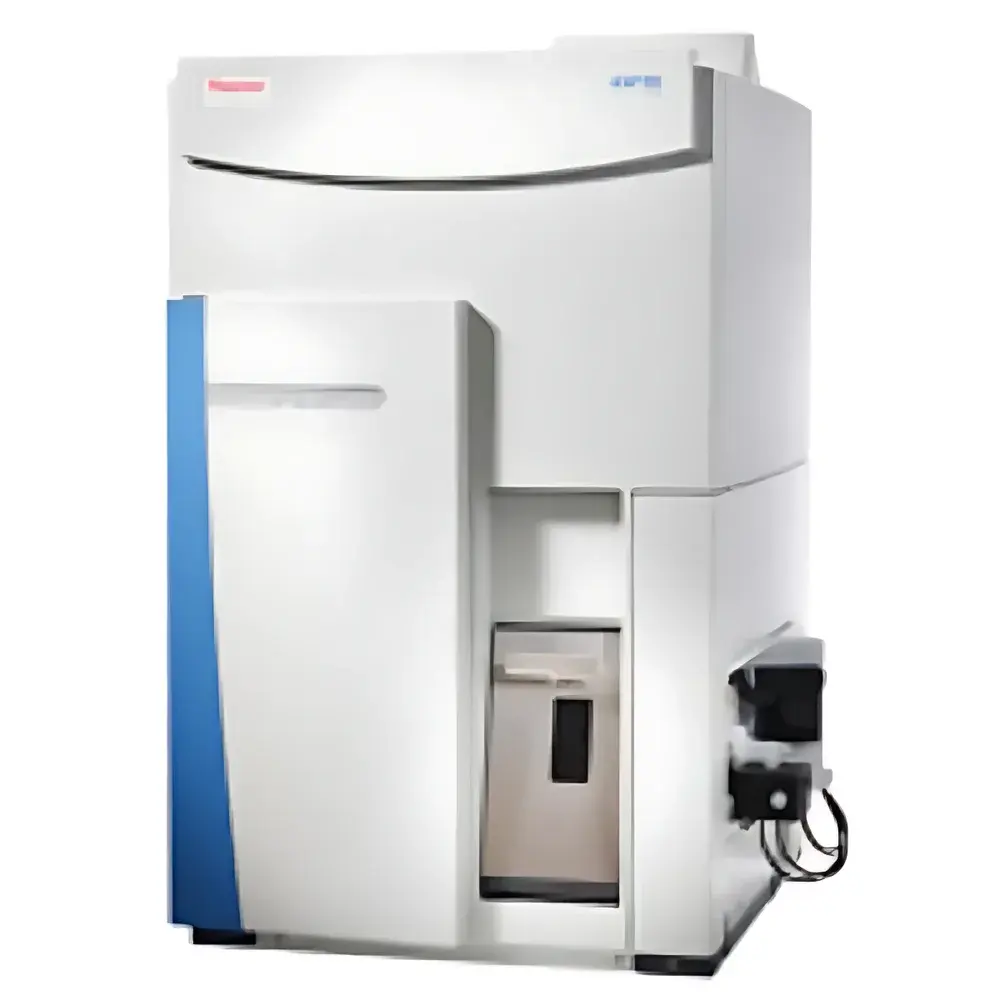
Thermo Scientific iCAP RQ Inductively Coupled Plasma Mass Spectrometer
| Brand | Thermo Fisher |
|---|---|
| Origin | Germany |
| Instrument Type | Quadrupole ICP-MS |
| Model | iCAP RQ |
| Vacuum System | High-vacuum dual-stage turbomolecular pumping |
| RF Generator | Solid-state, 27.12 MHz, auto-tuning |
| Collision/Reaction Cell | Quadrupole-based with KED (Kinetic Energy Discrimination) mode |
| Detection Range | Li (m/z 6) to U (m/z 238) |
| Detection Limit | Sub-pg/L (ppt) for low-mass elements in He KED mode |
| Sample Introduction | Compatible with standard nebulizers, microflow systems, and laser ablation interfaces |
| Regulatory Compliance | Designed for EPA Method 6020B, ISO/IEC 17025, USP <232>/<233>, FDA 21 CFR Part 11 support via Qtegra ISDS software |
Overview
The Thermo Scientific iCAP RQ Inductively Coupled Plasma Mass Spectrometer (ICP-MS) is a high-performance, quadrupole-based analytical platform engineered for multi-element trace metal analysis at sub-trace concentration levels. Operating on the fundamental principle of ion generation in a high-temperature argon plasma (≈7,000–10,000 K), followed by mass separation via a frequency-driven quadrupole mass filter and detection using a high-gain electron multiplier, the iCAP RQ delivers robust sensitivity, interference mitigation, and long-term stability across diverse sample matrices. Its architecture integrates a solid-state RF generator with automatic impedance matching, a thermally stabilized plasma interface, and a differentially pumped vacuum system—ensuring consistent ion transmission and minimizing oxide/hydride formation. Designed specifically for laboratories requiring both high-throughput routine analysis and method flexibility for research-grade applications, the iCAP RQ meets the technical demands of environmental monitoring, clinical toxicology, geochemical fingerprinting, semiconductor materials screening, and regulatory compliance testing.
Key Features
- Quadrupole mass analyzer with low-frequency drive electronics for enhanced mass resolution and signal stability over extended acquisition periods.
- Kinetic Energy Discrimination (KED) collision mode utilizing helium gas to suppress polyatomic interferences (e.g., 40Ar16O+ on 56Fe+, 40Ar35Cl+ on 75As+) while maintaining high transmission efficiency for low-mass elements including Li, Be, and B.
- Thermally balanced interface design with active cooling to minimize thermal drift and ensure reproducible signal intensity across multi-hour sequences.
- High-matrix tolerance enabled by optional high-salt sampling kit, robust nickel sampler and skimmer cones, and intelligent dilution algorithms embedded in Qtegra ISDS software.
- One-touch startup sequence with automated plasma ignition, torch alignment verification, and mass calibration—reducing operator dependency and method setup time.
- Modular vacuum architecture featuring dual-stage turbomolecular pumps and real-time pressure monitoring for rapid pump-down and stable operation under variable ambient conditions.
Sample Compatibility & Compliance
The iCAP RQ accommodates aqueous solutions (including seawater, digested biological tissues, and industrial effluents), organic solvents (up to 100% acetonitrile or methanol with optional cool plasma configuration), and solid samples via laser ablation coupling. Its robust plasma stability supports direct analysis of high-TDS samples without mandatory offline dilution. The system complies with key international standards including EPA Method 6020B for trace metals in environmental matrices, ISO/IEC 17025 for laboratory accreditation, and USP Chapters <232> and <233> for elemental impurities in pharmaceuticals. When operated with Qtegra ISDS software, it fulfills data integrity requirements under FDA 21 CFR Part 11, supporting electronic signatures, audit trails, role-based access control, and secure data archiving.
Software & Data Management
Qtegra ISDS is a validated, instrument-control and data processing platform designed for regulated and non-regulated environments. It provides intuitive method development wizards, automated QC checks (e.g., internal standard recovery, sensitivity drift correction), and batch-oriented workflow management. The software natively integrates with industry-standard autosamplers (e.g., Cetac ASX-560, Elemental Scientific Labs SC-2 DX) and programmable sample introduction valves. Reporting modules support customizable templates compliant with GLP/GMP documentation practices, and LIMS connectivity is achieved through ASTM E1578-compliant ODBC drivers and XML export protocols. All raw data files are stored in vendor-neutral .raw format with embedded metadata, enabling third-party reprocessing and long-term archival.
Applications
- Environmental labs performing ultra-trace analysis of heavy metals (Pb, Cd, Hg, As) in drinking water per EPA 200.8 and EU Directive 2020/2184.
- Clinical and forensic toxicology labs quantifying essential and toxic elements (e.g., Se, Co, Tl, U) in whole blood, serum, and urine.
- Geochemical research requiring isotopic ratio precision for Sr-Nd-Pb-Hf systems using standard bracketing and external normalization.
- Pharmaceutical quality control for elemental impurity screening in APIs and excipients per ICH Q3D guidelines.
- Materials science applications involving depth-resolved analysis of thin films and coatings via LA-ICP-MS coupling.
- Nuclear safeguards and fuel cycle monitoring via uranium and plutonium isotopic abundance measurements.
FAQ
What plasma gases are required for normal operation?
Argon is the primary plasma and nebulizer gas; helium is used exclusively in the collision cell for KED mode. Optional reactive gases (e.g., hydrogen, oxygen, ammonia) may be introduced via the reaction cell for specific interference removal strategies.
Is the iCAP RQ compatible with laser ablation systems?
Yes—the instrument features standardized ICP-MS interface ports and timing synchronization protocols for seamless integration with commercial LA systems, including those from CETAC, New Wave, and UP213.
How does the iCAP RQ handle high-salt or high-acid samples?
It employs a combination of robust nickel interface cones, optional high-matrix introduction kits, and software-driven intelligent dilution logic that triggers automatic sample dilution when signal saturation or matrix-induced drift exceeds user-defined thresholds.
Can Qtegra ISDS generate 21 CFR Part 11–compliant audit trails?
Yes—audit trail functionality records all user actions, method changes, data modifications, and instrument parameter adjustments with timestamps, operator IDs, and reason-for-change fields, fully configurable for GxP environments.
What maintenance intervals are recommended for routine operation?
Nebulizer and spray chamber cleaning is advised after every 10–20 samples depending on matrix complexity; cone replacement is typically performed every 3–6 months under continuous use, while RF generator and vacuum pump service is scheduled annually per Thermo Fisher’s Preventive Maintenance Plan.




