
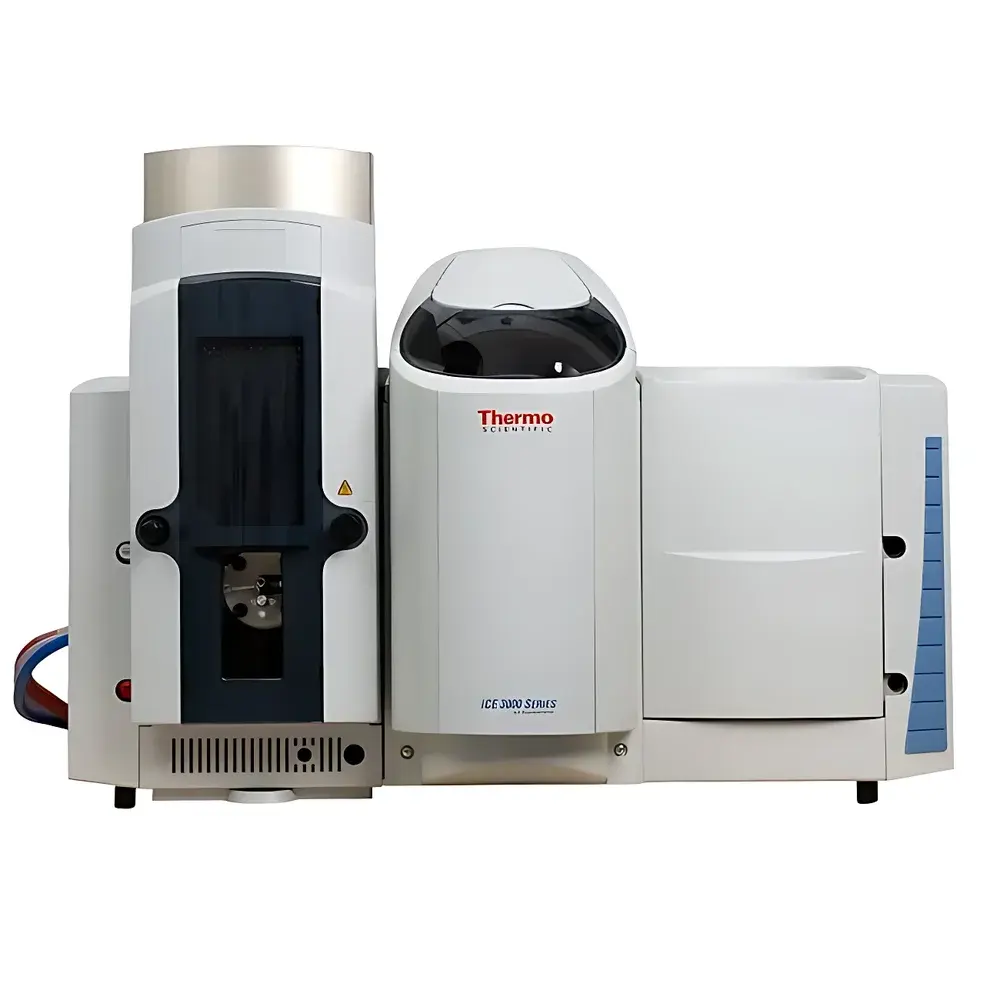
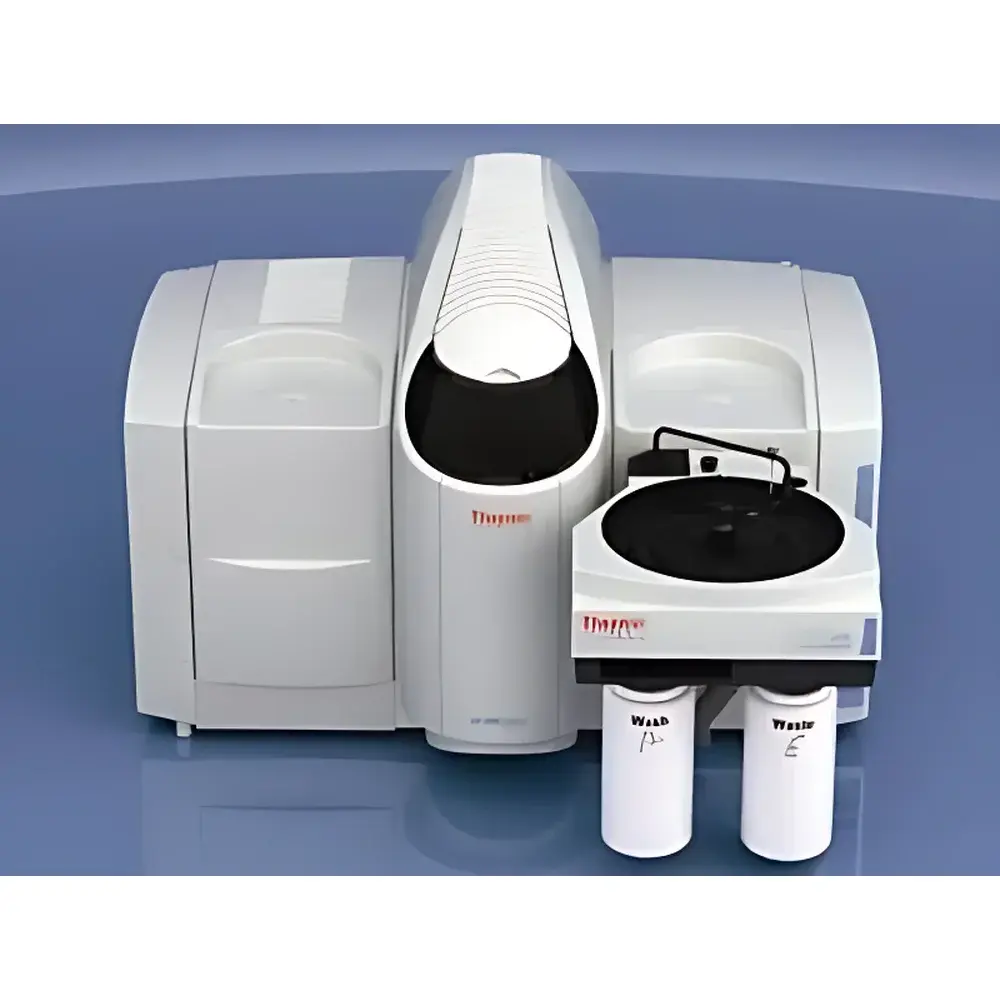
Thermo Scientific iCE 3500 Atomic Absorption Spectrometer
| Brand | Thermo Fisher |
|---|---|
| Origin | United Kingdom |
| Manufacturer Type | Original Equipment Manufacturer (OEM) |
| Origin Category | Imported |
| Model | iCE 3500 |
| Instrument Type | Flame and Graphite Furnace AAS |
| Monochromator | Echelle Grating |
| Optical System | Double-Beam |
| Detector | Photomultiplier Tube (PMT) |
| Background Correction | Deuterium Lamp + Self-Reversal (Auto-Absorption) |
Overview
The Thermo Scientific iCE 3500 Atomic Absorption Spectrometer is a dual-atomization, double-beam AAS platform engineered for high-precision elemental quantification across diverse sample matrices. It operates on the fundamental principle of atomic absorption spectroscopy—measuring the attenuation of characteristic hollow cathode lamp radiation as ground-state atoms in a flame or graphite furnace vapor phase absorb specific wavelengths. The instrument integrates both flame atomization (for higher concentration, routine analysis) and electrothermal graphite furnace atomization (for sub-pg detection limits and limited sample volumes), enabling seamless method switching without manual reconfiguration. Its echelle grating–prism dual monochromator delivers high spectral resolution and throughput, while the double-beam optical architecture compensates for source intensity drift and lamp aging—ensuring long-term photometric stability essential for regulatory compliance and multi-day calibration validity.
Key Features
- Dual-atomizer architecture with independent, permanently aligned flame and graphite furnace compartments—eliminates mechanical realignment during mode switching and maintains optical path integrity.
- Automated lamp turret accommodating up to six hollow cathode lamps, with motorized alignment and intensity optimization for maximum radiant flux and signal-to-noise ratio.
- Deuterium (D2) background correction standard for both flame and graphite furnace modes; optional Zeeman background correction via GFS35Z furnace upgrade for complex matrix interference suppression.
- Echelle grating–prism double monochromator system offering rapid wavelength scanning, high dispersion, and minimal stray light—critical for resolving adjacent spectral lines in multi-element or high-salt samples.
- Integrated graphite furnace television (GFTV) imaging system enabling real-time visual monitoring of sample deposition, drying, pyrolysis, and atomization stages—supporting precise method development and troubleshooting.
- Engineered gas flow control logic minimizing argon and acetylene consumption through dynamic pressure regulation and timed valve actuation—reducing operational cost and improving safety.
- Economical Long-life Graphite Tubes (ELC) rated for >2,000 heating cycles, significantly lowering consumables cost per analysis compared to conventional pyrolytic-coated tubes.
Sample Compatibility & Compliance
The iCE 3500 accommodates aqueous solutions, digested biological tissues, environmental extracts (e.g., EPA Method 200.9), and acid-digested geological samples. Its graphite furnace supports micro-volume analysis (1–20 µL), ideal for precious clinical specimens or isotopically labeled standards. The system complies with key international standards including ASTM D4294 (petroleum sulfur), ISO 11885 (water metals), and USP (heavy metals in pharmaceuticals). Full audit trail, electronic signatures, and instrument parameter locking are supported under SOLAAR software’s 21 CFR Part 11-compliant configuration—enabling deployment in GLP and GMP-regulated environments.
Software & Data Management
SOLAAR software provides guided workflow automation—from method creation and daily performance checks (e.g., lamp alignment verification, burner head cleaning alerts) to full unattended operation with autosampler integration. Built-in wizards streamline calibration curve generation, interference correction setup, and furnace temperature ramp optimization. All instrument parameters, raw spectra, peak area integrations, and QC metrics are stored in a relational database with timestamped metadata. Export formats include CSV, XML, and PDF reports compliant with LIMS interfaces. Software validation packages and IQ/OQ documentation templates are available for laboratory qualification.
Applications
The iCE 3500 serves core analytical functions in environmental monitoring (Pb, Cd, As in drinking water per WHO guidelines), clinical toxicology (blood Pb screening), food safety (Cd in rice, Hg in fish), and materials certification (Al, Fe, Cu in alloys). Its graphite furnace sensitivity supports trace metal analysis in semiconductor-grade chemicals (e.g., sub-pptr detection of Na, K in HF), while flame mode enables high-throughput QA/QC in mining labs (Fe, Mn, Zn in ore concentrates). Method transfer from legacy AAS platforms is facilitated by identical spectral line selection logic and comparable detection limit performance.
FAQ
Does the iCE 3500 support simultaneous multi-element analysis?
No—it is a sequential AAS system; elements are measured one at a time using discrete hollow cathode lamps. For true simultaneous analysis, ICP-OES or ICP-MS instrumentation is recommended.
Can the instrument be integrated with third-party autosamplers?
Yes—SOLAAR supports RS-232 and Ethernet communication protocols compatible with most industry-standard autosamplers, including those from Cetac and CETAC Technologies.
Is Zeeman background correction available as a field-upgrade?
Yes—the GFS35Z graphite furnace module can be installed post-purchase to enable Zeeman-effect background correction, requiring only firmware update and hardware retrofit.
What maintenance intervals are recommended for the echelle grating optics?
Under normal laboratory conditions, no user-accessible optical alignment or cleaning is required; the sealed monochromator housing prevents dust ingress and thermal drift—verified during annual preventive maintenance.
How does the iCE 3500 handle high-salt or organic matrix samples in graphite furnace mode?
Method development tools—including integrated GFTV imaging, programmable pyrolysis hold steps, and matrix modifier selection guidance—enable robust stabilization of volatile analytes and efficient ashing of organic residues prior to atomization.





