
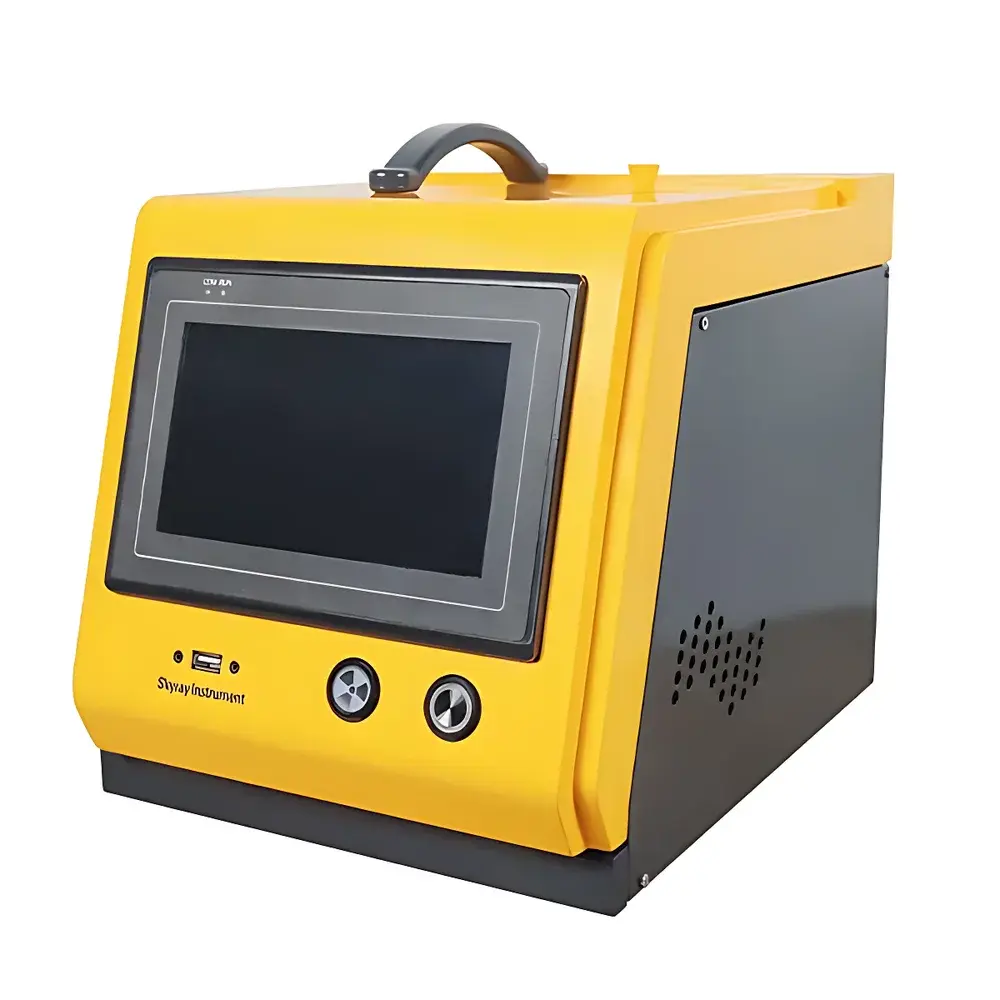
Thermo Scientific iXR-EDX3300S Energy Dispersive X-Ray Fluorescence Spectrometer for Sulfur and Chlorine Analysis
| Brand | Skyray Instrument |
|---|---|
| Origin | Jiangsu, China |
| Manufacturer Type | OEM Manufacturer |
| Regional Classification | Domestic (China) |
| Model | EDX3300S |
| Configuration | Benchtop & Floor-Standing Options |
| Industry Application | Energy & Petrochemicals |
| Elemental Range | S, Cl |
| Quantification Range | 0.5 ppm – 20 wt% |
| Energy Resolution | 125 ± 5 eV (Mn Kα) |
| Repeatability | ≤0.5 ppm (at 10 ppm S in matrix-matched oil standard) |
| Detector | Fast Silicon Drift Detector (SDD) |
Overview
The Thermo Scientific iXR-EDX3300S is a benchtop and floor-standing energy dispersive X-ray fluorescence (EDXRF) spectrometer engineered specifically for rapid, non-destructive quantification of sulfur (S) and chlorine (Cl) in liquid hydrocarbon matrices—including gasoline, diesel, jet fuel, lubricating oils, marine fuels, and crude fractions. It operates on the fundamental principle of X-ray fluorescence: primary X-rays from a high-stability end-window X-ray tube excite inner-shell electrons in sample atoms; upon relaxation, characteristic secondary X-rays are emitted, with energy signatures uniquely identifying each element and intensity correlating to concentration. The iXR-EDX3300S integrates monochromatic excitation via a high-flux, full-focusing polycapillary double-curved crystal (DCC), which selectively delivers the tube’s anode characteristic line (e.g., Mo Kα or Ag Lα) onto the sample surface. This monochromatic excitation dramatically suppresses bremsstrahlung background, improves peak-to-background ratio by >3× compared to conventional broadband EDXRF, and enables sub-ppm detection limits without vacuum or helium purge—critical for field-deployable, regulatory-compliant sulfur analysis in energy-grade fuels.
Key Features
- Monochromatic Excitation Architecture: Dual-curved crystal (DCC) optics deliver focused, single-wavelength excitation, minimizing spectral interference and enhancing sensitivity for light elements (S, Cl) in low-Z matrices.
- No Vacuum Required: Operates under ambient air conditions—eliminates pump maintenance, startup delays, and vacuum-related drift—ideal for high-throughput QC labs and mobile refinery monitoring.
- Fast SDD Detection System: High-count-rate silicon drift detector (≥100,000 cps) with Peltier cooling ensures excellent energy resolution (125 ± 5 eV at Mn Kα) and long-term stability across thermal gradients.
- Automated Calibration & Drift Correction: Built-in reference standards and internal intensity normalization algorithms maintain calibration integrity over time without manual recalibration.
- Ruggedized Sample Handling: Accommodates standardized 30–40 mm diameter disposable polypropylene cups (ASTM D7039-compliant); no digestion, dilution, or solvent extraction required.
- Regulatory-Ready Firmware: Compliant with ASTM D7039, ISO 8754, and EN ISO 20884; supports audit trails, user access levels, and electronic signature protocols aligned with GLP/GMP data integrity expectations.
Sample Compatibility & Compliance
The iXR-EDX3300S is validated for direct analysis of transparent to mildly turbid liquid hydrocarbons with kinematic viscosity ≤ 15 cSt at 40 °C (e.g., gasoline, ultra-low-sulfur diesel [ULSD], aviation turbine fuel, marine distillates). It meets all method requirements specified in ASTM D7039 (Standard Test Method for Sulfur in Gasoline and Diesel Fuel by Monochromatic Wavelength Dispersive X-ray Fluorescence Spectrometry), including minimum counting time (60 s), calibration verification frequency (per 20 samples), and precision thresholds (RSD ≤ 5% at 10 ppm S). It also satisfies Chinese national standards GB 252–2015 (Ordinary Diesel), GB 17411–2015 (Marine Fuel Oil), and GB 17930–2016 (Gasoline), supporting full traceability to NIM (National Institute of Metrology, China) certified reference materials. Instrument design conforms to IEC 61000-6-3 (EMC) and IEC 61010-1 (safety), with CE marking and RoHS compliance documented in factory test reports.
Software & Data Management
The instrument is controlled via Thermo Scientific iXR Suite v3.2—a Windows-based application compliant with FDA 21 CFR Part 11 requirements. It features role-based user authentication (administrator, analyst, reviewer), secure electronic signatures, immutable audit trails (including method changes, calibration events, and result modifications), and automated PDF report generation with embedded metadata (sample ID, operator, timestamp, instrument serial number, calibration status). Raw spectra are stored in vendor-neutral .spc format; quantitative results export to CSV, Excel, or LIMS-compatible XML. Optional integration with Thermo Scientific SampleManager LIMS enables bidirectional workflow synchronization, automated QC flagging, and statistical process control (SPC) charting per ASTM E2917.
Applications
- Refinery Process Control: Real-time sulfur monitoring at hydrotreater outlets, blending racks, and finished product tanks to ensure compliance with Euro 6, Tier 3, and IMO 2020 sulfur cap (0.50 wt% in marine fuel).
- Fuel Certification & Trade Compliance: Verification of ULSD (<10 ppm S), gasoline (<10 ppm S), and marine gasoil against contractual specifications and customs inspection protocols.
- Research & Development: Catalyst deactivation studies, feedstock screening, and additive interaction analysis in low-sulfur formulation development.
- Third-Party Testing Laboratories: Accredited testing per ISO/IEC 17025:2017, with documented uncertainty budgets traceable to CRM SRM 2722 (diesel), SRM 2723 (gasoline), and NIM RM-101 series.
- Field Deployment: Battery-powered operation (optional external Li-ion pack), IP52-rated enclosure, and <8 kg net weight enable use in mobile labs, offshore platforms, and pipeline terminals.
FAQ
Does the iXR-EDX3300S require helium purge or vacuum for sulfur analysis?
No. Its monochromatic excitation and high-resolution SDD eliminate the need for atmosphere displacement—analysis occurs in ambient air.
Can it quantify chlorine simultaneously with sulfur?
Yes. The system is calibrated for concurrent S and Cl measurement using matrix-matched CRMs; Cl detection limit is 1.2 ppm (1σ) in base oil.
Is method validation support provided for ISO/IEC 17025 accreditation?
Yes. Skyray provides full validation documentation package—including linearity (0.5–200 ppm), LOD/LOQ determination, ruggedness testing (pH, viscosity, temperature), and inter-laboratory reproducibility data.
What sample volume is required?
2–3 mL is sufficient; filled to 8–10 mm depth in standard 32 mm polypropylene cups.
How frequently must the instrument be recalibrated?
Initial calibration is performed using three CRMs spanning 0.5–50 ppm S; subsequent verification is recommended every 20 samples or 8 hours of continuous operation.





