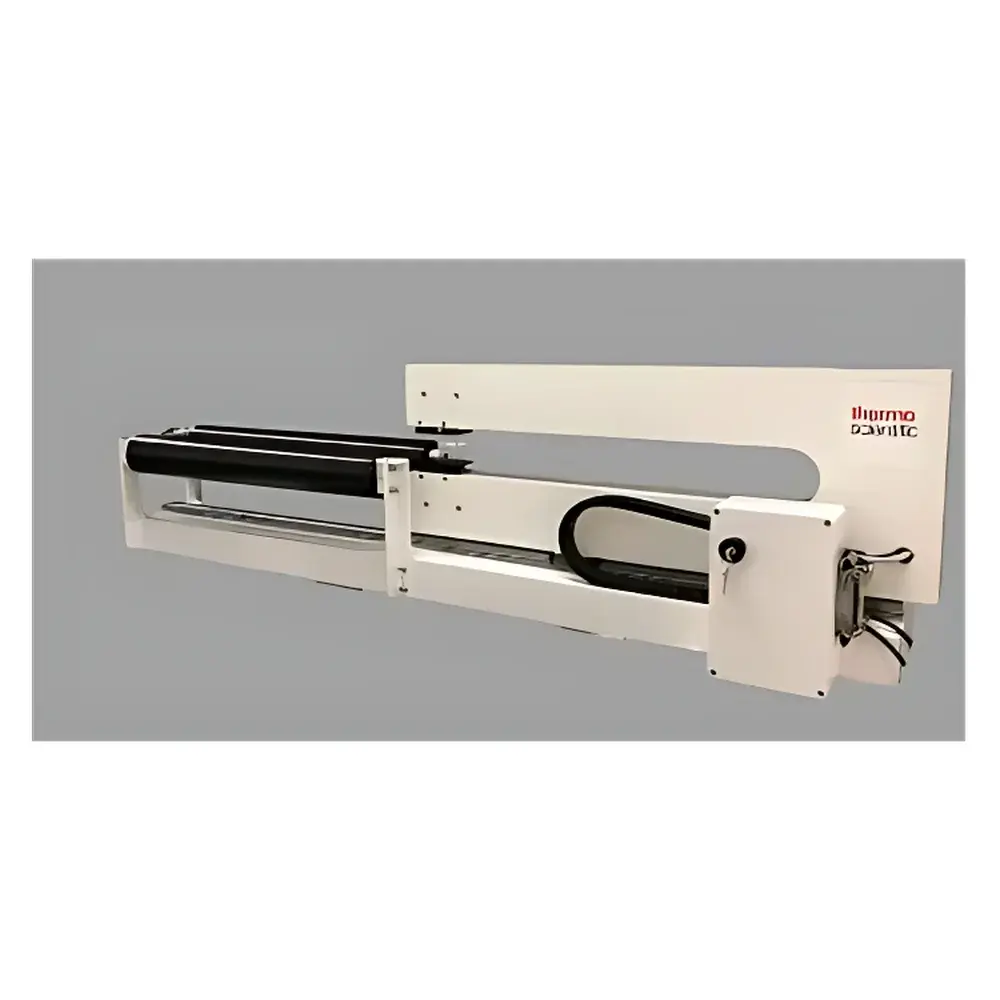
Thermo Scientific LInspector™ Measurement and Control System
| Brand | Thermo Scientific |
|---|---|
| Origin | USA |
| Manufacturer Type | Original Equipment Manufacturer (OEM) |
| Origin Category | Imported |
| Model | LInspector™ Measurement and Control System |
| Pricing | Available upon Request |
Overview
The Thermo Scientific LInspector™ Measurement and Control System is an industrial-grade, non-contact inline metrology platform engineered for high-precision thickness and coating uniformity monitoring in lithium-ion battery electrode and separator manufacturing. Leveraging over eight decades of Thermo Scientific expertise in radiation-based thickness measurement—primarily utilizing beta backscatter, X-ray transmission, and dual-energy gamma techniques—the LInspector system delivers real-time, sub-micron resolution data across continuous web processes. It operates as a closed-loop control node within modern battery production lines, integrating directly with coater, calender, and slitting equipment to enable adaptive process correction. Its core function is to ensure dimensional compliance of anode/cathode coatings (typically 50–200 µm), multilayer separators (e.g., 12–30 µm trilayer films), and calendered electrode density profiles—critical parameters directly linked to cell energy density, cycle life, and safety performance.
Key Features
- Sub-100 µm optical spot size with ≥2 kHz sampling rate, enabling high-fidelity edge detection and stripe-level defect localization on moving webs up to 10 m/min.
- Multi-sensor fusion architecture supporting simultaneous beta backscatter (for thin coatings <100 µm), X-ray transmission (for thicker layers or metal foils), and infrared reflectance (for solvent content estimation).
- Real-time closed-loop actuation interface compatible with industry-standard PLCs (Siemens S7, Rockwell ControlLogix) and DCS platforms for automatic die lip adjustment, roller gap modulation, and speed synchronization.
- Cloud-native Instrument Performance Management (IPM) framework compliant with ISO/IEC 17025:2017 calibration traceability requirements and supporting automated audit trails per FDA 21 CFR Part 11 Annex 11.
- End-to-end encrypted defect annotation pipeline: raw sensor data, image-derived anomaly maps, and contextual metadata (timestamp, line speed, temperature, humidity) are time-synchronized and archived in AWS S3 with WORM (Write Once Read Many) retention policies.
- Proactive health monitoring via embedded telemetry—including detector gain drift, source activity decay, collimator alignment shift, and thermal stability metrics—triggering configurable alerts for predictive maintenance.
Sample Compatibility & Compliance
The LInspector system accommodates standard battery manufacturing substrates including aluminum and copper current collectors (6–20 µm), aqueous and NMP-based slurries (Ni-rich NMC, LFP, silicon composites), and polyolefin separators (PP/PE/PP trilayers). It meets IEC 62660-1:2022 for electric vehicle battery cell quality assurance and supports GLP/GMP-aligned documentation workflows. All radiation sources are type-approved under U.S. NRC 10 CFR Part 30 and EU Council Directive 2013/59/Euratom, with full shielding certification (ANSI N43.3-2022) and annual leak testing protocols integrated into the IPM dashboard.
Software & Data Management
LInspector Control Suite v4.x provides a browser-based HMI with role-based access control (RBAC), configurable dashboards, and statistical process control (SPC) charts aligned with ASTM E2587-21. Raw spectral data is stored in HDF5 format with embedded metadata per NIEM 4.2 standards. The cloud-hosted analytics layer performs unsupervised clustering (DBSCAN) on thickness deviation patterns to identify root causes—such as doctor blade wear, slurry rheology shifts, or environmental humidity excursions—without requiring labeled training sets. All data exports comply with ISO 8601 timestamps, SI unit conventions, and GDPR-compliant anonymization options for multi-site deployments.
Applications
- Real-time monitoring of electrode coating weight (g/m²) during slot-die and comma-bar coating, with ±0.15 g/m² repeatability at 95% confidence.
- In-line thickness profiling of dry and wet calendered electrodes to quantify density gradients and detect localized delamination precursors.
- Separator thickness uniformity assessment across width (±0.5 µm across 600 mm web) and through-thickness (layer-wise resolution via dual-energy XRF).
- Defect classification and trend analysis for recurring issues such as pinholes, agglomerates, streaks, and edge thinning—mapped to specific machine settings and material lots.
- Supporting APQP Phase II validation and PPAP documentation for Tier-1 automotive battery suppliers requiring AS9100D-compliant measurement system analysis (MSA).
FAQ
Does the LInspector system require radioactive source licensing?
Yes—beta and gamma variants require site-specific licensing from national regulatory authorities (e.g., NRC or Agreement State programs in the U.S.; ONR in the UK). Thermo Scientific provides full technical documentation, shielding design support, and personnel dosimetry program guidance.
Can LInspector integrate with existing MES/SCADA systems?
Yes—via OPC UA 1.04, MQTT 3.1.1, and RESTful APIs. Pre-built connectors are available for Siemens Opcenter, Rockwell FactoryTalk, and PTC ThingWorx.
What calibration standards are supported?
NIST-traceable certified reference materials (CRMs) for thickness (e.g., NIST SRM 2134 series), plus in-situ reference foil checks using electroplated nickel standards calibrated against SEM cross-sections.
Is offline data reprocessing supported?
Yes—raw sensor frames and metadata can be exported for post-acquisition analysis using MATLAB, Python (SciPy/Pandas), or Thermo’s optional Advanced Analytics Toolkit.
How is cybersecurity addressed in the cloud architecture?
All communications use TLS 1.3; device authentication employs X.509 certificates; cloud infrastructure adheres to ISO/IEC 27001:2022 and SOC 2 Type II attestation.