
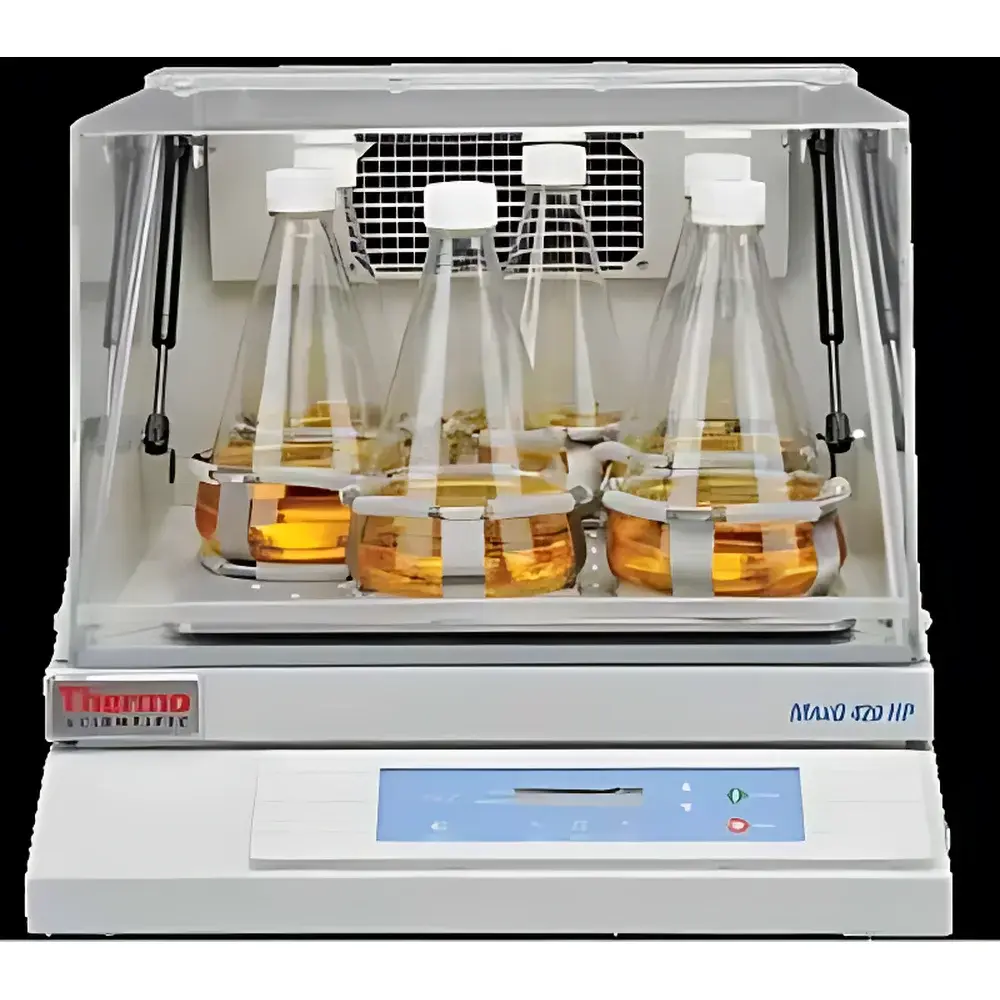
Thermo Scientific MaxQ 420HP High-Performance Benchtop Incubated Shaker
| Brand | Thermo Fisher Scientific |
|---|---|
| Origin | USA |
| Manufacturer | Thermo Fisher Scientific |
| Import Status | Imported |
| Model | MaxQ 420HP |
| Pricing | Available upon Request |
| Speed Range | 25–525 ±1 rpm |
| Orbit Diameter | 1.0 in (2.5 cm) |
| Max Load Capacity | 71 lb (32 kg) |
| Temperature Range | Ambient +5°C to 80°C |
| Temperature Accuracy | ±0.1°C |
| Temperature Uniformity (within flask at 37°C) | ±0.3°C |
| External Dimensions (L×W×H) | 29.0×24.3×20.9 in (73.7×61.7×53.1 cm) |
| Shipping Weight | 250 lb (113.4 kg) |
| Power Supply | 115/230 V, 50/60 Hz dual-voltage |
Overview
The Thermo Scientific MaxQ 420HP is a high-performance benchtop incubated shaker engineered for reproducible, temperature-controlled orbital agitation of microbiological, mammalian, and biochemical cultures. It operates on the principle of controlled orbital motion—generating uniform shear and oxygen transfer across liquid media—while maintaining precise thermal conditions essential for sensitive cell growth, protein expression, and fermentation optimization. Unlike non-incubated shakers, the MaxQ 420HP integrates a fully insulated double-wall chamber with dual centrifugal blowers and intelligent airflow management to achieve exceptional thermal stability and spatial uniformity within culture vessels. Its design prioritizes operational integrity under continuous use in regulated laboratory environments, supporting workflows aligned with Good Laboratory Practice (GLP) and cGMP-compliant bioprocess development.
Key Features
- Dual-blower forced-air circulation system and gasketed acrylic lid ensure ±0.3°C temperature uniformity inside flasks at 37°C—critical for high-yield microbial and eukaryotic cell propagation.
- Triple-balance mechanical drive mechanism minimizes vibration transmission, enhances long-term bearing life, and preserves sample integrity during extended runs (e.g., 72+ hr fermentations).
- Microprocessor-based controller with membrane keypad enables precise setpoint calibration, real-time parameter monitoring, and nonvolatile storage of user-defined protocols.
- Large platform accommodates up to six 2 L Erlenmeyer flasks simultaneously—optimized for scalable culture expansion without compromising mixing efficiency or thermal consistency.
- Optically clear, UV-stabilized acrylic outer cover resists yellowing, microcracking, and chemical haze over years of routine autoclave-cleaned or ethanol-wiped maintenance.
- Independent high- and low-temperature audible/visual alarm system provides immediate notification of thermal excursions—integral to sample protection and audit-ready incident logging.
- Integrated overflow containment architecture prevents liquid ingress into motor housing or control electronics, safeguarding against corrosion and electrical fault conditions during accidental spills.
Sample Compatibility & Compliance
The MaxQ 420HP supports standard microbiology and cell culture formats including glass and polycarbonate Erlenmeyer flasks (up to 2 L), baffled flasks, and multi-well plates mounted on adaptable platforms. Its temperature range (ambient +5°C to 80°C) and tight accuracy (±0.1°C) comply with ASTM E145-22 (Standard Specification for Gravity-Convection and Forced-Ventilation Ovens) and ISO 20387:2018 (Biotechnology — Biobanking). The unit’s dual-voltage power supply (115/230 V, 50/60 Hz) meets IEC 61010-1 safety requirements for laboratory equipment. While not inherently 21 CFR Part 11–compliant, its event-driven alarm logs and stable parameter retention support integration into validated systems when paired with compliant data acquisition software.
Software & Data Management
The MaxQ 420HP operates via an embedded microcontroller with local interface only—no proprietary software or PC connectivity is required for basic operation. All settings (speed, temperature, run time) are retained in nonvolatile memory after power loss. For laboratories requiring electronic recordkeeping, optional analog output (0–10 V) or digital RS-232 interface modules (sold separately) enable connection to SCADA systems or LIMS platforms. When integrated with validated third-party software, the device supports timestamped event logging—including alarm triggers, setpoint changes, and runtime completion—for GLP audit trails and deviation investigations.
Applications
- High-density bacterial culture (e.g., E. coli BL21(DE3) induction for recombinant protein production)
- Mammalian suspension cell expansion in serum-free media under tightly controlled hypothermic or normothermic conditions
- Yeast fermentation kinetics studies requiring consistent dissolved oxygen profiles and thermal stability
- Enzyme activity assays where reaction rate is highly temperature-dependent (e.g., polymerase chain reactions pre-amplification steps)
- Environmental microbiology—growth of thermophilic isolates at elevated temperatures (60–80°C) with minimal gradient formation
- Pharmaceutical QC testing of microbial limits in raw materials using standardized shake-flask enrichment protocols
FAQ
Does the MaxQ 420HP support remote monitoring or Ethernet connectivity?
No—the base model features only a local control panel. Optional RS-232 or analog output modules must be installed for external data capture.
Can the shaker operate continuously for 7 days or longer?
Yes. Its brushless DC motor, sealed bearings, and thermal overload protection are rated for uninterrupted operation under nominal load and temperature conditions.
Is the platform compatible with magnetic stir bars or vacuum-sealed vessels?
The orbital motion is optimized for standard flasks with loose-fitting closures. Vacuum-rated vessels require verification of mechanical resonance compatibility; magnetic stir bars are not supported as the system lacks integrated magnetic drive functionality.
What maintenance intervals are recommended for long-term reliability?
Thermo Fisher recommends biannual inspection of blower filters, gasket integrity, and platform leveling. No routine lubrication is required due to the maintenance-free drive train design.
How does the double-wall insulation contribute to energy efficiency?
The evacuated air gap between inner and outer chamber walls reduces conductive heat loss by >40% compared to single-wall designs—lowering steady-state power draw during prolonged incubation cycles.




