
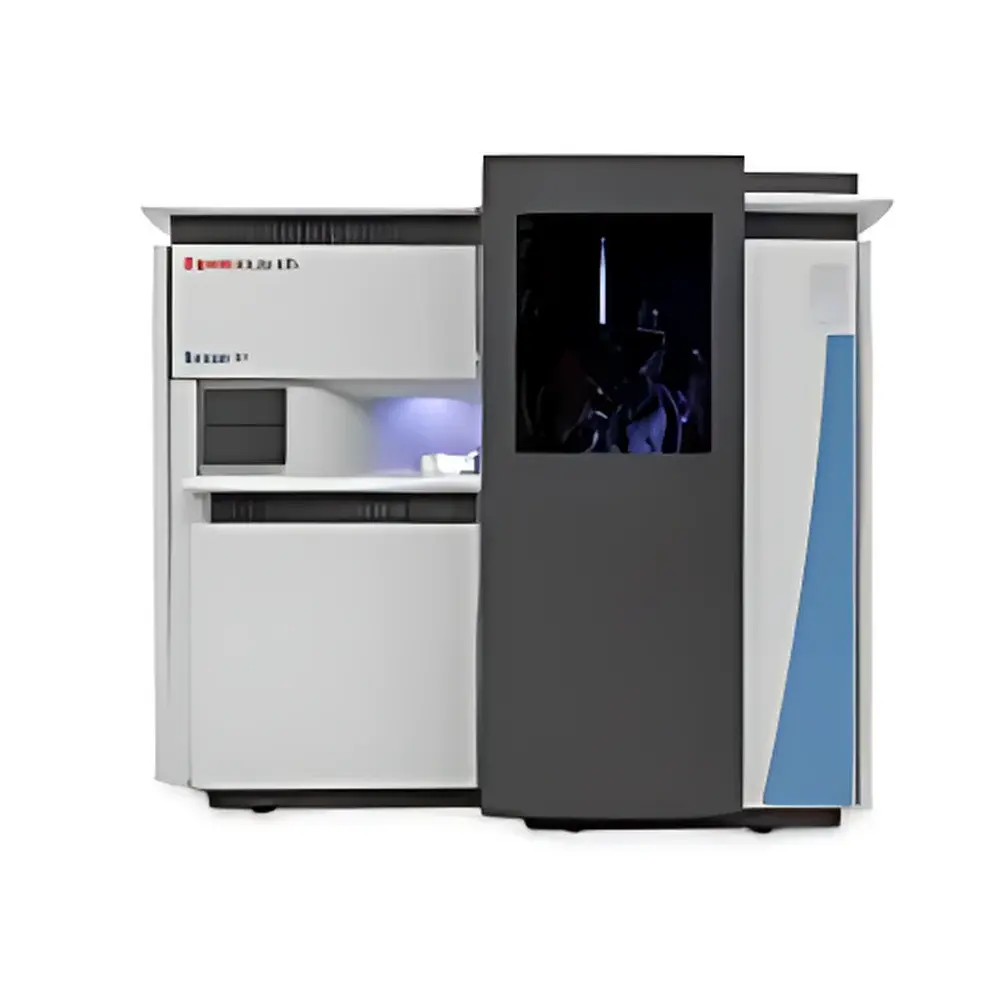
Thermo Scientific Nexsa G2 X-ray Photoelectron Spectrometer
| Brand | Thermo Fisher |
|---|---|
| Origin | United Kingdom |
| Manufacturer Type | Original Equipment Manufacturer (OEM) |
| Import Status | Imported |
| Model | Nexsa G2 |
| Pricing | Available upon request |
Overview
The Thermo Scientific Nexsa G2 X-ray Photoelectron Spectrometer (XPS) is a high-performance surface and interface analysis system engineered for quantitative elemental composition, chemical state identification, and depth-resolved characterization of solid materials. Operating on the fundamental principle of the photoelectric effect—where monochromatic X-rays eject core-level electrons from sample surfaces—the Nexsa G2 measures the kinetic energy of emitted photoelectrons to determine binding energy with sub-0.1 eV energy resolution. This enables precise identification of oxidation states, functional groups, and interfacial chemical reactions. Designed for both single-user research labs and multi-user core facilities, the system integrates XPS with complementary surface-sensitive techniques—including Ion Scattering Spectroscopy (ISS), Ultraviolet Photoelectron Spectroscopy (UPS), Reflected Electron Energy Loss Spectroscopy (REELS), and confocal Raman microscopy—within a single ultra-high vacuum (UHV) platform (<1×10⁻⁹ mbar base pressure). Its modular architecture supports seamless expansion into a full analytical workstation without compromising vacuum integrity or measurement reproducibility.
Key Features
- Microfocused Monochromated Al Kα X-ray Source: Continuously adjustable beam spot size from 10 µm to 400 µm in 5 µm increments, enabling spatially resolved analysis of microstructures, thin-film heterojunctions, and patterned devices.
- Automated Charge Neutralization: Dual-beam low-energy electron/ion neutralizer with real-time feedback control eliminates charging effects on insulating samples (e.g., oxides, polymers, ceramics), eliminating manual charge referencing in >95% of routine analyses.
- Depth Profiling Capabilities: Integrated standard Ar+ ion gun plus optional MAGCIS (Monatomic and Gas Cluster Ion Source) for gentle sputtering of organic layers, multilayer stacks, and radiation-sensitive materials with minimized interface mixing.
- Multi-Technique Integration: Co-located ISS, UPS, REELS, and Raman modules share identical sample positioning and UHV environment, ensuring exact spatial correlation between datasets.
- Avantage Data System: Unified software platform for instrument control, spectral acquisition, peak fitting (with Shirley/Tougaard background models), quantification (based on Scofield sensitivity factors), chemical state mapping, and automated report generation compliant with ISO/IEC 17025 documentation requirements.
Sample Compatibility & Compliance
The Nexsa G2 accommodates diverse sample geometries—from standard 12 mm pin-mount wafers to irregularly shaped electrodes, catalyst pellets, and cross-sectioned device fragments—via motorized XYZ stage with ±1° tilt and 360° rotation. Optional accessories include an NX heating stage (up to 600 °C, UHV-compatible), a multi-contact biasing stage for in-situ electrical stimulation during XPS acquisition, an inert-gas transfer chamber (Ar/N2) for air-sensitive samples (e.g., battery cathodes, 2D materials, organometallics), and an MCA stage enabling correlated XPS–SEM analysis on identical surface regions. All hardware and software comply with ISO 14644-1 Class 5 cleanroom integration standards and support GLP/GMP audit trails per FDA 21 CFR Part 11 when configured with electronic signature modules.
Software & Data Management
Avantage v3.0+ provides role-based user access control, versioned data storage, and embedded metadata tagging (including instrument parameters, calibration history, and operator logs). Raw spectra are stored in vendor-neutral .vms format; processed data exports to CSV, CDF, and JCAMP-DX for third-party chemometric analysis. Batch processing workflows support automated peak deconvolution across large datasets (e.g., compositional gradients across wafer maps), while spectral libraries (NIST, SDBS, and proprietary Thermo databases) enable rapid chemical state matching. Data security protocols include AES-256 encryption for archived projects and configurable retention policies aligned with institutional data governance frameworks.
Applications
- Quantitative analysis of passivation layers on semiconductor devices and photovoltaic absorbers
- Chemical mapping of catalyst surface sites before/after reaction cycles
- Interface chemistry characterization in solid-state battery electrodes and SEI layers
- Surface functionalization verification of biomedical coatings and polymer membranes
- Failure analysis of corrosion products, adhesion promoters, and thin-film delamination mechanisms
- Electronic structure determination via valence band UPS combined with core-level XPS
FAQ
What vacuum level does the Nexsa G2 achieve, and how is it maintained?
The system maintains a base pressure of ≤1×10⁻⁹ mbar using a combination of turbomolecular pumping and non-evaporable getter (NEG) panels, with real-time pressure monitoring and automatic pump sequencing.
Can the Nexsa G2 perform angle-resolved XPS (ARXPS)?
Yes—the motorized sample stage supports precise emission angle control from 0° to 80° relative to the analyzer axis, enabling non-destructive depth profiling of ultra-thin films (<5 nm) without sputtering.
Is Avantage software validated for regulated environments?
Avantage supports 21 CFR Part 11 compliance when deployed with Thermo’s SecureLog module, including electronic signatures, audit trail review, and password-protected configuration lockdown.
How is detector dead time corrected during high-count-rate acquisitions?
The hemispherical analyzer incorporates real-time pulse processing with adaptive dead-time correction algorithms, ensuring accurate intensity quantification across count rates from 102 to 106 cps.
Does the system support external gas dosing for in-situ reaction studies?
Optional differential pumping and UHV-compatible gas inlets allow controlled introduction of reactive gases (O2, H2, CO) at pressures up to 1×10⁻⁶ mbar for dynamic surface chemistry investigations.




