
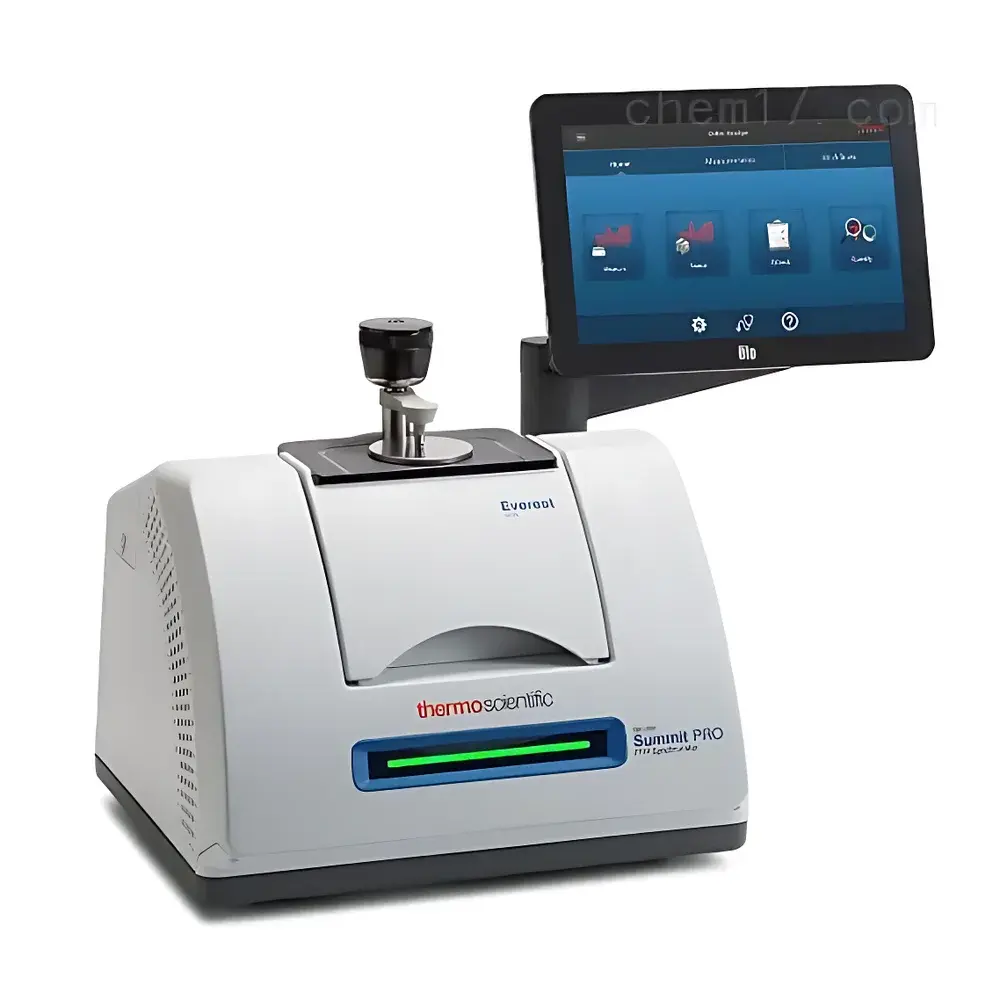
Thermo Scientific Nicolet Summit Fourier Transform Infrared (FT-IR) Spectrometer
| Origin | USA |
|---|---|
| Manufacturer Type | Authorized Distributor |
| Origin Category | Imported |
| Model | Nicolet Summit |
| Price Range | USD 0–15,000 (FOB) |
| Spectral Range | 7500–350 cm⁻¹ |
| Spectral Resolution | 0.5 cm⁻¹ |
| Wavenumber Accuracy | Better than 0.01 cm⁻¹ |
| Detector Type | Dual-mode DTGS/KBr-beam splitter optimized for broadband mid-IR |
| Cooling | Uncooled (ambient temperature operation) |
| Measurement Mode | Transmission, Reflection, ATR |
| Sample Compatibility | Solids (pellets, films, tablets), Liquids (cells, ATR), Powders, Gases |
| Software Platform | Thermo Scientific OMNIC Paradigm v3.x with Audit Trail, Electronic Signatures, and 21 CFR Part 11 Compliance Modules |
| Optical Engine | LightDrive™ Interferometer with Solid-State Laser Reference |
| Frame Rate | N/A (scanning FT-IR, not real-time imaging) |
| Thermal Sensitivity (NETD) | Not applicable (non-imaging spectrometer) |
| Operating Temperature | 15–30 °C, 30–70% RH non-condensing |
| Dimensions | 35 × 28 × 22 cm |
| Weight | 10 kg |
| Enclosure | Magnesium alloy monocoque chassis with sealed optical bench |
| Warranty | 10-year interferometer warranty |
Overview
The Thermo Scientific Nicolet Summit Fourier Transform Infrared (FT-IR) Spectrometer is a high-performance, compact benchtop instrument engineered for precision molecular identification, quantitative analysis, and regulatory-compliant material verification across pharmaceutical, academic, polymer, and quality control laboratories. Unlike infrared thermal imaging cameras — which map surface temperature distributions — the Nicolet Summit operates on the fundamental principle of interferometric spectroscopy: it measures the absorption, transmission, or reflection of mid-infrared radiation (7500–350 cm⁻¹) as a function of wavenumber, generating high-fidelity interferograms that are Fourier-transformed into chemically informative spectra. Its LightDrive™ optical engine integrates a solid-state laser-referenced Michelson interferometer, thermally stabilized KBr beam splitter, and dual-mode DTGS detector to deliver consistent spectral resolution of 0.5 cm⁻¹ and wavenumber accuracy better than ±0.01 cm⁻¹ — performance metrics validated per ASTM E1421 and ISO 17025-accredited protocols.
Key Features
- Compact, Rugged Architecture: Engineered with a one-piece magnesium alloy chassis, the Summit provides exceptional mechanical rigidity, thermal stability, and vibration damping — enabling reliable operation in shared labs, production environments, and mobile analytical stations without optical realignment.
- LightDrive™ Optical Engine: Features a maintenance-free, solid-state laser reference and monolithic interferometer design, eliminating moving-mirror wear and delivering 10-year interferometer warranty — a benchmark for long-term spectral reproducibility and minimal downtime.
- OMNIC Paradigm Software Suite: Includes full 21 CFR Part 11 compliance modules: role-based access control, electronic signatures, audit trail logging, data integrity validation, and secure digital signing of reports — fully aligned with USP , EP 2.2.24, JP 2.10, and ChP 0401 requirements.
- Integrated Touch Interface & Smart Background: Optional onboard touchscreen enables walk-up operation; Smart Background functionality automates background collection based on ambient conditions and accessory configuration, reducing operator dependency and human error.
- Modular Accessory Compatibility: Supports universal mounting for transmission cells, diamond ATR accessories, gas cells, diffuse reflectance units, and the optional Nicolet Summit Microscope — enabling seamless transition from bulk to micro-scale analysis.
Sample Compatibility & Compliance
The Nicolet Summit accommodates diverse sample forms — including compressed KBr pellets, thin polymer films, liquid cells (0.1–100 µm pathlength), aqueous solutions (with appropriate ATR crystals), volatile organics, and controlled gas-phase analytes — without hardware reconfiguration. Its optical design ensures optimal signal-to-noise ratio across the full 7500–350 cm⁻¹ range, critical for detecting functional group vibrations (e.g., C=O stretch at ~1700 cm⁻¹, O–H broad band at 3600–3200 cm⁻¹, or Si–O–Si network modes near 1000 cm⁻¹). All software workflows comply with GLP/GMP documentation standards, supporting automated report generation with embedded metadata (instrument ID, operator, date/time, calibration status, spectral acquisition parameters). The system is pre-validated for pharmacopeial testing (USP , EP 2.2.24) and supports IQ/OQ/PQ documentation packages upon request.
Software & Data Management
OMNIC Paradigm serves as both acquisition and interpretation platform — featuring intuitive workflow-driven interfaces for method creation, spectral preprocessing (baseline correction, normalization, derivative transformation), multicomponent quantitation (PLS, CLS), and library searching against >300,000 reference spectra (including Sadtler, Polymer, and Pharma libraries). Audit Manager logs every user action — from spectrum acquisition to report export — with immutable timestamps and operator credentials. Data files (.spa, .srs) are encrypted and digitally signed; raw interferograms and processed spectra are stored with full provenance tracking. Integration with LIMS via ASTM E1703 or direct SQL database export ensures traceability across enterprise analytical networks. Wi-Fi and Ethernet connectivity enable remote monitoring, centralized method deployment, and cloud-synced spectral libraries — all without compromising local data sovereignty.
Applications
- Pharmaceutical raw material identification and counterfeit detection per ICH Q5C and FDA Guidance for Industry
- Polymorph screening and crystallinity assessment in API development
- Coating thickness and composition analysis in medical device manufacturing
- Contaminant identification in failure analysis (e.g., extraneous particles in injectables)
- Reaction monitoring in catalysis and process chemistry (via time-resolved ATR-FTIR)
- Micro-domain characterization using the integrated microscope: layer-by-layer analysis of laminated packaging, cross-sectional mapping of battery electrodes, and inclusion analysis in semiconductor wafers
FAQ
Is the Nicolet Summit compliant with 21 CFR Part 11?
Yes — OMNIC Paradigm includes configurable electronic signature workflows, audit trail logging, and role-based permissions required for regulated environments.
Can it be used for quantitative analysis of mixtures?
Yes — the software supports partial least squares (PLS) and classical least squares (CLS) modeling with calibration set management and statistical validation per ISO/IEC 17025 guidelines.
What maintenance is required for the optical system?
The LightDrive interferometer requires no periodic alignment; users can replace the DTGS detector and desiccant cartridge independently — no field service engineer visit needed.
Does it support hyphenated techniques like FT-IR/GC?
While not a built-in GC interface, the Summit accepts external analog/digital triggers and time-stamped spectral streams compatible with third-party chromatography data systems (CDS) via RS-232 or TCP/IP.
Is the microscope module included by default?
No — the Nicolet Summit Microscope is an optional accessory; when installed, it shares the same optical path and is fully controlled through OMNIC Paradigm with synchronized visible imaging and spectral acquisition.




