
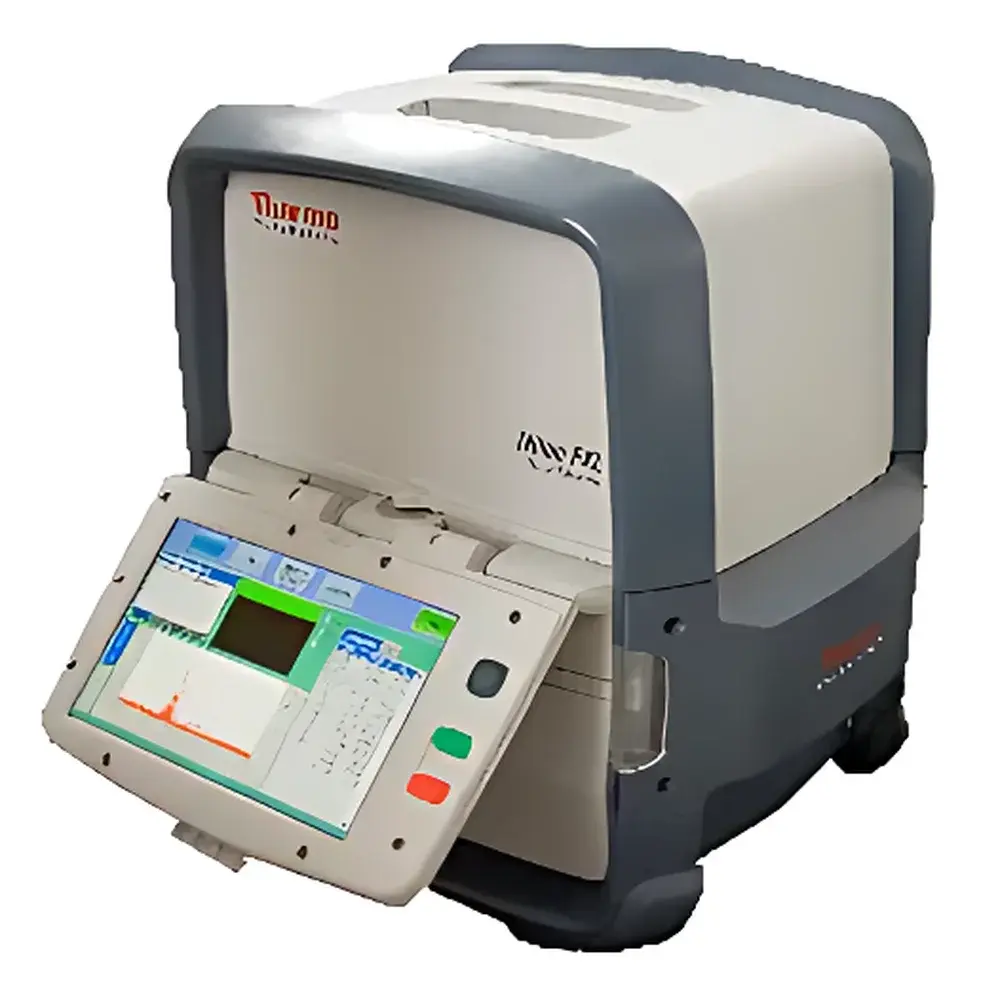
Thermo Scientific Niton FXL Energy Dispersive X-Ray Fluorescence (ED-XRF) Field Laboratory
| Brand | Thermo Fisher |
|---|---|
| Origin | USA |
| Manufacturer | Thermo Fisher Scientific |
| Type | Imported |
| Model | Niton FXL |
| Form Factor | Benchtop/Floor-Standing |
| Application Sector | Geological & Mining |
| Elemental Range | Na (11) – U (92) |
| Detection Limit | ppm-level |
| Energy Resolution | <145 eV at Mn Kα |
| Repeatability | ≥99% RSD (for certified reference materials under controlled conditions) |
| Weight | <14 kg |
| Dimensions (External) | 250 × 350 × 300 mm |
| Sample Chamber | 229 × 305 × 114 mm |
| Detector | Geometrically Optimized Large-area Drift Detector (GOLDD™) |
| Display | 9-inch adjustable-angle color touchscreen |
| Data Interface | USB 2.0 |
| Security | Password-protected user accounts with role-based access |
| Preloaded Modes | TestAll Geo (soil/mineral), TestAll (plastics/electronics/paint), Alloy, Precious Metals, RoHS, Environmental, Cement/Industrial Minerals |
Overview
The Thermo Scientific Niton FXL is a benchtop-to-field deployable Energy Dispersive X-Ray Fluorescence (ED-XRF) spectrometer engineered for laboratory-grade elemental analysis in non-laboratory environments. Unlike handheld XRF analyzers, the FXL integrates a fully enclosed, shielded sample chamber with a high-efficiency GOLDD™ detector and optimized X-ray excitation geometry—enabling quantification of elements from sodium (Na, Z=11) to uranium (U, Z=92) at sub-ppm detection limits in solid, powdered, or fused-bead samples. Its sealed-beam architecture complies with international radiation safety standards—including ANSI N43.3 (USA), IEC 61010-1 (EU), and ISO 21876—requiring minimal regulatory permitting in most jurisdictions. Designed for operational continuity across geoscience, environmental monitoring, industrial quality control, and regulatory compliance workflows, the FXL delivers analytical reproducibility exceeding 99% RSD when validated against CRM matrices (e.g., NIST SRM 2710a, GBW 07105), without reliance on vacuum or helium purge.
Key Features
- Lab-Grade ED-XRF Performance in Field-Deployable Form: Combines high-count-rate GOLDD™ detection with dual-anode X-ray source (Ag/Rh) and multi-layer secondary targets to maximize peak-to-background ratios for light elements (Na–Cl) and heavy metals (Pb, U) simultaneously.
- Enclosed, Safety-Certified Sample Chamber: Fully shielded 229 × 305 × 114 mm cavity with interlocked door and real-time beam status monitoring; meets ALARA principles and eliminates need for external shielding or operator dosimetry in routine use.
- Variable Spot Size Analysis: Motorized collimation system supports 1 mm, 4 mm, and 8 mm diameter excitation footprints—enabling micro-heterogeneity assessment in ore chips or bulk homogeneity verification in cement clinker.
- Intuitive, Mode-Driven Workflow: Preconfigured application-specific methods (TestAll Geo, RoHS, Precious Metals, Environmental Soil) include matrix-matched calibration curves, spectral deconvolution algorithms, and interference correction per ASTM E1621 and ISO 22036.
- Ruggedized Industrial Design: Aluminum alloy chassis with IP54-rated electronics enclosure; operates continuously at 10–40 °C and 20–80% RH non-condensing; weight <14 kg enables transport via standard logistics (e.g., cargo van, warehouse cart, or field vehicle).
Sample Compatibility & Compliance
The Niton FXL accommodates heterogeneous geological specimens (core chips, drill cuttings, pulverized rock), industrial powders (cement, slag, fly ash), soil cores (RCRA-regulated metals), consumer goods (PCBs, jewelry, painted surfaces), and alloy coupons. Sample preparation follows ISO 12847 (XRF solid sampling) and ASTM D7724 (soil digestion alternatives). All factory calibrations are traceable to NIST and BAM reference materials. The instrument supports audit-ready data integrity per FDA 21 CFR Part 11 (electronic signatures, audit trails, user permissions) and GLP/GMP documentation requirements. Regulatory mode libraries comply with EU RoHS Directive 2011/65/EU, China RoHS II, US EPA Method 6200, and ASTM D6440 for petroleum catalyst analysis.
Software & Data Management
Powered by Thermo Scientific Niton Data Transfer Software (v4.x), the FXL enables secure local data export via USB 2.0 to CSV, PDF, or XML formats—with embedded metadata (operator ID, timestamp, GPS coordinates if paired with external GNSS module). The touchscreen interface supports multi-language UI (English, Spanish, Mandarin, Russian, Arabic) and allows on-device method editing using fundamental parameter (FP) modeling. All spectra are stored with raw counts, processed intensities, and uncertainty estimates. Remote firmware updates and method library synchronization occur over encrypted HTTPS connections. For enterprise deployment, optional integration with LIMS platforms (e.g., LabWare, STARLIMS) is supported via ODBC-compliant database export.
Applications
- Exploration & Mining: Real-time grade control of Cu-Pb-Zn-Au ores; PGE (Pt, Pd, Rh) quantification in ultramafic hosts; lithogeochemical mapping of alteration zones using K/Al/Si ratios.
- Industrial Minerals: CaO/MgO/SiO₂ quantification in limestone and dolomite; Fe/Ti/V content in ilmenite sands; alkali metal profiling in feldspar for ceramic applications.
- Environmental Monitoring: Screening of RCRA metals (As, Cd, Cr, Pb, Hg) in soils below 10 ppm; speciation-independent total element reporting for site remediation verification.
- Consumer Product Safety: Pb/Cd/Hg/Br screening in toys (ASTM F963), packaging inks (CPSIA), and electronics components (IEC 62321-5); pass/fail reporting aligned with EU Annex II thresholds.
- Petrochemical & Refining: Catalyst Ni/V/Fe monitoring in FCC units; S content in crude fractions; wear metal analysis in lubricants (ASTM D5185).
FAQ
Does the Niton FXL require external cooling or vacuum systems?
No. It operates air-cooled with solid-state Peltier stabilization and requires no vacuum pump, helium gas, or liquid nitrogen—reducing operational overhead and enabling continuous duty cycle in remote locations.
Can the FXL analyze liquids or loose powders directly?
Yes, using optional sample cups with Mylar or polyimide film windows; however, quantitative accuracy for volatile or low-density matrices requires pressed pellet or fused bead preparation per ISO 22036.
Is method validation support available for regulated industries?
Thermo Fisher provides IQ/OQ documentation packages, CRM-based performance qualification protocols, and on-site validation assistance compliant with ISO/IEC 17025 and FDA guidance for analytical instrument qualification.
What maintenance is required for long-term stability?
Annual detector energy calibration and X-ray tube output verification are recommended; the GOLDD™ detector exhibits <0.5% resolution drift over 5 years under typical usage, verified via built-in Mn Kα check source.
How does the FXL compare to laboratory WDXRF systems?
While WDXRF offers superior resolution for overlapping peaks (e.g., S Kα/Pb Mα), the FXL achieves comparable precision for major/minor elements in geological and industrial matrices—without the footprint, cost, or infrastructure demands of floor-mounted WDXRF instrumentation.




