
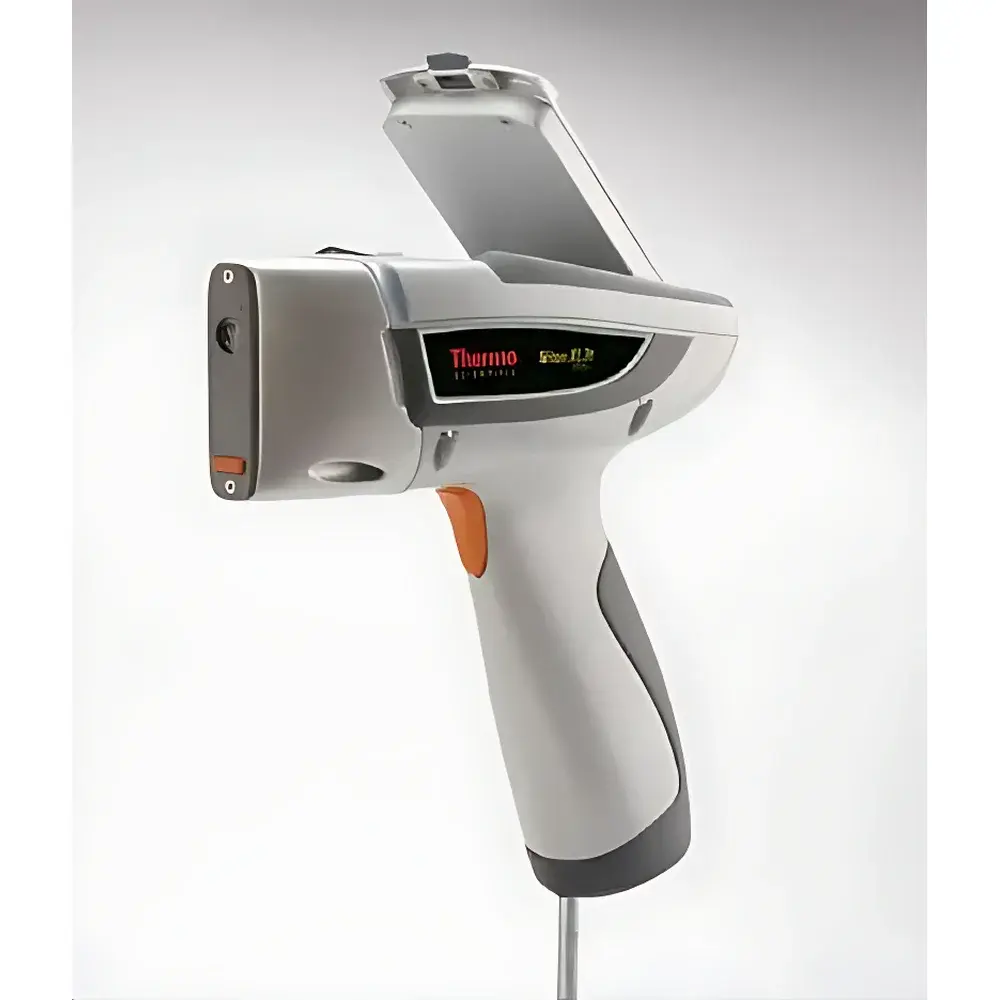
Thermo Scientific Niton XL3t GOLDD+ Handheld Energy Dispersive X-Ray Fluorescence (ED-XRF) Spectrometer
| Brand | Thermo Fisher |
|---|---|
| Origin | USA |
| Manufacturer | Thermo Fisher Scientific |
| Import Status | Imported |
| Model | XL3t GOLDD+ |
| Application | Handheld / Portable |
| Industry Type | General Purpose |
| Elemental Range | Mg to S |
| Detection Limit | <10 ppm |
| Tube Voltage | 9–50 kV |
| Tube Current | 0–40 µA max |
| Repeatability | ±0.1% RSD |
Overview
The Thermo Scientific Niton XL3t GOLDD+ is a handheld energy dispersive X-ray fluorescence (ED-XRF) spectrometer engineered for rapid, non-destructive elemental analysis of solid and powdered samples in field and industrial environments. Utilizing a high-performance microfocus X-ray tube and the proprietary GOLDD+ (Geometry Optimized Large Area Drift Detector) silicon drift detector (SDD), this instrument delivers superior peak resolution, enhanced light-element sensitivity (down to magnesium), and improved count-rate capability compared to conventional Si-PIN or earlier-generation SDD configurations. Its measurement principle relies on excitation of sample atoms by primary X-rays, followed by detection of characteristic secondary (fluorescent) X-rays emitted during electron relaxation—enabling quantitative and semi-quantitative determination of elemental composition without sample digestion or vacuum requirements. Designed for compliance-driven workflows, the XL3t GOLDD+ supports real-time decision-making at incoming inspection points, production lines, scrap yards, and regulatory checkpoints.
Key Features
- GOLDD+ silicon drift detector with optimized geometry for increased solid-angle collection efficiency and reduced dead time—critical for accurate low-concentration quantification of Mg, Al, Si, P, and S.
- Microfocus X-ray tube with selectable voltage (9–50 kV) and current (0–40 µA), enabling tailored excitation for diverse matrices—from light alloys to high-Z ceramics and polymers.
- Ruggedized IP54-rated housing with integrated shock-absorbing bumper, MIL-STD-810G certified for drop resistance (up to 1 m onto concrete), and operating temperature range of –10 °C to 50 °C.
- Integrated high-resolution color touchscreen with glove-compatible interface and intuitive icon-based navigation—designed for use in manufacturing, warehouse, and outdoor conditions.
- Battery life up to 12 hours per charge (dual hot-swappable Li-ion batteries), supporting uninterrupted shift-long operation without recharging.
- Onboard spectral deconvolution algorithms compliant with ASTM E1621 and ISO 21043 standards for multi-element quantification in heterogeneous or layered materials.
Sample Compatibility & Compliance
The XL3t GOLDD+ accommodates a broad spectrum of sample forms—including bulk metals, coated surfaces, plastics, soils, ores, catalysts, and electronic components—without requiring homogenization or pelletization. Its collimated beam (3 mm or 8 mm spot size selectable) minimizes matrix effects and enables precise analysis of small features or weld seams. Regulatory alignment includes full support for restricted substance screening per CPSIA/HR4040 (Pb, Cd, Hg, Cr(VI), total Br), EU RoHS 2 (2011/65/EU), WEEE Directive, EN 71-3 (Toy Safety), and China RoHS. Instrument firmware and calibration libraries are validated against NIST traceable reference materials (e.g., SRM 2582, 2583) and undergo periodic verification per ISO/IEC 17025–accredited laboratory protocols. Data audit trails comply with FDA 21 CFR Part 11 requirements when used in GLP/GMP-regulated environments.
Software & Data Management
Niton Data Transfer (NDT) software provides secure, encrypted data synchronization between instruments and enterprise networks via USB, Wi-Fi, or Bluetooth. All spectra, calibration files, and user-defined methods are stored with time/date stamps, operator ID, GPS coordinates (optional), and environmental metadata (temperature, humidity). The software supports batch reporting in PDF/XLS formats, customizable pass/fail thresholds per element, and integration with LIMS platforms through ODBC-compliant export. Firmware updates include version-controlled change logs and validation documentation required for internal quality audits. Remote diagnostics and over-the-air calibration verification minimize downtime and ensure continuous measurement integrity.
Applications
- Raw material verification in automotive and aerospace supply chains—rapid identification of alloy grades (e.g., 6061 vs. 7075 Al, 304 vs. 316 SS) and detection of tramp elements (e.g., Pb in zinc die-castings).
- RoHS/WEEE compliance screening of printed circuit boards, cables, and plastic housings—simultaneous quantification of Cd, Pb, Hg, Cr, Br, and Cl at sub-10 ppm levels.
- Consumer product safety testing—lead and cadmium screening in toys, jewelry, and cosmetics per ASTM F963 and EN 71-3.
- Scrap metal sorting and recycling—real-time differentiation of stainless steels, nickel alloys, titanium grades, and copper-bearing alloys.
- Environmental site assessment—field screening of soil and sediment for heavy metals (As, Cd, Cr, Cu, Ni, Pb, Zn) prior to lab submission.
- Geological exploration and mining—qualitative and quantitative analysis of drill core chips and grab samples for base and precious metals.
FAQ
What regulatory standards does the XL3t GOLDD+ support out-of-the-box?
It includes pre-loaded calibrations and reporting templates for CPSIA, RoHS 2, WEEE, EN 71-3, and ASTM F963—each verified using certified reference materials.
Can the instrument analyze light elements such as magnesium and aluminum in air?
Yes—the GOLDD+ detector and helium purge option (available as accessory) enable reliable Mg–S detection without vacuum chamber requirements.
Is spectral data export compatible with third-party chemometric software?
Raw spectra (.spc) and processed results (.csv/.xlsx) are fully exportable; peak fitting parameters and matrix correction coefficients are accessible for advanced modeling.
How is measurement repeatability ensured across operators and shifts?
Built-in daily verification checks, auto-calibration routines, and operator-specific authentication prevent unauthorized method changes and maintain inter-user consistency.
Does the device meet international shipping and customs inspection requirements?
Yes—it is widely deployed by U.S. CBP, EU Member State customs authorities, and PROSAFE partners for border screening of consumer goods and industrial imports.






