
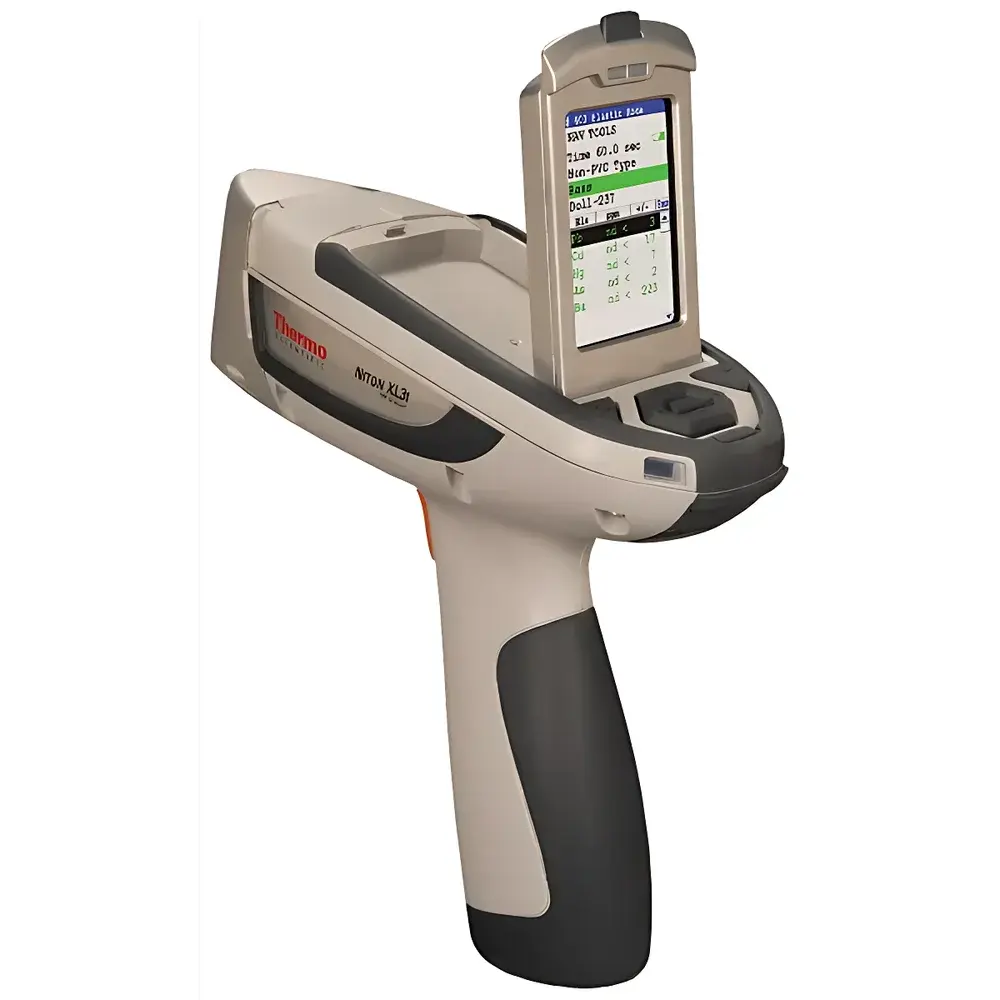
Thermo Scientific Niton XL3t Handheld Energy Dispersive X-Ray Fluorescence (ED-XRF) Spectrometer
| Brand | Thermo Fisher Scientific |
|---|---|
| Origin | Shanghai, China |
| Manufacturer Type | Authorized Distributor |
| Country of Origin | China |
| Model | Niton XL3t Handheld ED-XRF Spectrometer |
| Price | Upon Request |
| Detector Type | High-Performance Silicon Drift Detector (SDD) |
| X-ray Tube | Au anode, 50 kV max, 200 µA max |
| Minimum Detection Limits | Sub-ppm for high-Z elements |
| Elemental Range | S (16) to U (92) — up to 25 elements simultaneously quantified |
| Standard Spot Size | 3 mm collimated beam |
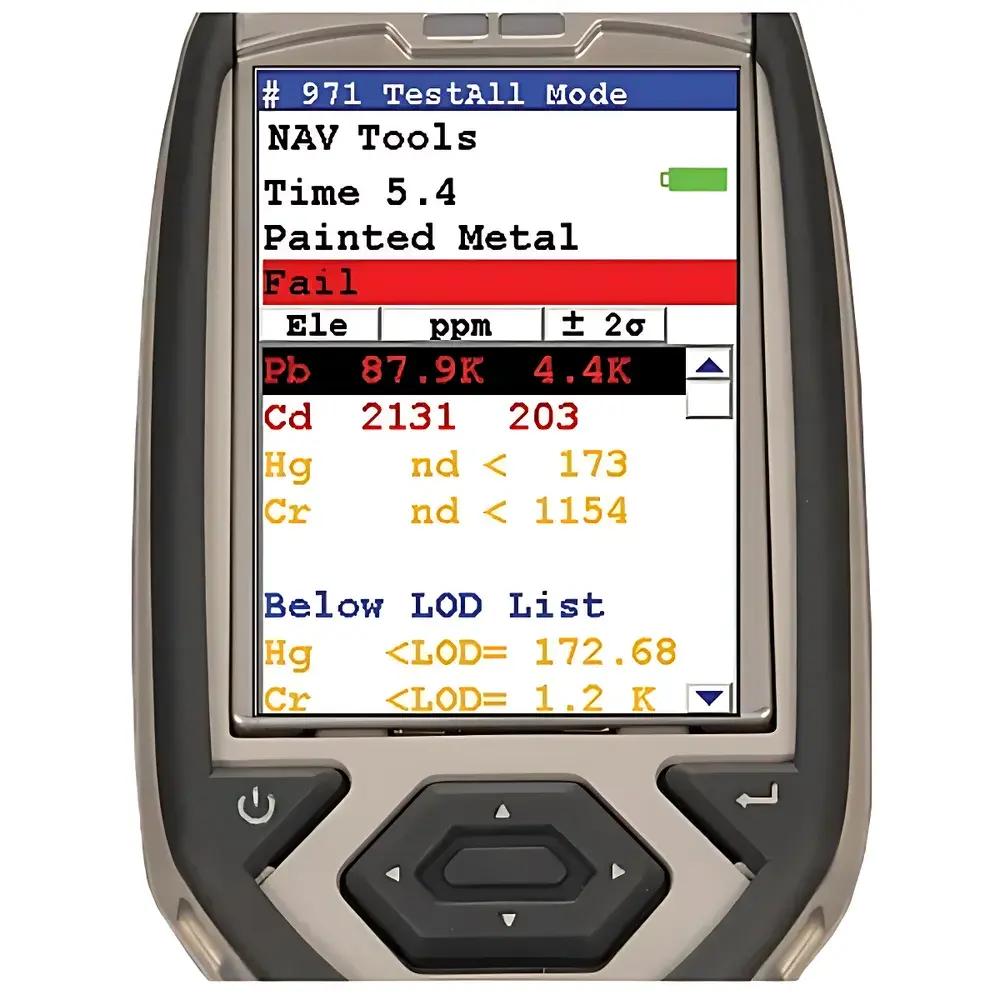
| Display | Tilting full-color capacitive touchscreen (4.3″) |
| Operating Temperature | –10 °C to 50 °C |
| Hot Surface Capability | Up to 450 °C (842 °F) with HotFoot™ adapter |
| Data Connectivity | Integrated USB 2.0, Bluetooth 4.0, RS-232 |
| Software | Thermo Scientific Niton Data Transfer (NDT™) v9.x with user permission management, audit trail, CFR Part 11-compliant reporting options |
| Dimensions (L × W × H) | 244 × 230 × 95.5 mm |
| Weight | 1.3 kg |
| Power | Dual hot-swappable Li-ion battery packs (4-cell or optional 6-cell), 100 µA typical operating current |
| Compliance | CE, RoHS 2011/65/EU, IEC 62471, FDA 21 CFR Part 1020.40, ISO 12885, ASTM E1621–22, ASTM E2857–22 |
Overview
The Thermo Scientific Niton XL3t Handheld Energy Dispersive X-Ray Fluorescence (ED-XRF) Spectrometer is an industrial-grade, field-deployable elemental analyzer engineered for rapid, non-destructive compositional analysis across metallurgy, mining, environmental screening, and regulatory compliance applications. Utilizing a high-output 50 kV microfocus X-ray tube with gold anode and a high-resolution silicon drift detector (SDD), the XL3t delivers laboratory-grade precision in a ruggedized portable platform. Its measurement principle relies on excitation of characteristic secondary X-rays from sample atoms under primary X-ray irradiation, followed by energy-resolved detection and quantitative spectral deconvolution using fundamental parameters-based calibration algorithms. The instrument is optimized for trace-level detection of regulated elements—including Pb, Cd, Hg, Cr, Br (as proxy for flame retardants), and As—in alloys, soils, plastics, coatings, and consumer goods—enabling real-time pass/fail decisions aligned with CPSIA, RoHS Directive 2011/65/EU, Proposition 65, and USP / requirements.
Key Features
- 50 kV X-ray source delivering ~2× higher photon flux than legacy 40 kV systems—improving count statistics and reducing measurement time to ≤2 seconds for alloy identification and ≤10 seconds for low-concentration regulatory screening
- Optional helium purge mode enabling reliable quantification of light elements Mg, Al, Si, and P—critical for aluminum alloy grading, catalyst analysis, and geological surveying
- 3 mm collimated beam spot size with integrated CCD camera for precise targeting and digital documentation of analysis location and sample morphology
- Ergonomic, balanced chassis with tilting 4.3-inch capacitive touchscreen interface—operable with gloves and in variable lighting conditions
- HotFoot™ thermal adapter certified for direct contact measurements on surfaces up to 450 °C, supporting in-situ inspection in refinery piping, furnace components, and heat-exchanger tubes
- Robust IP54-rated enclosure with MIL-STD-810G shock/vibration resistance and extended battery life (up to 12 hours per dual-battery configuration)
Sample Compatibility & Compliance
The Niton XL3t accommodates heterogeneous solid matrices without sample preparation: bulk metals, irregular scrap fragments, coated substrates, soil cores, plastic housings, painted surfaces, and thin-film electronics. It supports preloaded application-specific modes—Alloy, Mining/Soil, RoHS Plastics, Lead Paint, and Custom—each with factory-validated calibrations traceable to NIST SRMs and ISO-certified reference materials. All analytical workflows comply with ASTM E1621 (standard guide for ED-XRF analysis of metals), ASTM E2857 (performance verification of handheld XRF), and ISO 12885 (safety requirements for X-ray equipment). Data integrity meets GLP/GMP expectations through NDT™ software’s electronic signature support, configurable audit trails, and 21 CFR Part 11-compliant user access controls and report generation.
Software & Data Management
Niton Data Transfer (NDT™) v9.x provides centralized instrument configuration, method deployment, and secure data aggregation. Operators can define role-based permissions (e.g., analyst, supervisor, QA reviewer), schedule automated firmware updates, and generate customizable PDF or CSV reports compliant with internal QA protocols or external regulatory submissions. Raw spectra, measurement metadata (GPS coordinates, operator ID, timestamp, environmental temperature), and image overlays are stored locally and synchronized via USB or Bluetooth to networked servers or cloud repositories. Optional integration with LIMS platforms is supported via ODBC-compliant export modules. All data transfers adhere to TLS 1.2 encryption standards when interfacing with enterprise IT infrastructure.
Applications
- Metals Manufacturing & Recycling: Positive material identification (PMI) of stainless steels, Ni-alloys, Ti grades, and Cu-based alloys; scrap sorting by composition; QA/QC of incoming billets and finished castings
- Mining & Exploration: In-field grade control of ore samples; geochemical mapping of pathfinder elements (e.g., Cu, Zn, Pb, As) in drill core and trench samples
- Consumer Product Safety: Screening for restricted substances in toys, jewelry, electronics housings, and packaging per CPSIA Section 101 and EU RoHS Annex II
- Environmental Monitoring: Rapid assessment of heavy metal contamination (Pb, Cd, Cr, As) in soils, sediments, and paint chips at brownfield sites
- Petrochemical Infrastructure: Corrosion product analysis on pipe interiors, weld inspection, and catalyst elemental profiling during turnaround inspections
FAQ
Is the Niton XL3t certified for use in intrinsically safe environments?
No—the XL3t is not ATEX or IECEx certified. It is intended for general industrial use outside classified hazardous locations.
Can the instrument analyze liquids or powders directly?
Yes—when placed in a sealed sample cup with Mylar or polypropylene film window, the XL3t provides semi-quantitative results for slurries, powders, and homogenized liquids; however, certified calibrations are validated only for solid-state matrices.
What is the typical measurement repeatability for alloy analysis?
Under controlled conditions (same spot, 5-second measurement), relative standard deviation (RSD) is ≤1.5% for major constituents (>5 wt%) in standardized alloy reference materials.
Does the system require annual recalibration by the manufacturer?
No—routine performance verification using supplied check standards (e.g., stainless steel, brass) is sufficient per ASTM E2857; full recalibration is recommended every 24 months or after significant mechanical impact.
How is data security enforced during remote operation?
NDT™ enforces AES-256 encryption for data at rest and TLS 1.2 for data in transit; all user actions are logged with immutable timestamps and linked to individual credentials.




