
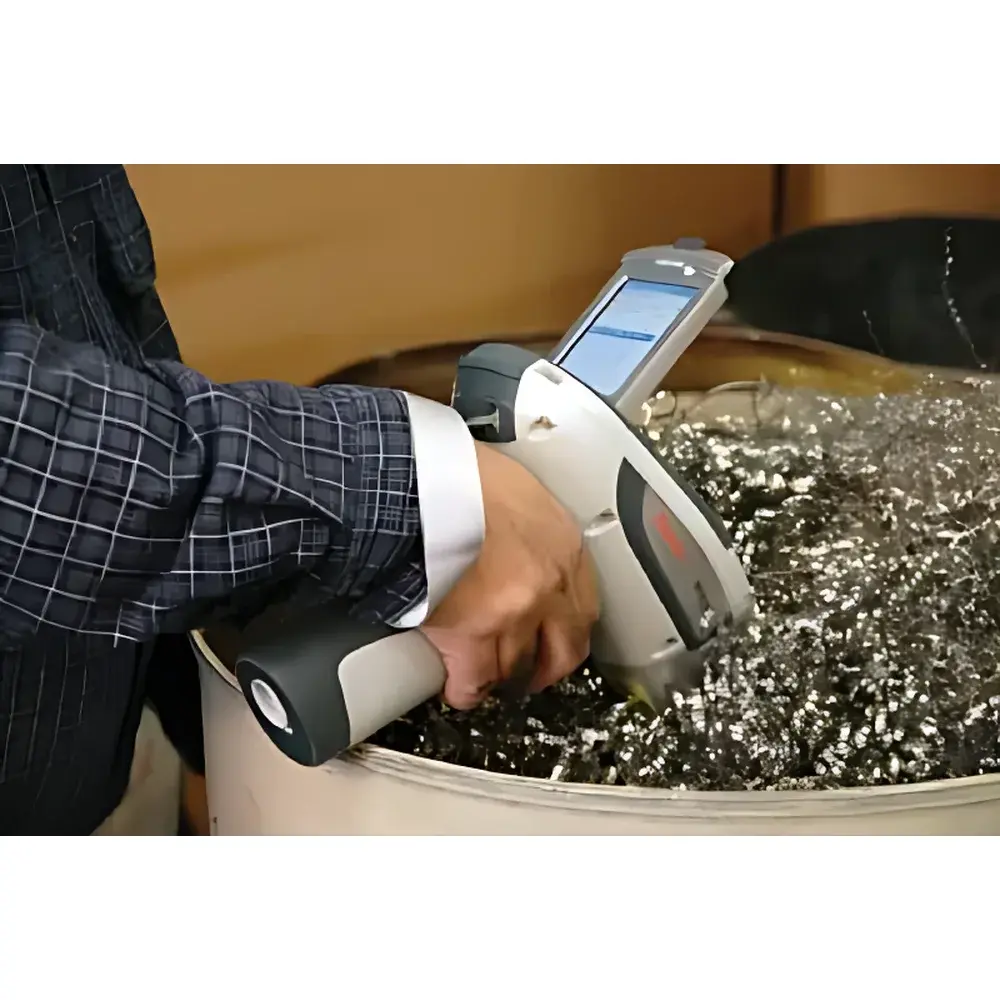
Thermo Scientific Niton XL3t800 Handheld Energy Dispersive X-Ray Fluorescence (EDXRF) Spectrometer
| Brand | Thermo Fisher |
|---|---|
| Origin | USA |
| Manufacturer Type | Original Equipment Manufacturer (OEM) |
| Origin Category | Imported |
| Model | XL3t800 |
| Portability | Handheld/Portable |
| Weight | <1.3 kg |
| Dimensions | 244 × 230 × 95.5 mm (9.60 × 9.05 × 3.75 in) |
| X-ray Tube | High-performance micro-focus tube with Au anode (max 50 kV / 40 µA) |
| Detector | High-sensitivity Si-PIN semiconductor detector |
| Battery | Rechargeable Li-ion, >10 h operation per charge |
| Display | Adjustable-angle (0–90°) high-brightness VGA color touchscreen |
| Standard Elemental Range | Ti–U (23 elements: Ti, V, Cr, Mn, Fe, Co, Ni, Cu, Zn, Zr, Nb, Mo, Pd, Ag, Sn, Hf, Ta, W, Re, Pb, Bi, Se, Sb) |
| Optional Helium Purge Kit | Enables Mg, Al, Si, P, S analysis |
| Data Storage | >10,000 spectra + results |
| Analysis Modes | Alloy Grade ID & quantitative composition, Grade Match, Super Quant, 3-mm spot mode (optional) |
| Connectivity | USB 2.0, Bluetooth 4.0 |
| Software | NITON Data Transfer (NDT) v8.x with PMI reporting, remote control, user permission management, audit trail, and CFR Part 11-compliant report generation |
| Safety | Radioisotope-free |
Overview
The Thermo Scientific Niton XL3t800 is a field-deployable, handheld energy dispersive X-ray fluorescence (EDXRF) spectrometer engineered for rapid, non-destructive elemental analysis of metallic alloys and engineering materials. Operating on the fundamental principle of X-ray fluorescence—where primary X-rays excite atoms in the sample, causing emission of secondary (characteristic) X-rays—the XL3t800 quantifies elemental composition by measuring energy and intensity of emitted photons. Its optimized geometry, micro-focus X-ray tube, and Si-PIN detector deliver laboratory-grade precision under real-world industrial conditions. Designed for rigorous use in uncontrolled environments—including refinery pipe racks, offshore platforms, fabrication yards, and scrap sorting facilities—the instrument meets ISO 17025-aligned performance expectations for Positive Material Identification (PMI), material verification, and regulatory compliance workflows.
Key Features
- Ultra-lightweight design (<1.3 kg) with ergonomic grip and balanced center-of-mass for extended single-hand operation
- VGA color touchscreen with 0–90° tilt adjustment, supporting glove-compatible touch input and intuitive icon-driven navigation
- Radioisotope-free excitation source: dual-anode (Au/Ag) micro-focus X-ray tube with programmable voltage (5–50 kV) and current (1–40 µA) control
- High-resolution Si-PIN detector with Peltier cooling, delivering stable spectral resolution (<180 eV at Mn Kα) across temperature ranges from –10 °C to 50 °C
- Integrated thermal management system ensuring consistent detector performance during prolonged field use
- IP54-rated enclosure with MIL-STD-810G certified drop resistance (1.2 m onto concrete) and ingress protection against dust and water splashes
- Real-time spectrum display with live peak identification, background subtraction, and interference correction algorithms
- On-device alloy grade library with >1,200 preloaded standards (ASTM, ASME, SAE, EN, GB, JIS), editable via NDT software
- Automatic calibration verification using internal reference standards before and after each analysis sequence
- Firmware-upgradable architecture with secure over-the-air (OTA) updates via encrypted HTTPS connection
Sample Compatibility & Compliance
The XL3t800 analyzes solid metallic samples—including castings, forgings, welds, pipes, valves, fasteners, and scrap fragments—with minimal surface preparation. It supports direct measurement of curved, rough, or coated surfaces without requiring polishing or removal of protective layers (e.g., paint, oxide, galvanizing). For light-element extension (Mg, Al, Si, P, S), optional helium purge enables detection limits down to 100 ppm for Mg and 50 ppm for Al in aluminum alloys. The instrument complies with international safety and metrological standards: IEC 62495 (handheld XRF safety), ANSI N43.3 (radiation safety), EU Directive 2014/30/EU (EMC), and 2011/65/EU (RoHS). Its data acquisition and reporting modules support GLP/GMP traceability requirements, including full audit trails, electronic signatures, and 21 CFR Part 11–compliant PDF report generation.
Software & Data Management
NITON Data Transfer (NDT) software v8.x serves as the central hub for instrument configuration, method development, and regulatory reporting. It provides role-based user access control (administrator, analyst, reviewer), customizable PMI report templates (PDF/XLS), and automated spectral archiving with metadata tagging (location, operator, timestamp, GPS coordinates). All analyses are time-stamped and cryptographically signed to ensure data integrity. NDT integrates seamlessly with LIMS and ERP systems via CSV export or ODBC connectivity. Remote instrument diagnostics, firmware deployment, and spectral library synchronization are performed securely through Thermo Fisher’s cloud-managed portal. Audit logs record every configuration change, calibration event, and result export—fully satisfying FDA, TÜV, and API RP 578 documentation requirements.
Applications
- Positive Material Identification (PMI) for piping, pressure vessels, and structural components in oil & gas, power generation, and chemical processing
- Scrap metal sorting and recycling quality assurance, including stainless steel grade verification and Cu/Ni alloy segregation
- Weld metal verification and filler material authentication in ASME Section IX-compliant fabrication shops
- Quality control of incoming raw materials and finished goods in aerospace (Ti-6Al-4V, Inconel), automotive (Al-Si, Mg-Al), and electronics (Cu-Be, Sn-Pb)
- Failure analysis root-cause investigations involving intergranular corrosion, stress corrosion cracking, or improper heat treatment
- Regulatory compliance auditing per ASTM E1479 (standard guide for PMI), API RP 578 (material verification), and ISO 14284 (steel sampling)
FAQ
Is the XL3t800 certified for use in hazardous locations (e.g., Class I Div 1)?
No—it is not intrinsically safe or ATEX-certified. Use in classified areas requires prior risk assessment and adherence to site-specific hot work permits.
Can the instrument analyze coatings or plating thickness?
It is not designed for quantitative coating thickness measurement; however, qualitative layer composition (e.g., Zn/Ni on steel) can be assessed using multi-layer modeling in advanced NDT modes.
What is the typical detection limit for Cr in stainless steel?
Under standard air-mode conditions, the 3σ detection limit for Cr is ≤30 ppm in 304 stainless steel matrix, verified per ASTM E2857 practice.
Does the device require annual recalibration by an authorized service center?
No—built-in calibration verification ensures ongoing accuracy; however, biannual performance qualification (PQ) using certified reference materials is recommended per ISO/IEC 17025.
How is data security enforced during wireless transmission?
Bluetooth and USB transfers employ AES-256 encryption; NDT software enforces TLS 1.2+ for cloud sync and prohibits plaintext credential storage.
Related Products





