
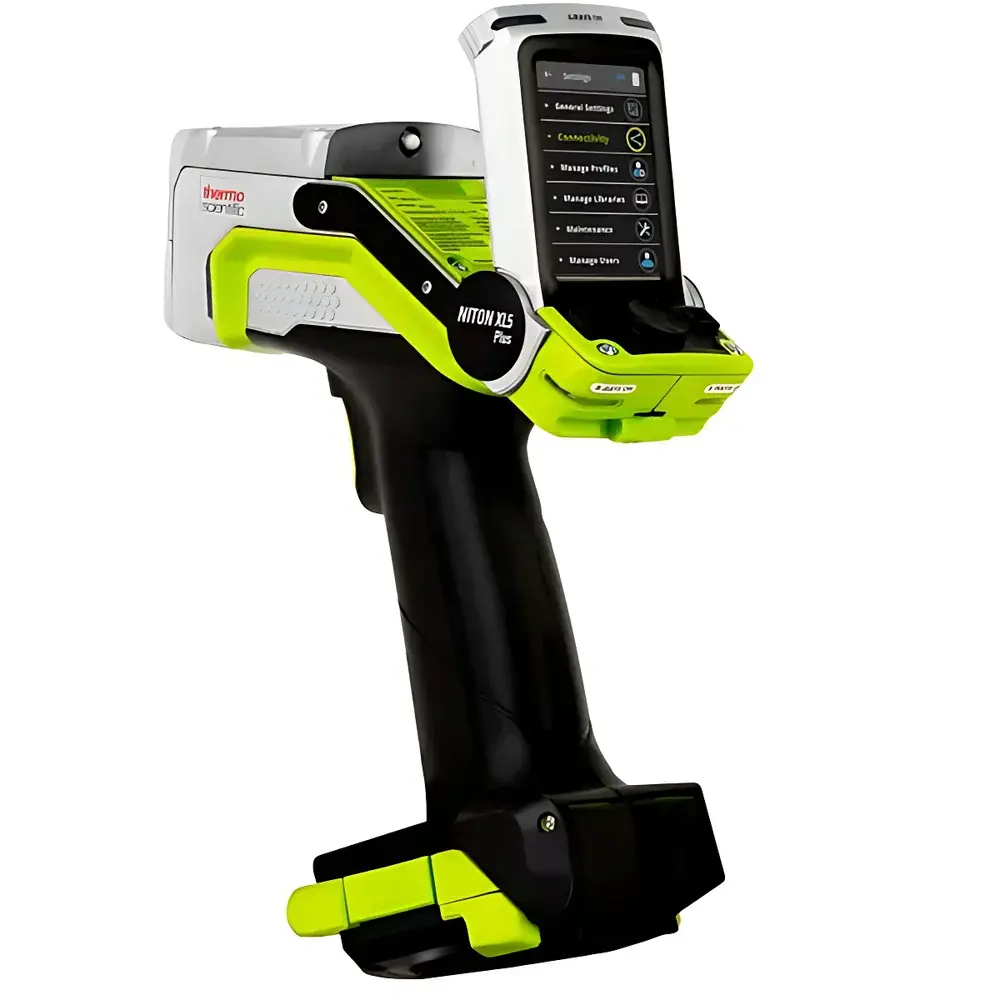
Thermo Scientific Niton™ XL5 Plus Handheld X-Ray Fluorescence (XRF) Spectrometer
| Brand | Thermo Fisher |
|---|---|
| Origin | Shanghai, China |
| Manufacturer Type | Authorized Distributor |
| Country of Origin | China |
| Model | Niton™ XL5 Plus |
| Price | Upon Request |
| Detector Type | High-Count-Rate, High-Resolution, Large-Area Silicon Drift Detector (SDD) with 1 µm Graphene Window and ProGuard Protection |
| X-ray Source | Silver-Anode X-ray Tube (6–50 kV, 0–500 µA, up to 5 W) |
| Beam Spot Size | Standard 8 mm |
| Filtration | 6-Position Filter Wheel |
| Sample Interface | Micro & Macro Cameras, Reversible Scattering Shield Support, Optional Soil Guard Sleeve |
| Display | Tilt-Adjustable Color Resistive Touchscreen |
| Weight | 1.3 kg (2.8 lb) with Battery |
| Dimensions (L×W×H) | 24.23 × 20.8 × 6.78 cm (9.54 × 8.19 × 2.67 in) |
| Environmental Rating | IP54 (Dust-Resistant & Splash-Protected) |
| Operating Temperature | 0–50 °C (External fan recommended above 33 °C) |
| Relative Humidity | 10–90% RH (non-condensing) |
| Power | Hot-Swappable 12 V Li-ion Battery or 12 V DC/3 A Input |
| Data Storage | 512 MB RAM / 16 GB Industrial-Grade Flash (≈130,000 spectra + metadata |
| Connectivity | Wi-Fi, USB-C, Bluetooth (optional GPS, barcode scanner) |
| Software | NitonConnect PC Software with Audit Trail, Report Generation, and Library Management |
| Compliance | CE, RoHS, FCC, ISED (Canada), IEC 61010-1:2010 |
| Safety | Password-Protected User Access, Interlock Logic, Real-Time Dose Monitoring, Regulatory Licensing Support per Regional Authority |
Overview
The Thermo Scientific Niton™ XL5 Plus Handheld X-Ray Fluorescence (XRF) Spectrometer is an industrial-grade elemental analyzer engineered for precision, speed, and field-deployable robustness. It operates on the fundamental principle of energy-dispersive X-ray fluorescence: a focused X-ray beam excites atoms in the sample, causing emission of characteristic secondary X-rays whose energies are uniquely associated with specific elements. The XL5 Plus employs a high-count-rate, large-area silicon drift detector (SDD) with a proprietary 1 µm graphene window—optimized for enhanced transmission of low-energy photons—enabling reliable detection of light elements including magnesium (Mg), aluminum (Al), silicon (Si), phosphorus (P), and sulfur (S). Its 5 W silver-anode X-ray tube, coupled with dynamic current regulation and a six-position filter wheel, ensures optimal excitation conditions across diverse matrices—from high-Z alloys to low-Z geological samples—without manual reconfiguration.
Key Features
- Light-element capability enabled by graphene-window SDD and Ag-target X-ray source (6–50 kV, up to 500 µA)
- Compact, ergonomic design weighing only 1.3 kg (2.8 lb), with tilt-adjustable resistive touchscreen for variable-angle operation
- Dual-camera system (macro and micro) for precise targeting and spatial documentation of analysis spots
- Hot-swappable battery architecture ensures uninterrupted operation during extended field sessions
- IP54-rated enclosure meets stringent requirements for dust and water-splash resistance in harsh industrial environments
- Integrated GPS (internal + optional external Bluetooth module) embeds geospatial metadata directly into spectral records
- Real-time dose monitoring and password-protected user access comply with radiation safety protocols and audit-ready security policies
- Standard 8 mm collimation; optional 3 mm micro-spot collimator for localized analysis of small features or coatings
Sample Compatibility & Compliance
The Niton XL5 Plus supports non-destructive analysis of solid, powdered, and irregularly shaped samples—including metals, ores, soils, polymers, coatings, and consumer goods—without requiring vacuum or helium purging. Its analytical libraries conform to widely accepted industry standards: ASTM E1996 (alloy identification), ISO 17025-compliant data handling workflows, and USP / guidelines for elemental impurities in pharmaceuticals. For regulated environments, the instrument supports GLP/GMP-aligned data integrity through NitonConnect software’s electronic signatures, full audit trail, and 21 CFR Part 11–compliant reporting. Regulatory licensing varies by jurisdiction; users must consult local radiation safety authorities prior to deployment. All units carry CE, RoHS, FCC, and ISED certifications, and meet IEC 61010-1:2010 safety requirements for laboratory and field instrumentation.
Software & Data Management
NitonConnect PC software provides comprehensive post-acquisition analysis, library customization, and regulatory reporting. Users can create, duplicate, and edit custom grade libraries aligned with SAE, AISI, ASTM, AA, DIN, or GB specifications. Spectral data—including raw counts, peak deconvolution, and statistical uncertainty estimates—is stored with full metadata (operator ID, timestamp, GPS coordinates, camera images, measurement parameters). The 16 GB industrial flash memory accommodates approximately 130,000 full-spectrum readings; storage capacity scales dynamically based on image inclusion. Data export supports CSV, PDF, and XML formats compatible with LIMS integration. Remote firmware updates and configuration synchronization are supported via Wi-Fi or USB-C.
Applications
- Metal and alloy verification in manufacturing QA/QC and MRO operations
- Material reliability identification (PMI) for piping, valves, and structural components in oil & gas and power generation
- Scrap metal sorting via one-touch grade classification in recycling facilities
- Multi-layer coating thickness quantification using fundamental parameter (FP) modeling
- Field-based geochemical mapping and exploration drilling support
- Soil screening for As, Pb, Cd, Cr, Hg, and other priority contaminants per EPA Method 6200
- Routine screening of consumer products for restricted substances (e.g., RoHS, CPSIA, EN71-3)
- Gold, platinum, and palladium assay in jewelry and bullion with certified reference material traceability
FAQ
Which XRF analyzer is appropriate for my application?
Selection depends on required light-element sensitivity, sample geometry, regulatory environment, and throughput needs. The XL5 Plus is optimized for Mg–U quantification in heterogeneous solids under ambient conditions.
Should I purchase or lease this instrument?
Leasing is suitable for short-term projects or compliance-driven deployments where technology refresh cycles align with financial planning; purchasing offers long-term TCO advantages and full data ownership.
Where can I obtain radiation safety training?
Thermo Fisher Scientific provides region-specific operator certification courses compliant with national radiation protection regulations; authorized distributors also offer localized training and licensing support.
What is XRF technology?
XRF is a non-destructive elemental analysis technique that measures characteristic X-ray emissions induced by primary X-ray excitation, enabling quantitative and qualitative determination of elements from sodium (Na) to uranium (U).
What are typical use cases for handheld XRF in industrial settings?
Common applications include positive material identification (PMI), scrap metal sorting, mining exploration, environmental site assessment, precious metal valuation, and regulatory screening for hazardous substances in manufactured goods.
Related Products




