
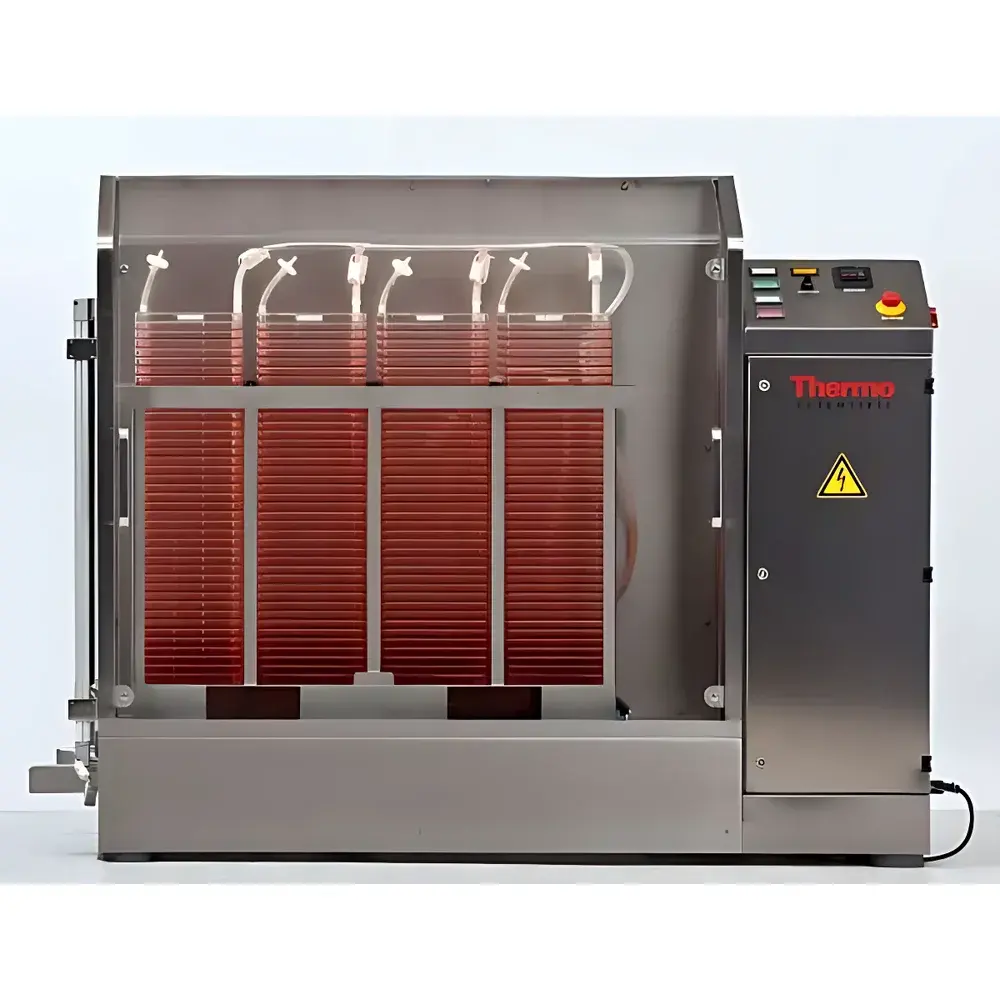
Thermo Scientific Nunc Cell Factory Shaker
| Brand | Thermo Scientific |
|---|---|
| Origin | USA |
| Manufacturer Type | Original Equipment Manufacturer (OEM) |
| Import Status | Imported |
| Instrument Type | Air-Jacketed Temperature-Controlled Orbital Shaker |
| Oscillation Mode | Continuous Horizontal Acceleration/Deceleration |
| Frequency Range | 0–2 Hz |
| Programmable Timing | Yes |
| Application-Specific Design | Optimized for Nunc Cell Factory stacking systems (1–10 layers) |
Overview
The Thermo Scientific Nunc Cell Factory Shaker is an engineered platform specifically designed to support scalable adherent cell culture within the Nunc Cell Factory system—a modular, multi-layered cell culture format widely adopted in bioprocessing, vaccine production, and therapeutic protein manufacturing. Unlike generic orbital shakers, this device implements a precisely controlled horizontal acceleration/deceleration motion profile to promote uniform nutrient distribution, gas exchange, and shear-sensitive cell detachment without compromising monolayer integrity. Its operation is grounded in orbital oscillation physics with programmable inertial modulation—enabling reproducible mechanical stimulation across stacked Cell Factory units (1–10 layers). The air-jacketed thermal architecture ensures stable temperature maintenance (typically 37 °C ±0.3 °C) throughout extended culture durations, meeting core requirements for mammalian cell expansion under cGMP-aligned workflows.
Key Features
- Application-optimized motion dynamics: Delivers continuous horizontal acceleration/deceleration at frequencies from 0 to 2 Hz (0–120 cycles per minute), minimizing turbulent shear while maximizing medium homogenization across vertically stacked Cell Factory trays.
- Air-jacketed temperature control: Integrated PID-regulated heating system maintains setpoint stability within ±0.3 °C over 72-hour runs—critical for maintaining physiological conditions during large-scale adherent culture.
- Programmable timing interface: Supports multi-step oscillation protocols with start/stop scheduling, dwell time definition, and frequency ramping—enabling automated harvest preparation or differentiation induction sequences.
- Nunc Cell Factory–specific mechanical coupling: Precision-machined platform accommodates standard 1-, 2-, 5-, and 10-layer Cell Factory configurations with integrated alignment guides and clamping force calibration to prevent lateral slippage during motion cycles.
- Robust stainless-steel frame and vibration-dampened base: Designed for cleanroom-compatible installation and long-term operational reliability under ISO Class 5–7 environments.
Sample Compatibility & Compliance
The shaker is validated exclusively for use with Thermo Scientific Nunc Cell Factory systems (Cat. No. 130001–130010 series), including surface-treated polystyrene trays with gas-permeable membranes. It supports culture volumes ranging from 10 mL (single-tray assay mode) to 2,000 mL (10-layer configuration) and is compatible with common media formulations (e.g., DMEM/F12, MEM-α, EX-CELL® ACF). Device firmware and hardware design conform to IEC 61000-6-2 (immunity) and IEC 61000-6-4 (emissions) standards. While not intrinsically certified for GMP production, its operational traceability, programmable audit log, and stable thermal performance support qualification under FDA 21 CFR Part 11–aligned validation protocols when deployed in GLP/GMP facilities.
Software & Data Management
The unit operates via an embedded microcontroller with local LCD interface for manual parameter entry; no external PC connection is required for basic operation. For integration into digital lab infrastructure, optional RS-485/Modbus RTU output enables connection to SCADA or MES platforms for remote monitoring of runtime status, temperature history, and cycle completion signals. All user-defined programs—including frequency profiles, duration, and ramp parameters—are stored in non-volatile memory with timestamped execution logs. Audit trail functionality meets minimum ALCOA+ principles (Attributable, Legible, Contemporaneous, Original, Accurate) for regulated environments where procedural documentation is mandated.
Applications
- Scalable expansion of anchorage-dependent cells (e.g., Vero, CHO-K1, MRC-5, HEK293) for viral vector production and monoclonal antibody manufacturing.
- Controlled enzymatic detachment of confluent monolayers prior to harvest—reducing trypsin exposure time and improving post-detachment viability.
- Enhanced oxygen transfer in high-density cultures by promoting interfacial mixing without foam generation or bubble entrainment.
- Process development studies comparing static vs. dynamic culture conditions for adherence kinetics, metabolic profiling, and productivity assessment.
- Support of regulatory filings requiring documented consistency in physical culture parameters across batches (e.g., USP , ICH Q5D).
FAQ
Is the shaker compatible with non-Nunc multi-layer culture vessels?
No. Mechanical interface, load distribution, and motion calibration are validated solely for Thermo Scientific Nunc Cell Factory trays. Use with third-party systems voids warranty and compromises performance reproducibility.
What temperature range does the air-jacketed system support?
The standard configuration operates between ambient +5 °C and 45 °C, with factory-set default at 37 °C. Extended-range variants (up to 60 °C) are available under custom order with additional thermal shielding.
Can oscillation frequency be modulated during a single run?
Yes. The programmable timer supports up to three sequential frequency steps with defined ramp rates and dwell times—enabling staged protocols such as gentle pre-harvest agitation followed by accelerated detachment.
Does the device include data export capability?
Raw sensor data (temperature, motor current, elapsed time) is retained internally for 30 days. Export requires connection to a Modbus master device; CSV-formatted logs can be generated externally via compatible HMI or PLC software.
What maintenance intervals are recommended?
Annual calibration of temperature sensors and verification of platform leveling are advised. Belt tension and bearing inspection should occur every 2,000 operating hours or biannually—whichever comes first—using Thermo Scientific Field Service documentation (Ref. TN-CF-002).




