
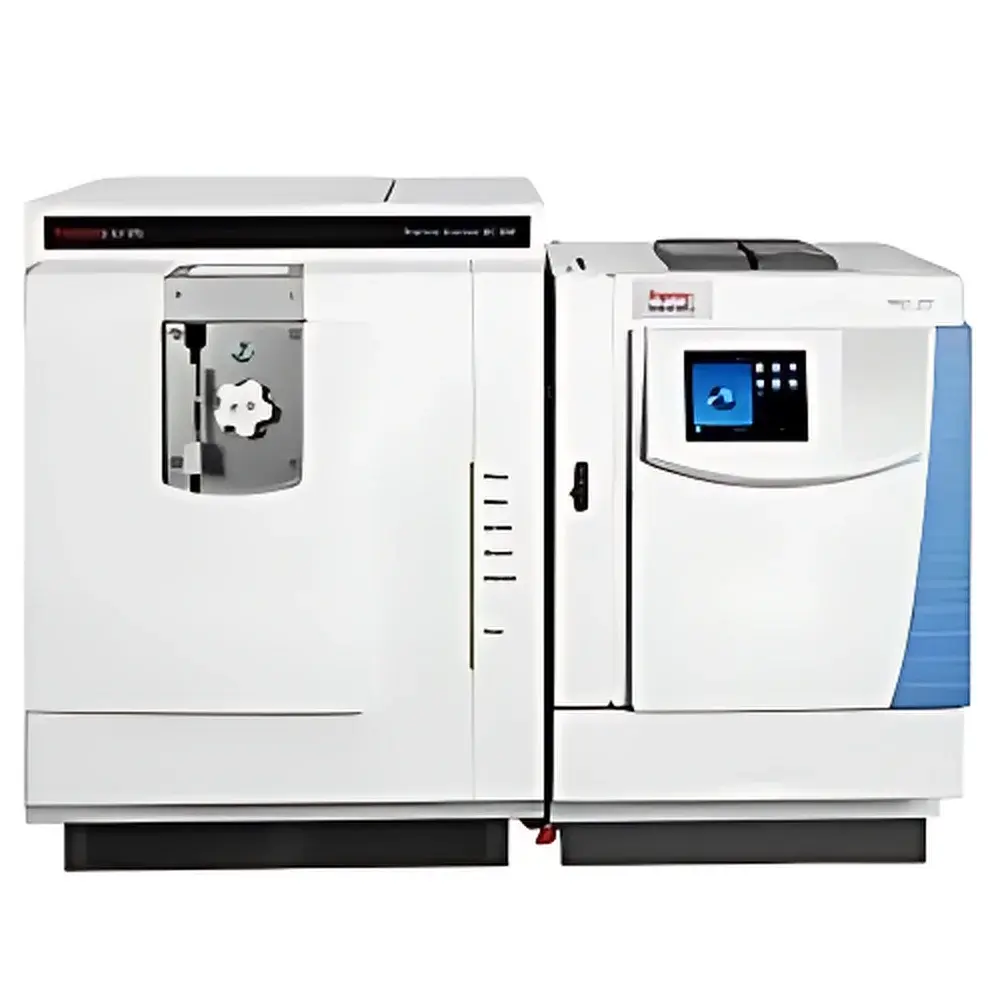
Thermo Scientific Orbitrap Exploris GC 240 High-Resolution Gas Chromatography Mass Spectrometer
| Brand | Thermo Fisher |
|---|---|
| Origin | Imported |
| Manufacturer Type | Original Equipment Manufacturer (OEM) |
| Instrument Type | Orbitrap Mass Spectrometer |
| GC Configuration | Conventional Gas Chromatography Interface |
| Mass Range | m/z 30–3000 |
| Resolution | Up to 240,000 at m/z 200 |
| Scan Speed | Up to 40 Hz at resolution setting 7,500 (m/z 200) |
Overview
The Thermo Scientific Orbitrap Exploris GC 240 is a high-resolution gas chromatography mass spectrometry (GC-MS) system engineered for rigorous analytical laboratories requiring unambiguous compound identification, structural elucidation, and confident quantitation in complex matrices. At its core lies the Orbitrap mass analyzer—a Fourier-transform-based detection platform that measures ion oscillation frequencies in an electrostatic field to deliver high mass accuracy (< 3 ppm RMS mass error), exceptional mass resolving power, and intrinsic dynamic range. Coupled with a robust electron ionization (EI) and optional chemical ionization (CI) source, and integrated with industry-standard gas chromatographs (e.g., Thermo Scientific Trace 1300/1600 series), the system enables routine acquisition of full-scan HRMS data at up to 240,000 resolution (FWHM at m/z 200), supporting both targeted and untargeted workflows across environmental, food safety, forensic, pharmaceutical, and academic research applications.
Key Features
- Orbitrap mass analyzer delivering up to 240,000 resolution at m/z 200, enabling separation of isobaric interferences and confident elemental composition assignment
- Mass range spanning m/z 30–3000, optimized for small-molecule analysis including volatile and semi-volatile organic compounds (VOCs/SVOCs)
- Scan speed of up to 40 Hz at 7,500 resolution—enabling high-fidelity peak sampling across narrow GC peaks without sacrificing spectral fidelity
- Integrated ExtractaBrite dual-mode ion source supporting rapid, tool-free switching between EI and CI modes, minimizing downtime during method transitions
- Modular GC interface design compatible with standard 0.25 mm ID capillary columns and common inlet configurations (split/splitless, PTV, cold injection)
- Compact benchtop footprint with reinforced thermal management and vibration-damping architecture for stable long-term operation in shared lab environments
- Fully compliant with instrument control standards (SCPI, ASTM E1947) and supports GLP/GMP-ready audit trails when paired with Thermo Scientific Chromeleon CDS software
Sample Compatibility & Compliance
The Orbitrap Exploris GC 240 is validated for use with liquid, solid, and gaseous samples following appropriate sample preparation protocols—including solvent extraction, SPME, purge-and-trap, and thermal desorption. It meets critical regulatory expectations for data integrity: raw data files are stored in open-format .raw containers with embedded metadata; all acquisition parameters, calibration history, and user actions are time-stamped and logged. The system supports 21 CFR Part 11-compliant workflows when deployed with validated software modules (e.g., Chromeleon 7.3+ with electronic signatures and role-based access control). Method validation documentation aligns with ISO/IEC 17025 requirements for testing laboratories, and routine performance verification follows ASTM D7829 (petroleum hydrocarbons), EPA Method 8270/8260 (semivolatiles/volatiles), and USP chromatographic system suitability criteria.
Software & Data Management
Data acquisition, processing, and reporting are managed through Thermo Scientific Compound Discoverer and TraceFinder software platforms—both built on a scalable, database-driven architecture. Compound Discoverer enables non-targeted screening via retention time alignment, molecular formula generation, isotopic pattern matching, and in silico fragmentation prediction (using CFM-ID and Mass Frontier libraries). TraceFinder delivers validated, template-driven workflows for targeted quantitation, supporting internal standard calibration curves, matrix-matched calibration, and automated peak integration per ICH Q2(R2) guidelines. All raw and processed data are exportable in open formats (mzML, CSV, SDF) and integrate seamlessly with LIMS systems via ODBC or RESTful APIs. Audit trail functionality records every parameter change, file export, and report generation event with immutable timestamps and operator IDs.
Applications
- Environmental analysis: Identification and quantification of persistent organic pollutants (POPs), pesticides, PAHs, and emerging contaminants (e.g., PFAS precursors) in soil, water, and air extracts
- Food and beverage safety: Screening for mycotoxins, veterinary drug residues, flavor adulterants, and thermal process contaminants (e.g., acrylamide, furan)
- Forensic toxicology: Comprehensive drug screening in biological matrices (urine, blood) with retrospective data mining capability
- Pharmaceutical impurity profiling: Structural characterization of low-level degradants and synthetic by-products in active pharmaceutical ingredients (APIs)
- Academic metabolomics: Untargeted volatile metabolite profiling in plant volatiles, microbial headspace, and breath analysis studies
FAQ
What is the typical mass accuracy achievable under routine GC-MS conditions?
Mass accuracy remains consistently below 3 ppm RMS when calibrated using standard tuning mixtures (e.g., FC43, DFTPP) and maintained with daily lock-mass correction.
Can the system operate in both full-scan and data-dependent MS/MS modes within a single run?
Yes—the acquisition engine supports hybrid scan functions, allowing simultaneous full-scan HRMS acquisition and triggered MS/MS events based on intensity or inclusion lists.
Is column bleed compensation supported in real time during data acquisition?
Yes—background subtraction algorithms are applied during acquisition using pre-run blank spectra, and baseline correction is configurable per segment in TraceFinder.
What level of IT infrastructure is required for optimal deployment?
A minimum of 64 GB RAM, 2 TB SSD storage, and Windows 10/11 Enterprise (64-bit) is recommended; network connectivity to centralized storage or HPC clusters is supported via SMB/NFS protocols.
Does the system support remote monitoring and diagnostics?
Instrument status, vacuum levels, ion source temperature, and acquisition progress can be viewed remotely via Thermo Scientific Connect cloud portal with TLS 1.2 encryption and multi-factor authentication.





