
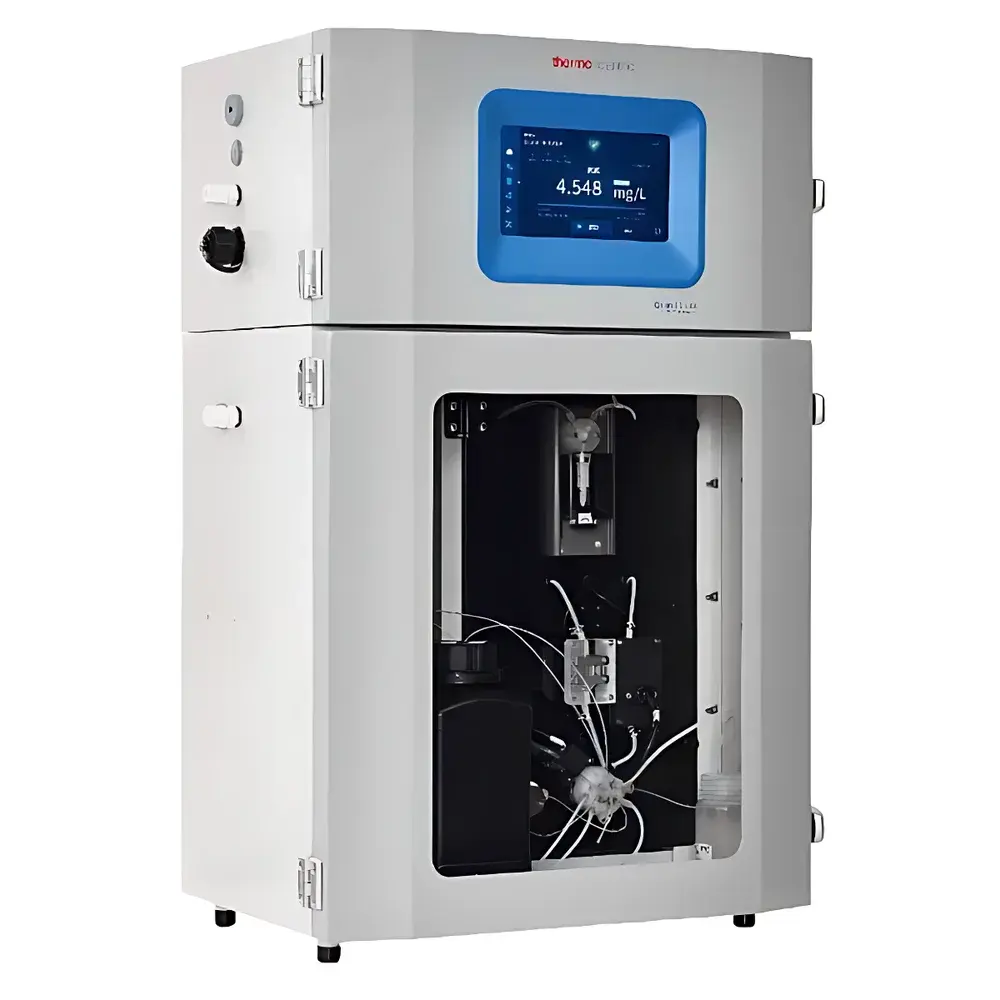
Thermo Scientific Orion 8010cX Online Ammonia Nitrogen Analyzer
| Brand | Thermo Fisher Scientific |
|---|---|
| Origin | Shanghai, China |
| Manufacturer Type | Original Equipment Manufacturer (OEM) |
| Product Category | Domestic |
| Model | Orion 8010cX |
| Instrument Type | Online Analyzer |
| Measurement Principle | Salicylate Spectrophotometry |
| Measurement Ranges | 0.02–2 mg/L |
| Accuracy | ±3% of reading + 0.04 mg/L (0.02–2 mg/L) |
| Detection Limit | 0.02 mg/L |
| Analysis Time | ≤30 min |
| Environmental Operating Temperature | 5–40 °C |
| Relative Humidity | ≤95% RH (non-condensing) |
| Sample Flow Rate | 50–1000 mL/min |
| Sample Pressure | 1–5 bar |
| Sample Temperature | 5–50 °C |
| Sample Requirements | TDS < 170 mg/L, TSS < 30 mg/L, pH 4–9, Color < 180 Pt-Co units |
| Enclosure Rating | IP65 |
| Dimensions (W×H×D) | 450 × 737 × 322 mm |
| Weight | 40 kg |
| Power Supply | 100–240 VAC, 100 W, 50/60 Hz |
| Analog Outputs | Two 4–20 mA (max. 900 Ω load) |
| Digital Interface | RS485 |
| Relay Outputs | Two dry contacts (2 A @ 250 VAC) |
| Regulatory Compliance | cTUVus, CB, CE-LVD, RCM (safety) |
Overview
The Thermo Scientific™ Orion™ 8010cX Online Ammonia Nitrogen Analyzer is a fully automated, industrial-grade spectrophotometric instrument engineered for continuous, unattended measurement of total ammonia nitrogen (NH₃-N) in aqueous matrices. It implements the standardized salicylate-hypochlorite colorimetric method—aligned with ISO 11732:2005, EPA Method 350.1, and China’s HJ 535–2009—ensuring metrological traceability, regulatory acceptance, and compatibility with quality assurance frameworks such as ISO/IEC 17025 and GLP-compliant laboratory practices. Unlike reagent-intensive or hazardous methods (e.g., Nesslerization), the salicylate chemistry eliminates mercury-based reagents while maintaining high specificity for ammonia nitrogen in the presence of common interferences including chloride, nitrate, and low-level organic coloration. The analyzer operates on a segmented flow architecture with integrated photometric detection at 655 nm, delivering stable baseline performance across five auto-switching measurement ranges to accommodate diverse sample matrices—from low-concentration surface water sources to high-strength industrial effluents.
Key Features
- Five-Range Auto-Scaling Architecture: Seamlessly switches between five calibrated concentration ranges (0.02–2, 0.1–15, 0.5–30, 2–100, and 30–500 mg/L NH₃-N) without manual intervention, ensuring optimal signal-to-noise ratio and minimizing dilution errors.
- Robust Interference Mitigation: Proprietary optical compensation algorithms and dual-wavelength background correction correct for sample turbidity and intrinsic color (up to 180 Pt-Co units), validated per ISO 7027 for turbidity rejection and ASTM D1209 for color interference.
- Self-Maintaining Operational Design: Integrated automatic calibration (using certified standard solutions), scheduled air/water purging, and programmable chemical-line rinsing reduce scheduled maintenance intervals to ≤3 months under typical municipal wastewater conditions.
- Industrial-Grade Enclosure: IP65-rated stainless-steel and polycarbonate housing withstands ambient humidity up to 95% RH (non-condensing), temperature fluctuations (5–40 °C), and corrosive atmospheres typical of pump stations and treatment plant environments.
- Low Reagent Consumption & Waste Generation: Optimized fluidic path design achieves ≤1.2 mL reagent consumption per analysis cycle and <25 mL waste volume per measurement, supporting extended unattended operation and reducing hazardous waste disposal frequency.
- Modular Component Architecture: Field-replaceable optical cells, peristaltic pump heads, and reagent cartridges enable rapid component swaps without system recalibration—minimizing downtime during routine service events.
Sample Compatibility & Compliance
The Orion 8010cX is validated for use with raw influent, secondary effluent, tertiary-treated discharge, surface water, and drinking water process streams. To ensure analytical integrity, incoming samples must meet defined physicochemical criteria: total dissolved solids (TDS) < 170 mg/L, total suspended solids (TSS) < 30 mg/L, pH 4–9, and color < 180 Pt-Co units. For applications exceeding these thresholds—including high-TSS wastewater or colored industrial discharges—a pre-filtration module (e.g., 5 µm cartridge filter with backflush capability) is recommended and can be integrated upstream without compromising system certification. The analyzer conforms to international safety and electromagnetic compatibility standards, including cTUVus, CB Scheme, CE-LVD, RCM (electrical safety); FCC Part 15, CE-EMC, RCM (EMC); and environmental directives CE-RoHS, REACH, and China RoHS. Its measurement methodology satisfies statutory requirements for continuous emission monitoring systems (CEMS) under China’s GB 18918–2002 and EU’s Urban Wastewater Treatment Directive (91/271/EEC).
Software & Data Management
Operated via an embedded Linux-based controller with a 7-inch capacitive touchscreen interface, the Orion 8010cX provides intuitive graphical navigation, real-time trend visualization, and configurable alarm logic (e.g., high/low limits, rate-of-change thresholds). All measurement data—including raw absorbance values, calibration logs, diagnostic flags, and maintenance timestamps—are stored locally with ≥6-month retention capacity. Data export supports CSV and Modbus TCP protocols for seamless integration into SCADA, LIMS, or cloud-based environmental data platforms. Audit trails comply with FDA 21 CFR Part 11 requirements for electronic records and signatures, featuring user-level access control, immutable event logging, and time-stamped operator actions. Remote diagnostics and firmware updates are supported over secure TLS-enabled Ethernet connections, enabling predictive maintenance planning and regulatory audit readiness.
Applications
- Municipal Wastewater Monitoring: Real-time tracking of NH₃-N at influent, bioreactor zones (e.g., nitrification/denitrification basins), and final effluent discharge points to support compliance with national discharge permits and optimize aeration energy use.
- Surface Water Quality Surveillance: Long-term deployment at reservoir intakes, river gauging stations, and lake monitoring buoys to detect nutrient loading trends and early signs of eutrophication risk.
- Drinking Water Process Control: Monitoring chloramination efficacy and breakpoint chlorination stability, particularly where ammonia serves as a chlorine stabilizer in distribution systems.
- Industrial Effluent Compliance: Continuous verification of pretreatment performance for food processing, semiconductor manufacturing, pharmaceutical synthesis, and petrochemical facilities subject to sector-specific ammonia discharge limits.
- Research & Method Validation: Reference-grade instrumentation for method comparison studies, interlaboratory proficiency testing, and development of site-specific correction models for complex wastewater matrices.
FAQ
Does the Orion 8010cX require hazardous reagents such as mercury or phenol?
No. It exclusively uses non-mercury, low-toxicity reagents (salicylate, sodium nitroprusside, and hypochlorite) compliant with GHS hazard classification and OSHA permissible exposure limits.
Can the analyzer operate without external filtration for raw sewage applications?
Not without risk of fouling. While the system includes coarse particulate traps, raw sewage with TSS >30 mg/L requires upstream mechanical or cartridge filtration to prevent flow path occlusion and optical cell contamination.
Is remote calibration verification supported?
Yes. The instrument supports remote initiation of bracketing calibrations using onboard standard solutions, with full traceability to NIST-traceable reference materials and automatic report generation.
What is the minimum required sample pressure for reliable operation?
A sustained inlet pressure of ≥1 bar (14.5 psi) is required to maintain laminar flow through the reaction manifold and ensure consistent reagent/sample mixing ratios.
How does the system handle temperature-induced drift in photometric measurements?
It incorporates a thermally stabilized LED light source and dual-photodiode detection with real-time thermal compensation algorithms, maintaining absorbance stability within ±0.002 AU over the full 5–40 °C operating range.
Related Products







