
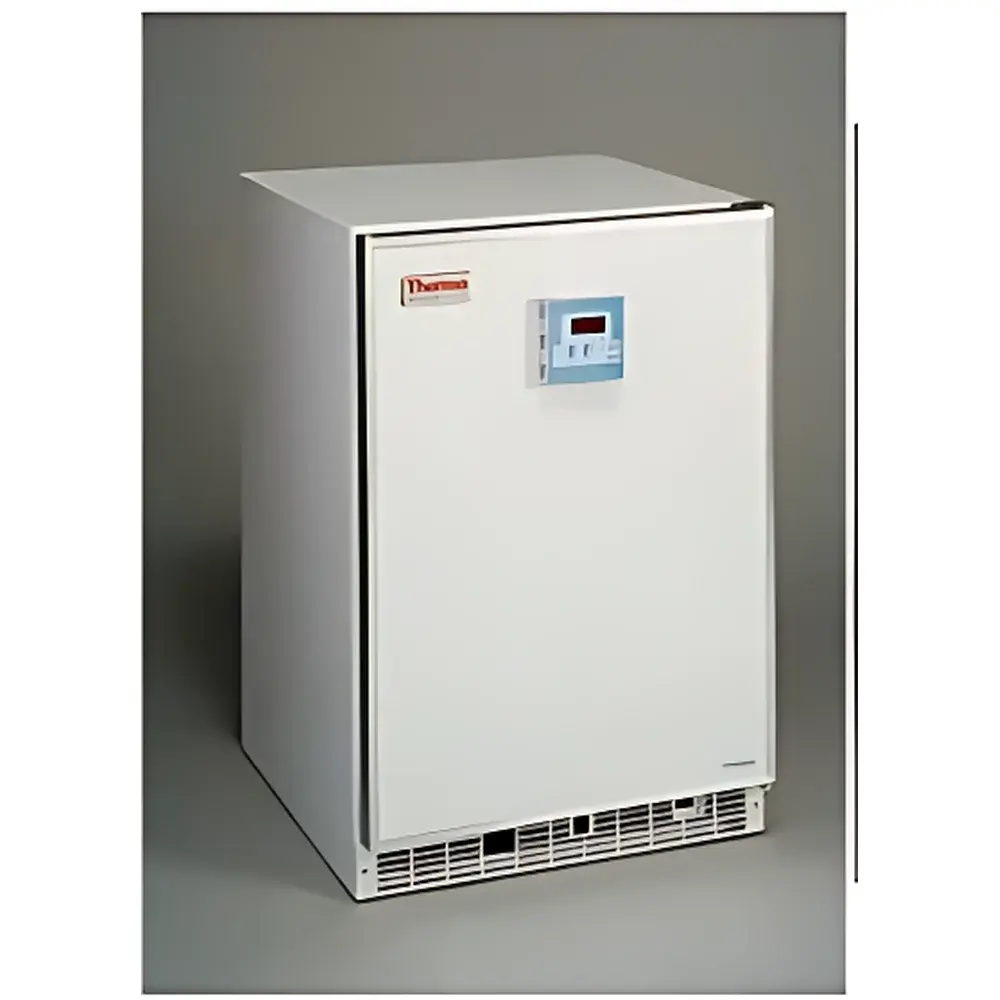
Thermo Scientific Precision 173L Low-Temperature Incubator
| Brand | Thermo Fisher Scientific |
|---|---|
| Origin | USA |
| Manufacturer | Thermo Fisher Scientific |
| Model | Precision 173L Low-Temperature |
| Internal Volume | 173 L |
| Temperature Range | −10 °C to +60 °C |
| Temperature Uniformity | ±1 °C at 37 °C |
| Temperature Sensitivity | ±0.1 °C at 37 °C |
| Air Circulation | Forced-air (mechanical convection) |
| Controller | Microprocessor-based with LED display |
| Sensor Type | RTD (Resistance Temperature Detector) |
| Insulation | Foamed polyurethane |
| Refrigerant | Non-CFC, non-HCFC |
| Shelving | 2 standard shelves (up to 4 optional) |
| External Dimensions (W×H×D) | 61 × 88 × 62 cm |
| Internal Dimensions (W×H×D) | 52 × 70 × 53 cm |
| Power Supply | 230 V, 50/60 Hz |
| Power Consumption | 800 W |
| Safety Features | Setpoint lockout, high/low temperature alarm, door-open alert |
Overview
The Thermo Scientific Precision 173L Low-Temperature Incubator is a benchtop-controlled environment chamber engineered for reproducible, long-term cultivation of temperature-sensitive biological samples—including mammalian cell lines, microbial cultures, and enzymatic assays requiring sub-ambient conditions. Unlike standard CO₂ or ambient incubators, this unit employs a dual-mode refrigeration and heating system with non-ozone-depleting refrigerant to maintain stable operation across a wide thermal range from −10 °C to +60 °C. Its forced-air convection architecture ensures uniform heat distribution via a rear-mounted fan and optimized internal ducting—critical for minimizing thermal gradients that compromise assay consistency. The incubator’s microprocessor-based control system integrates real-time feedback from a platinum RTD sensor mounted in the chamber core, delivering ±0.1 °C sensitivity at 37 °C and ±1 °C uniformity under steady-state conditions. Designed for GLP-compliant laboratories, the unit supports traceable temperature logging when paired with optional data acquisition modules.
Key Features
- Wide operational temperature range (−10 °C to +60 °C) enables both cryo-adapted and thermophilic culture protocols
- Forced-air circulation system with adjustable airflow velocity ensures rapid recovery after door openings and minimizes vertical/horizontal thermal stratification
- Microprocessor controller with LED display provides intuitive setpoint entry, real-time actual temperature readout, and programmable ramp-hold profiles
- Setpoint lockout function prevents accidental parameter changes during routine use—essential in shared-core or multi-user facilities
- Non-CFC, non-HCFC refrigerant complies with Montreal Protocol requirements and EU F-Gas Regulation (EU No. 517/2014)
- Foamed polyurethane insulation (≥65 mm thick) reduces thermal leakage and improves energy efficiency without compromising internal volume
- Integrated audible/visual high/low temperature alarms with latching capability support ICH Q5A and ISO 13485 environmental monitoring requirements
- Stainless steel interior chamber and removable anodized aluminum shelves facilitate cleaning, sterilization, and residue-free maintenance
Sample Compatibility & Compliance
The Precision 173L accommodates diverse sample formats—including Petri dishes, multiwell plates, flasks, and glass vials—across all four shelf positions. Its mechanical convection design avoids turbulent flow that could disturb delicate monolayers or suspension cultures. The unit meets IEC 61010-1:2010 safety standards for laboratory equipment and conforms to EN 60335-1 for electrical safety in climate chambers. While not a medical device, its temperature stability and alarm functionality align with FDA 21 CFR Part 11 expectations for electronic record integrity when used in regulated bioprocessing environments. Optional calibration certificates (NIST-traceable) and IQ/OQ documentation packages are available for GMP-aligned validation workflows.
Software & Data Management
The incubator operates as a standalone instrument but supports integration into centralized lab monitoring systems via analog output (0–5 V or 4–20 mA) for continuous temperature streaming. When connected to Thermo Scientific’s optional Traceable™ Data Logger or third-party SCADA platforms (e.g., LabVIEW, Ignition), users can generate audit-ready logs with timestamps, operator IDs, and deviation alerts. All firmware updates are delivered through secure USB interface, preserving data continuity during maintenance cycles. The system retains last-known setpoints and alarm history for ≥72 hours in non-volatile memory—even during brief power interruptions.
Applications
- Cultivation of psychrophilic bacteria and archaea requiring sustained sub-zero growth conditions
- Long-term storage of primary cells and hybridomas at controlled hypothermic temperatures (2–8 °C)
- Enzyme kinetics studies requiring precise thermal ramping between −5 °C and +45 °C
- Stability testing of biologics per ICH Q1A(R2) guidelines under accelerated and real-time conditions
- Pre-incubation of PCR master mixes and restriction digests prior to thermal cycling
- Environmental simulation for ecotoxicology assays involving cold-water aquatic species
FAQ
Does this incubator support CO₂ or humidity control?
No—this is a temperature-only incubator. For combined CO₂/humidity/temperature control, consider the Thermo Scientific Forma™ Series or Heracell™ series.
Can the shelving configuration be customized?
Yes—two shelves are included; up to two additional shelves (part number 50119212) may be installed, maintaining minimum clearance for airflow and sensor accuracy.
Is the unit suitable for use in cleanrooms?
It meets ISO Class 8 particulate limits when operated with HEPA-filtered air supply (optional external filtration kit available). Internal surfaces are non-shedding and compatible with IPA and hydrogen peroxide vapor decontamination.
What is the mean time between failures (MTBF) under continuous operation?
Based on field reliability data from >10,000 installed units, MTBF exceeds 25,000 hours at 25 °C ambient with standard maintenance intervals.
How is calibration performed and how often is it recommended?
Calibration uses dual-point verification (−5 °C and +45 °C) against NIST-traceable reference probes. Annual calibration is recommended for GLP/GMP applications; semi-annual for high-throughput QC labs.




