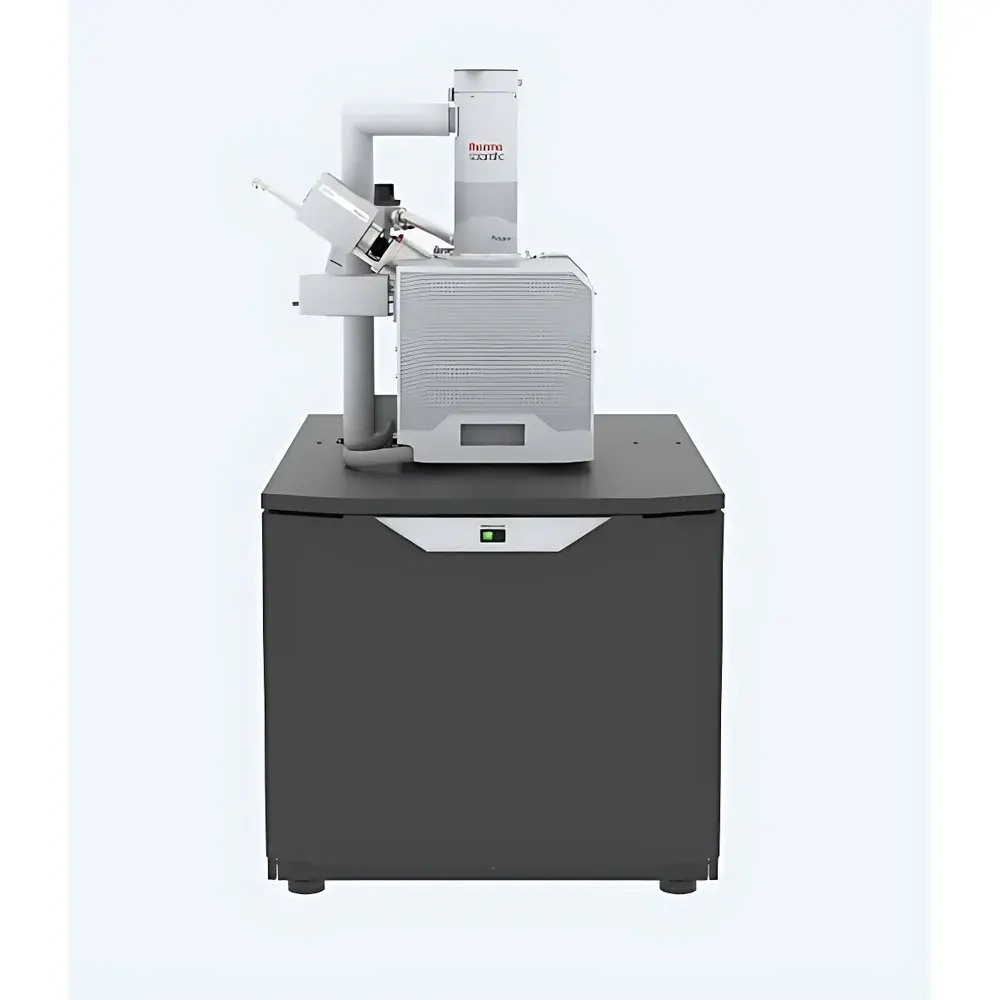
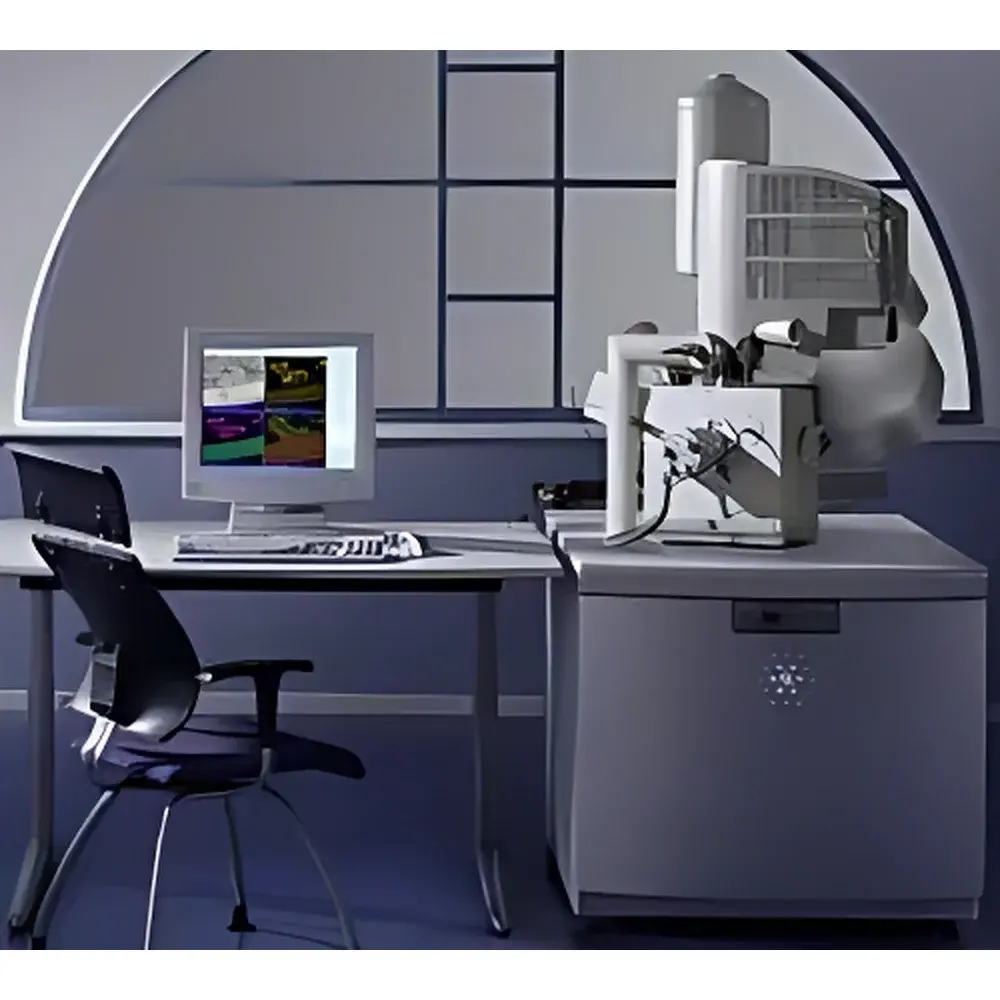
Thermo Scientific Prisma E SEM
| Brand | Thermo Fisher |
|---|---|
| Origin | Imported (Non-China) |
| Manufacturer Type | Original Equipment Manufacturer (OEM) |
| Electron Gun Type | Cold Field Emission |
| Model | Prisma E SEM |
| Vacuum Modes | High Vacuum, Low Vacuum, Environmental SEM (ESEM) Mode |
| Sample Chamber Capacity | Up to 18 samples per load |
| Detector Flexibility | Multiple detector options including SE, BSE, EDS, and optional STEM-in-SEM |
| Software Integration | ColorSEM real-time elemental mapping, image navigation, customizable UI with Undo/Redo functionality |
| Compliance | Designed for GLP/GMP environments |
Overview
The Thermo Scientific Prisma E SEM is a high-performance, tungsten-filament scanning electron microscope engineered for broad-spectrum materials characterization in academic, industrial, and quality control laboratories. Unlike conventional SEMs relying solely on topographic or compositional contrast, the Prisma E SEM integrates proprietary ColorSEM technology — a hardware-software co-engineered solution that fuses secondary electron (SE) and backscattered electron (BSE) imaging with real-time energy-dispersive X-ray spectroscopy (EDS) data processing. This enables pixel-level elemental assignment directly overlaid onto the SEM image, rendering chemical composition visually intuitive without requiring post-acquisition spectral analysis. Built upon the legacy of FEI’s Quanta platform, the Prisma E SEM retains proven mechanical stability and vacuum architecture while introducing enhanced environmental flexibility via its multi-mode vacuum system — supporting high vacuum (HV), low vacuum (LV), and full environmental SEM (ESEM) operation. This allows uncoated, hydrated, insulating, or beam-sensitive specimens — such as polymers, biological tissues, ceramics, and geological samples — to be imaged in their native state with minimal preparation.
Key Features
- ColorSEM Technology: Real-time color-coded elemental mapping synchronized with SE/BSE imaging; eliminates need for separate EDS acquisition and offline correlation.
- Multi-Mode Vacuum System: Seamless switching between high vacuum (<10⁻⁴ Pa), low vacuum (10–270 Pa), and ESEM mode (up to 2700 Pa water vapor), enabling direct observation of non-conductive and volatile samples.
- High-Throughput Sample Handling: Large-volume chamber accommodates specimens up to 150 mm in diameter; motorized 5-axis stage with programmable sample tray holds up to 18 standard stubs; integrated image-based navigation simplifies rapid repositioning.
- User-Centric Interface: Intuitive, customizable GUI featuring Undo/Redo commands, context-aware toolbars, and role-based workspace presets — optimized for both novice operators and expert microscopists.
- Modular Detector Architecture: Native support for Everhart-Thornley SE detector, solid-state BSE detector, silicon drift detector (SDD) for EDS, and optional STEM-in-SEM module for thin-section analysis.
- Robust Engineering: Cold field emission electron source ensures long-term beam stability and high brightness; vibration-damped optical column housed in thermally stabilized enclosure.
Sample Compatibility & Compliance
The Prisma E SEM is validated for use across diverse material classes including metals, composites, semiconductors, pharmaceutical powders, catalysts, and soft biological specimens. Its ESEM capability permits imaging of hydrated plant tissues, freeze-dried cells, and electrospun nanofibers without sputter coating — significantly reducing artifacts and preserving structural fidelity. The system complies with IEC 61000-6-3 (EMC emissions) and IEC 61000-6-2 (immunity) standards. When deployed in regulated environments (e.g., ISO 17025-accredited labs or pharmaceutical QC), optional software modules provide electronic signatures, time-stamped audit trails, and user-access controls aligned with FDA 21 CFR Part 11 and EU Annex 11 requirements. All hardware components meet RoHS and WEEE directives.
Software & Data Management
Acquisition and analysis are managed through Thermo Scientific Maps Software — a unified platform supporting live ColorSEM rendering, automated particle analysis, phase identification, and quantitative EDS quantification using ZAF or φ(ρz) correction models. Raw data (including spectrum images, stage coordinates, and detector metadata) are stored in vendor-neutral .tif and .emf formats compliant with ASTM E1558 and ISO/IEC 17025 documentation standards. Data export supports CSV, XML, and HDF5 for integration with third-party analytics tools (e.g., Python-based SciPy workflows or MATLAB). Remote monitoring and scheduled acquisition are enabled via secure HTTPS API endpoints, facilitating centralized fleet management in multi-user core facilities.
Applications
- Failure analysis of microelectronic packages under ambient conditions
- In-situ hydration/dehydration studies of cementitious materials
- Morphological and compositional screening of battery electrode slurries
- Particle size distribution and agglomeration assessment in inhalable drug formulations
- Corrosion product identification on stainless steel surfaces in chloride environments
- Mineral phase discrimination in ore samples without carbon coating
FAQ
Does the Prisma E SEM require conductive coating for non-metallic samples?
No — its ESEM mode enables charge dissipation via gas ionization, allowing direct imaging of uncoated polymers, ceramics, and biological specimens.
Can ColorSEM replace traditional EDS point analysis?
ColorSEM provides rapid qualitative elemental distribution; quantitative spot/line/area analysis remains available via dedicated EDS acquisition with standardless or standard-based calibration.
Is the system compatible with third-party EDS detectors?
Yes — the Prisma E SEM features standard detector ports and communicates via TCP/IP-based protocols, supporting integration with major EDS vendors’ hardware and software.
What maintenance intervals are recommended for the cold field emission gun?
Gun flashing is typically required every 6–12 months depending on usage intensity and vacuum integrity; full column bake-out is advised annually per Thermo Scientific service guidelines.
How does the system support compliance in GxP environments?
With optional Compliance Pack, it delivers 21 CFR Part 11-compliant audit trails, electronic signatures, and role-based access control — fully documented in the system validation package (IQ/OQ/PQ).