
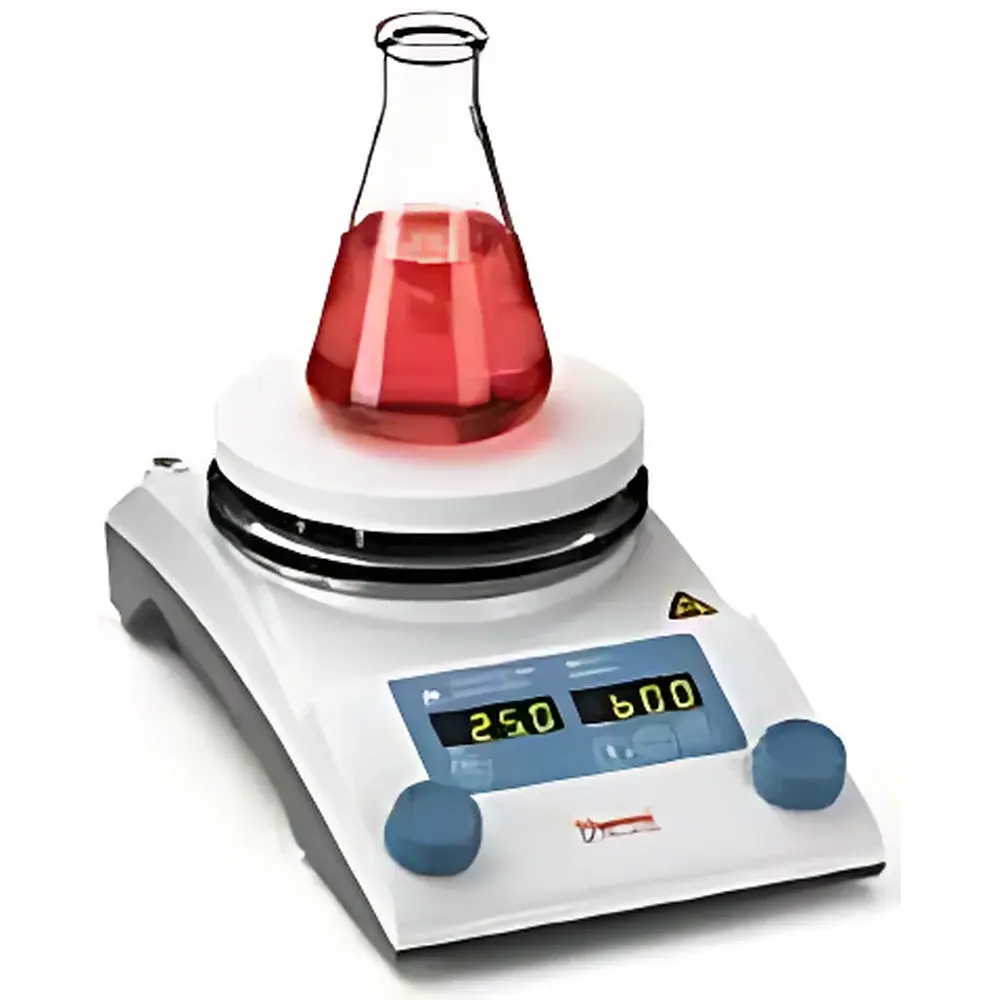
Thermo Scientific RT2 Advanced Hotplate Stirrer
| Brand | Thermo Fisher |
|---|---|
| Origin | South Korea |
| Manufacturer Type | Original Equipment Manufacturer (OEM) |
| Product Origin | Imported |
| Model | RT2 Advanced Hotplate Stirrer |
| Instrument Type | Magnetic Stirrer |
| Maximum Stirring Volume | 20 L |
| Speed Range | 30–2000 rpm |
| Temperature Control Range | RT + 50 °C to 350 °C |
| Heating Plate Surface | 140 mm diameter, ceramic-coated aluminum |
| Max. Surface Temperature | 450 °C |
| Over-Temperature Protection | Yes, with visual alarm indicator |
| Temperature Control Algorithm | PID microprocessor-based |
| Temperature Control Modes | 5 programmable modes (Optimized, Rapid, Gradual, Setpoint, User-defined with auto-tuning) |
| Dual Independent Timers | Yes |
| Real-Time Display | Simultaneous setpoint and actual values for speed and temperature |
| Adjustable Temperature Limit | Yes |
| Optional Accessories | Slip-resistant heating bath, transparent safety shield |
| Temperature Monitoring | External Pt100 probe compatible |
Overview
The Thermo Scientific RT2 Advanced Hotplate Stirrer is an integrated magnetic stirring and heating platform engineered for precision, repeatability, and operational safety in routine and demanding laboratory workflows. It operates on the principle of electromagnetic induction to rotate a PTFE- or glass-coated stir bar within a vessel while simultaneously delivering uniform conductive heating via a ceramic-coated aluminum plate. Designed for applications requiring both thermal stability and mechanical homogeneity—such as buffer preparation, dissolution testing, catalyst activation, and solvent reflux—the RT2 combines robust thermal management with high-resolution rotational control. Its PID-controlled microprocessor architecture ensures minimal temperature overshoot and tight thermal regulation across extended operation periods, supporting GLP-compliant documentation when paired with external data loggers.
Key Features
- Ceramic-coated 140 mm aluminum heating surface rated to 450 °C, offering chemical resistance, rapid thermal response, and long-term surface integrity.
- Wide speed range of 30–2000 rpm with digital feedback control, enabling precise agitation from gentle mixing to vigorous dispersion of viscous or particulate-laden solutions.
- Five programmable temperature control modes: Optimized (minimizes time-to-target while suppressing oscillation), Rapid (maximizes heating rate), Gradual (reduces thermal gradient-induced stress), Setpoint (linear ramp to target with fixed power output), and User-defined (auto-tuned PID parameters stored per application).
- Dual independent timers support concurrent monitoring of heating duration and stirring duration, each with audible end-of-cycle alerts.
- Over-temperature protection circuitry automatically deactivates the heater and triggers a visible LED alarm when surface or medium temperature exceeds user-defined thresholds.
- Real-time dual-display interface shows both setpoints and actual measured values for speed and temperature—enabling immediate verification of system status without menu navigation.
- External Pt100 temperature probe input allows direct measurement of sample medium temperature (not just plate temperature), critical for process-critical reactions where thermal lag must be minimized.
Sample Compatibility & Compliance
The RT2 accommodates standard laboratory vessels including glass beakers (up to 20 L), round-bottom flasks, and stainless-steel reactors. Its low-profile design supports compatibility with fume hoods and glove boxes. The ceramic surface resists corrosion from common solvents (e.g., acetone, ethanol, dilute acids/bases) and withstands repeated thermal cycling between ambient and 350 °C. The instrument complies with IEC 61010-1:2010 for electrical safety in laboratory equipment and meets EMC requirements per IEC 61326-1:2020. While not intrinsically safe, it is suitable for use in non-hazardous environments under ISO/IEC 17025-accredited laboratories. Optional slip-resistant heating baths and transparent polycarbonate safety shields facilitate containment during volatile or exothermic procedures—supporting adherence to institutional EHS protocols.
Software & Data Management
The RT2 operates as a standalone analog-digital hybrid controller with no embedded firmware update capability or USB/Ethernet connectivity. However, its analog output signals (0–10 V for temperature, 0–5 V for speed) are compatible with third-party data acquisition systems (e.g., LabVIEW, MATLAB, or SCADA platforms) for time-stamped logging. When used with an external Pt100 probe and compliant DAQ hardware, temperature and speed traces can be archived with timestamped metadata, satisfying basic FDA 21 CFR Part 11 audit trail requirements if paired with appropriate electronic signature and access control layers. No proprietary software is required; configuration is performed exclusively via front-panel keypad and rotary encoder.
Applications
- Preparation of homogeneous aqueous and organic solutions for analytical calibration standards (e.g., ICP-MS, HPLC mobile phase blending).
- Controlled heating and stirring during polymerization initiation, nanoparticle synthesis, and crystallization studies where nucleation kinetics depend on thermal history.
- Dissolution testing per USP and Ph. Eur. 2.9.3, particularly for poorly soluble APIs requiring elevated temperatures and consistent agitation.
- Sample digestion in environmental and food testing labs (e.g., EPA Method 3050B, AOAC 999.10), where reproducible thermal ramping improves metal recovery yields.
- Chemical synthesis workflows requiring inert-atmosphere compatibility—when used with sealed reactors and optional shielding, the RT2 maintains stable conditions without introducing mechanical vibration from overhead stirrers.
FAQ
What is the maximum recommended vessel size for optimal stirring performance?
For consistent vortex formation and thermal uniformity, a 10–15 L vessel is recommended at speeds above 800 rpm; 20 L is achievable at lower speeds (≤600 rpm) with appropriately sized stir bars.
Can the RT2 maintain ±0.5 °C temperature stability over 8 hours?
Yes—when using an external Pt100 probe immersed in the medium and operating in Optimized mode, typical stability is ±0.3 °C at 100 °C over 8 h (load-dependent; verified per ASTM E2207).
Is the heating plate surface resistant to hydrofluoric acid exposure?
No. While resistant to most common reagents, the ceramic coating is not HF-compatible; use alternative heating methods for HF-containing mixtures.
Does the RT2 support remote start/stop via digital I/O?
No. It lacks TTL or relay-triggered control inputs; all operation is local via front panel.
What safety certifications does the RT2 carry for EU shipment?
It bears CE marking per Directive 2014/30/EU (EMC) and 2014/35/EU (LVD), with test reports available upon request from Thermo Fisher Technical Support.



